![]() Issue 17 Laughter Spring 2005Artist Project / Even the Trees Would LeaveH. Lan Thao Lam and Lana LinAugust 23, 2008
June 20, 2005
January 17, 2004
December 26, 2003
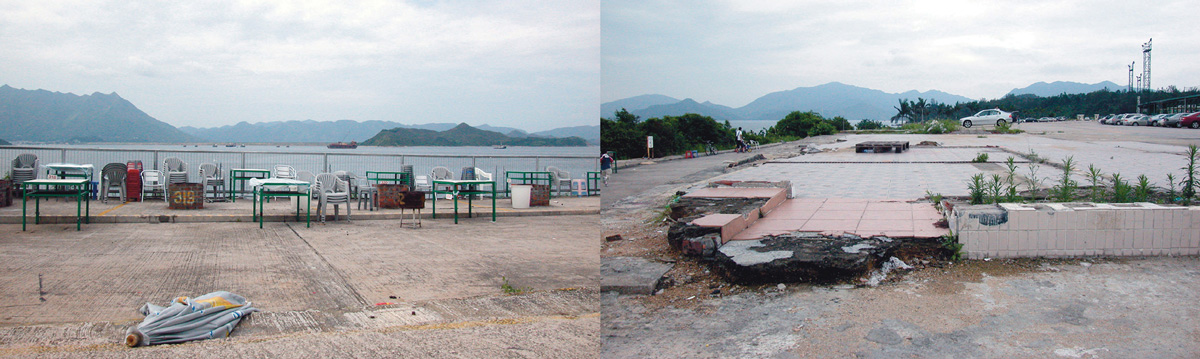
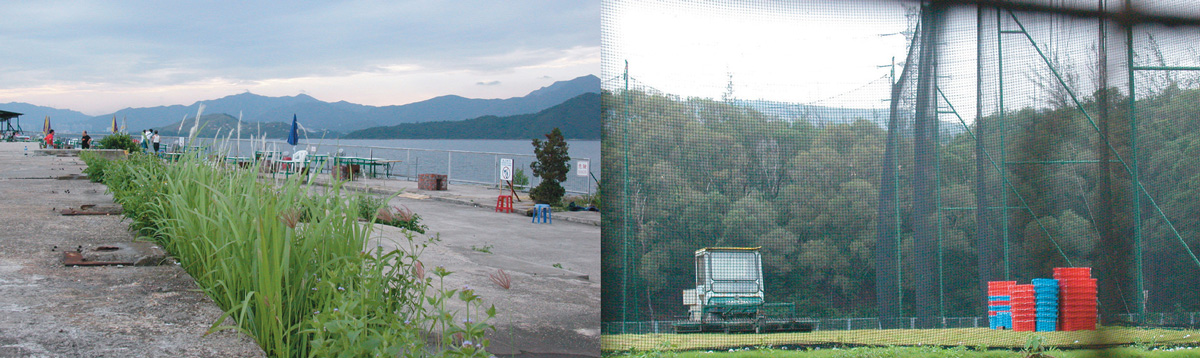
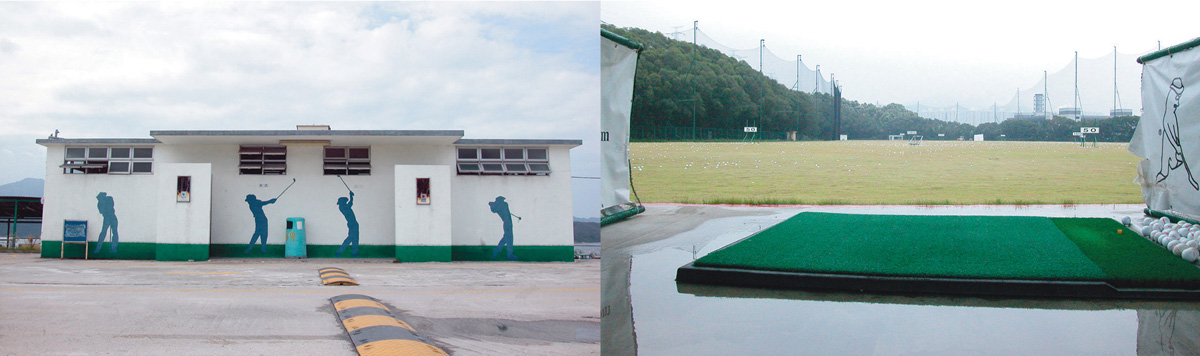
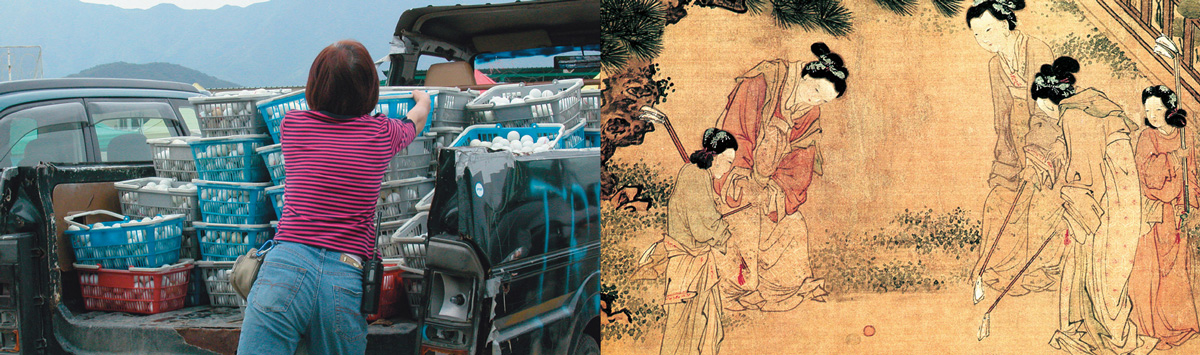
October 8, 2003 Entering the recreation site, she’s greeted by a towering golf ball at least two feet taller than she is. Cars pull in for the preliminary rounds of the HK$1 million Hole-in-One shootout at Golf & Fun Driving Range, Whitehead. Had the Hole-in-One sponsors noticed the footprint left from a structure that was once called the biggest prison in the world? An entrepreneur nabbed these vast unoccupied stretches of land with a lucrative business plan. At last, Hong Kong reclaims its own land. Not long ago, no one could bring sports equipment into these areas for fear that it would be turned into weapons; now even without a club membership, for HK$40 she can drive unlimited balls for half an hour. Nets as high as the former barbed wire fences now restrain high-flying golf balls. She stares at the row of golfers’ silhouettes that adorn the bathroom, monotone and unresisting. This is how they wanted the refugees—as mute and abiding as these painted figures. This is not the bathroom that served thousands of Vietnamese. It is air-conditioned, clean, too small.
July 28, 2001
June 20, 2001 The UN General Assembly adopts a resolution to celebrate World Refugee Day on June 20. May 31, 2000 Hong Kong’s last Vietnamese refugee camp—Pillar Point Vietnamese Refugees Centre, Tuen Mun—closes at midnight. She hears that there are proposals to turn it into a crematorium, a theme park, or a botanical garden. The last of the 230,000 Vietnamese that have passed through Hong Kong are free to “stand on their own feet.”
March 3, 2000
February 22, 2000 The Widened Local Resettlement Scheme is initiated, allowing 1400 VRs and VMs2 who have no prospects for acceptance elsewhere to apply for resettlement in Hong Kong. Removal allowance ranges from HK$3,950 to $11,410. January 9, 1998 The Hong Kong Special Administrative Region Government abolishes the “Port of First Asylum” policy. Vietnamese illegal arrivals after this date are treated as illegal immigrants, as opposed to refugees. July 1, 1997 The Government of the United Kingdom transfers sovereignty over Hong Kong to the People’s Republic of China. This is also the deadline China announces for the complete removal of VMs from Hong Kong. January 3, 1997 In Calgary, Canada, she reads the headline: “Saga of Vietnamese Boat People Nears End.” Whitehead Detention Centre, where she spent almost twelve years of her life, closes. At the height of the refugee influx, it contained 29,000 asylum-seekers. May 10, 1996 Another massive riot breaks out at Whitehead in protest against forced repatriation. Over 500 tear gas canisters are emptied. Fortunately, some families had the idea of making gas masks out of knitted hoods with plastic drink bottles cut out as visors. February 3, 1994 President Clinton lifts the nineteen-year US trade embargo on Vietnam.
November 1, 1991
June 16, 1988 All VMs arriving in Hong Kong undergo mandatory screening to determine whether they are genuine refugees or economic migrants. “Non-refugees” are repatriated to Vietnam. She has managed to learn a little bit of English, but they keep introducing new words. She cannot hear their words. Encamped on an unused military airstrip, she hears only the roar of jets flying overhead. Will she ever board one of them? Heading west or east? April 16, 1985 A volunteer lectures her on the competition for land in Hong Kong. To these tiny 1100 square kilometers of land, crowded with 6.8 million people, piled in high-rises standing on an artificial shoreline fashioned out of rubbish and imported soil, thousands of Vietnamese have fled. Hong Kong receives them under the “Port of First Asylum” policy. July 2, 1982 “Closed camps” are set up to deter more Vietnamese from flooding Hong Kong like a wave. She must give up her job at the hotel and clean the camp kitchen instead. September 23, 1981 Grim faces greet the news that Hong Kong will no longer grant automatic asylum. It is Wednesday and they dine on chicken wings as usual. This morning her uncle was given his “first chicken wing”. In camp lingo this means he will not fly to the West on a real jet wing; with chicken wings one cannot fly. But he will appeal to the Refugee Status Review Board. He has two more tries before he is sent back. May 15, 1980 She squats in line with the others, a first of many lines: waiting to identify herself, waiting for the bathroom, waiting for cans of beans, instant noodles, and Tang. A well-known Vietnamese song is amplified and distorted through loudspeakers: “Tomorrow you leave; the sea remembers your name; calls it to return...” The song was banned both in North and South Vietnam, but here it is played freely each time fellow campmates leave for their new countries. When she hears it after eighteen days at sea—her seventh attempt to flee—she could not hold back her tears. The sea may remember her name, but on this land, she is just one of thousands of boat people. In the sea, she had placed all her hopes for an unknown future. From inside the camp, the sea is what separates her from the free world. April 30, 1976 For the first anniversary of the fall of Saigon, her father gives the children a lesson on the Law of the Sea. Preparing to escape Vietnam, they should know their rights. She likes the sound of “Eleanor of Aquitaine”—the woman who brought admiralty law to England; its syllables come out of her mouth like a poem. She wonders whether Eleanor became interested in the law of the seas because her name refers to water. Her sisters copy maps and flags of different countries from the back of a Larousse French dictionary for their father to navigate their journey. May 4, 1975 The Communist takeover of the South precipitates a massive exodus from Vietnam. Those departing tear away from their ancestral roots. People say even the trees would leave if they could. The Danish container ship Clara Maersk containing 3,743 Vietnamese refugees enters Hong Kong’s waters.
H. Lan Thao Lam is a Vietnamese-Canadian artist based in New York. Her fourth attempt to escape Vietnam was successful in 1980, the same year as her sister’s eleventh attempt. Her mother’s second attempt succeeded in 1986. Lana Lin is an artist and filmmaker based in New York. Cabinet is a non-profit organization supported by the Lambent Foundation, the Orphiflamme Foundation, the New York Council on the Arts, the NYC Department of Cultural Affairs, the National Endowment for the Arts, the Andy Warhol Foundation for the Visual Arts, the Katchadourian Family Foundation, Goldman Sachs Gives, the Danielson Foundation, and many generous individuals. Please consider making a tax-deductible donation by visiting here.
|
|
© 2005 Cabinet Magazine |