Issue 19 Fall 2005

A Machine for Constructing Stories
Francine Prose, Denis Johnson


An Introduction

The exact origins of tarot cards are uncertain, but references to them first emerge in Western Europe during the mid-fifteenth century, a renaissance moment in general for card games. Believed to descend from the playing cards for an Italian game known first as trionfi and in the next century more familiarly as tarocchi (from a word meaning "foolish"), these early cards featured the four suits the tarot still uses today— cups, swords, coins (or "pentacles") and batons (or "wands.")

Despite its contemporary reputation as a tool for soothsaying, the tarot deck did not begin to acquire its occult connotations until the late 18th century. It was then that figures like the French-born pastor Antoine Court de Gébelin and the Parisian wigmaker-turned-esoteric Jean-Baptiste Alliette, drawing on the current fascination with things Egyptian, popularized the power of "les Taraux" to establish contact with the mysteries of the past and predict future fortune. (In a chapter on tarot in his 1773 Le Monde Primitif, Gébelin asserted that the cards were actually created by the Egyptian god Thoth to share ancient wisdom; a decade later Alliette, using the inverted name "Etteila," gained fame as the day's leading fortune-teller.) Employing their special interpretive sensitivities, tarot "readers" could use the images on the various cards of the Major and Minor Arcana— kings and beggars, hierophants and fools, angels and devils— to build a narrative suggesting the outcome of particular events or situations in the lives of their subjects.

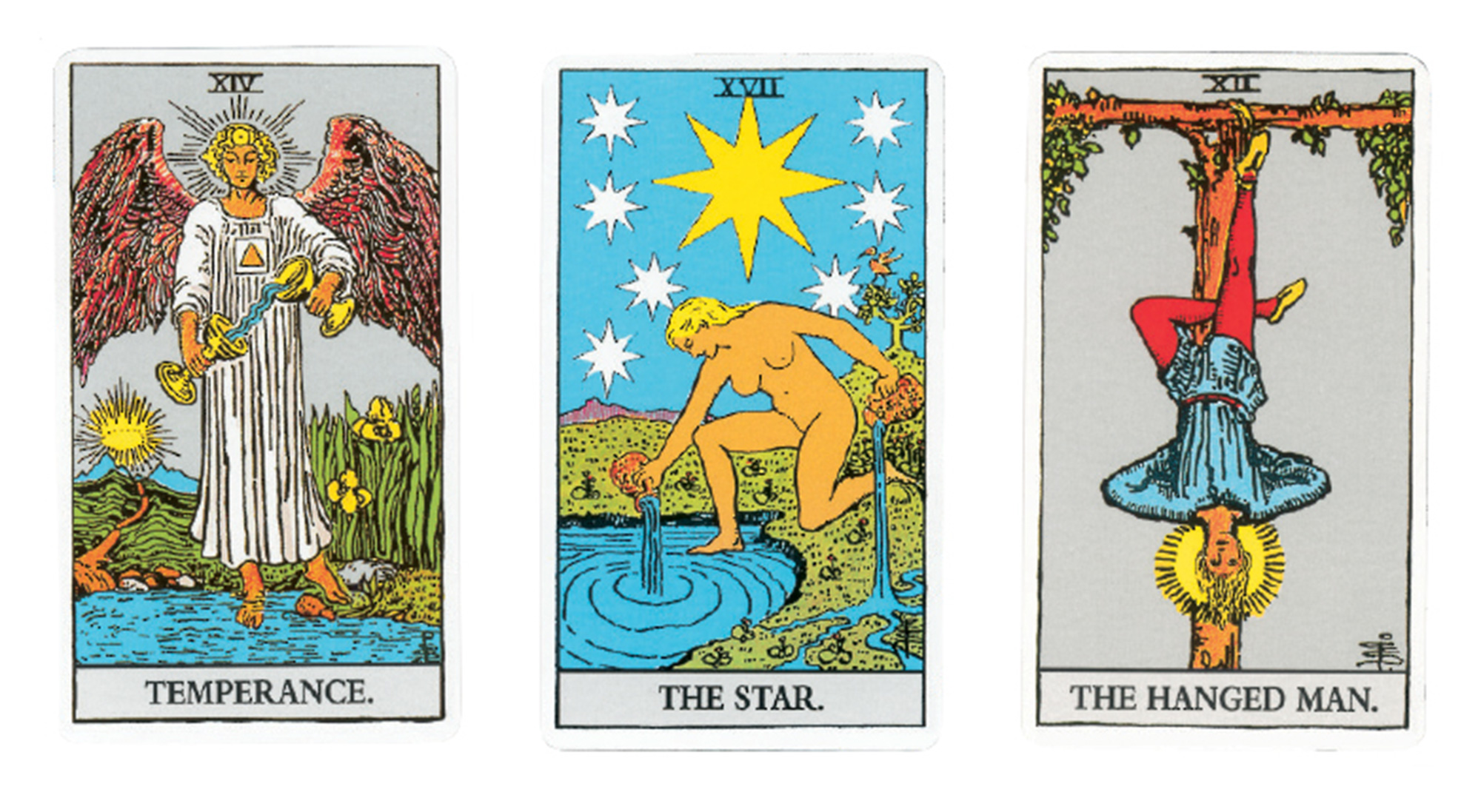
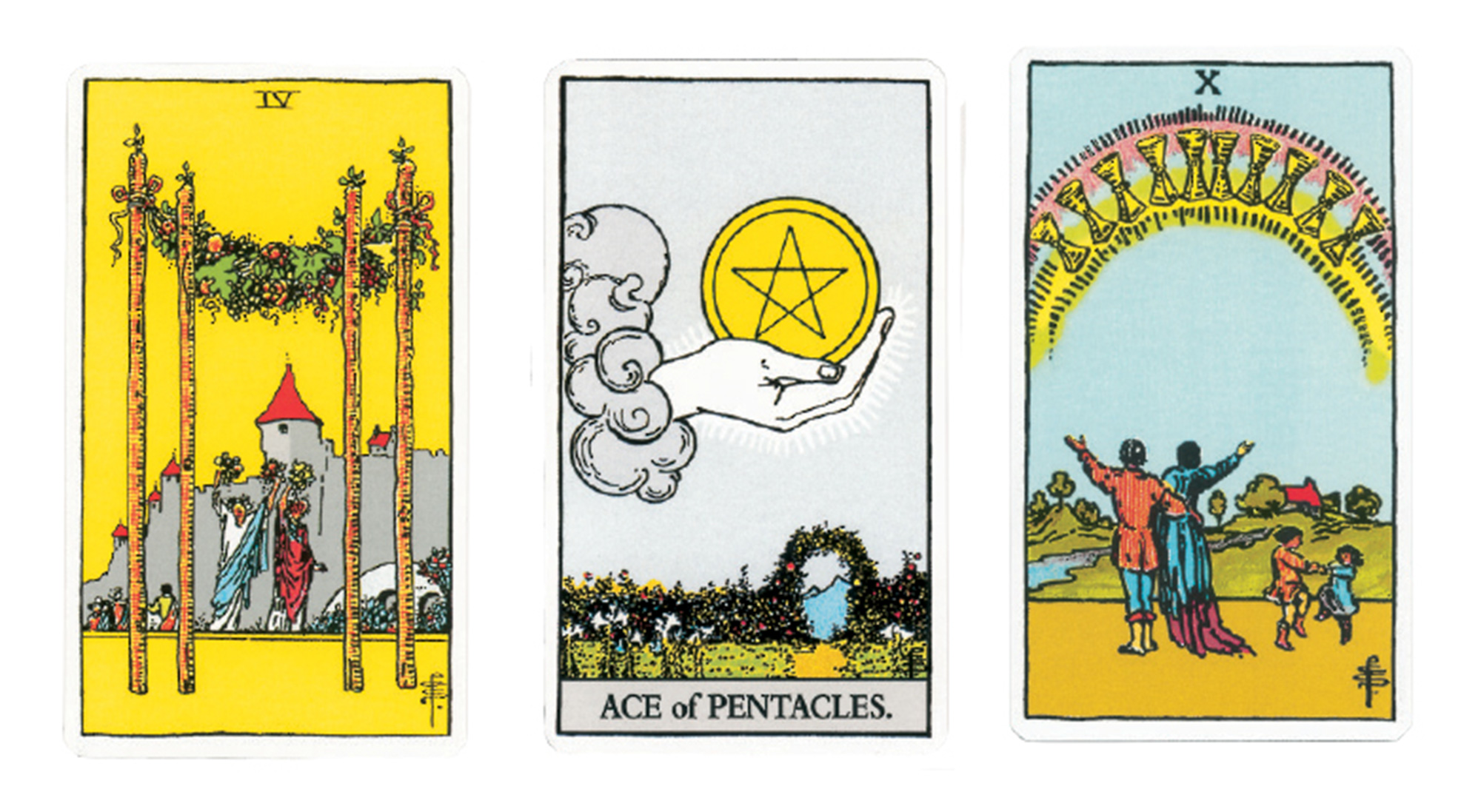
As we were researching this current issue devoted to Chance, a colleague suggested we seek out Italo Calvino's The Castle of Crossed Destinies, a novel based on this idea of the tarot as a generator of narrative possibility— what Calvino calls a "machine for constructing stories." For the following two pieces, authors Denis Johnson and Francine Prose were asked to participate in an experiment designed to gauge this latent potential. Provided with identical tarot decks, each was asked to lay out three cards from each the Major and Minor Arcana in sequence and then to write, as extemporaneously as possible, texts that responded in some way to the cards they were dealt. What follows are these texts, accompanied by the sequence of cards that inspired them.


Breakfast
Francine Prose


The images of the tarot deck are supposed to buzz through your brain, forging new neural pathways, making speedy end-runs around language, culture, experience, and whether or not you have any idea what the cards mean. The beauty of the Waite deck is you do know what they mean. A guy lying on his face with ten swords sticking out of his back like toothpicks on an hors d'oeuvres tray probably means what you think. Which is why they are frightening even for the unsuperstitious. Everyone knows the Death card is lurking in there, waiting. You don't have to believe in the predictive powers of a deck of cards. Everyone believes in the armored skeleton on horseback.

Laying out the cards, I find myself dealing oddly, from left to right, as if some part of me truly believes that I am involved in a voodoo event. To tell the truth, it's a bit of a horror-movie moment, like the scene in The Hands of Orlac in which the injured pianist with the transplanted killer's hands suddenly realizes he's got murderers at the end of his wrists.

The tarot, and the operations of chance, should inspire intuition, quick readings burbling up from the fountain of the unconscious, or from one of those newly discovered kinds of subcerebral intelligence. And this experiment, as I understand it, is meant to involve the fictive imagination, the power of the images to inspire narrative. Each card should have been a bead to string on that cord that runs through a story.

But the the six cards I have dealt mean nothing to me. Nothing. No narrative, no mirror.

It doesn't take a serious student of the tarot to figure out that these cards are the tarot equivalent of the three cherries coming up on the slot machine. You don't need to know that the ace of pentacles means money, that the hanged man is the most problematic image, but that may just signify indecision or transition. As tarot readings go, this one is heaven. Pure vanilla.

I have dealt a TV ad for a breakfast cereal.

Perhaps I should explain that recently there has been a death in our family, so that if the Death card had turned up, it would have simply seemed like reportage. All these trees and flowers and fruit, blues skies and happy dancing children could not have less to do with my current state of mind, nor can I imagine generating a story from a series of images that have no conflict, no variation, no nuance. No event.

Maybe the problem is that I didn't leave enough to chance, or left the wrong things to chance. Perhaps I started at the wrong point. Perhaps the taxi-meter of chance began ticking earlier, not when I dealt the six cards, but when I first took the deck out of the box. The first card I saw was the Tower, the lightning-struck Tower, which describes my psyche at the moment better than the pre-Raphaelite Disneyland of the cards I have actually dealt.

I dealt the three from the major arcana first, but was my major-before-minor decision a matter of chance, or of some status-conscious preconditioning? And then there is this: The deck arrived already separated into the major and minor arcana, but still I had to look for the place where the break was divided. As I flipped through the deck, it seemed to me that chance was flinging certain cards out at me. The Moon with its the howling dogs and the lobsterlike creature crawling up out of the sea. The lightning struck Tower and The Moon. That could have led into a story. But that isn't my story, the one inspired by chance. I was playing by the rules, but what are the rules of chance? And what exactly does the chaos of chance have to do with the logical order of science?

As the six cards turn up in front of me, there's no spark to set off that chain reaction that sets a story in motion. I leave the room and return. Still nothing. I leave them out on my desk. I'll let them sit there as long as it takes, until they reveal what they mean.

The next morning, my husband makes breakfast: the first blossoms from the zucchini plant in the garden, deep fried in batter, and fried eggs from the chickens that we only recently got, so that the eggs are still an occasion.

I look at the glowing food, radiant in the sunlight.

I realize that the tarot cards have predicted breakfast: the zucchini blossom and the sunny-side-up egg. I've never thought of the tarot that way, as a sort of menu.

I had thought the word breakfast. Or actually, breakfast cereal. But I'd gotten it wrong, imagining that Waite deck must mean some sort of granola or possibly some pink and hideous British breakfast sausage.

I also realize, only now, how rural and springlike is the image that the six cards combine to form. The iris on the Temperance card is blooming outside at this very moment, and is that one of our chickens in the tree below The Star? Was it sheer chance that the tarot deck intuited that I am in the country, and that it is mid-June?

This is what the experiment has left me wondering about chance: Was it chance, or something else, that allowed the six cards to predict the next day's breakfast? And was it chance, or something else, that this breezy, lightweight, limited prognostication is the heaviest message from destiny that I could have borne, or can bear, at the moment?

BEELZEBUB RADIO— THE WORLD HAS BEEN SAVED
Denis Johnson


(This isn't fiction.) I first met the Devil Satan in February, 1978. He manifested himself, or rather lost interest in disguising his presence, as a result of a very aggressive series of incursions the God Jehovah had made in my universe, and these visits of His, in turn, came about because the Devil had gripped me more strongly as I made small experiments with prayer, meditation, reading spiritual books, things like that.

I worked as a temp for state agencies. By an insane coincidence, only a few days after the onset of these adventures, I was assigned a clerking job in an outpatient facility of the state mental hospital. All day long madmen and madwomen appeared before me with their stories, their complaints, their theories. A man called on the phone: "I think I'm the devil." "You do?" was all I could say. "I drink and I hurt people when I drink and I can't stop drinking and hurting people." "Have you contacted Alcoholics Anonymous?" "I am the Devil," he said, "I am Alcoholics Anonymous, I am the cosmos, I am the beginning and the end," and I could hear him laughing as I hung up the phone. When my boss came back from lunch I took a walk with him over the grounds where crazy people stood still or strolled cautiously over the earth or sat on concrete benches or swings meant for small children, and I told him, "I think I'm losing touch with reality and I shouldn't be working here." None of the crazy people all around us talked to any of the others, none of them looked at anybody else. We all knew what was going on. The gigantic clash of good and evil tearing apart our souls left us no strength to focus on anything else. "Whatever you think is best for you," said my temporary boss. When I went to clean out my desk I found a tarot card. I threw it in the trash. I went to the bus stop just outside the stone and iron walls of the facility. The bus came, but I didn't get on. I went back through the gates, went to the outpatient clinic, told the people there, "I forgot something." I stood beside my desk. They were all looking at me. A couple of patients said nothing, staring at me, breathing hard. They knew. I said, "I think it's in the trash, maybe." I took the tarot card from the wastebasket. The Ten of Cups. Cups, drinking, hurting people. I threw it back in the trash. On my way out I said to a thin, ropy crazy woman, "Tell him I get the message. But I'm still with God." "Who?" she said innocently, and I said, "You know who," and she said, "All right, I'll tell him, but when should I tell him?" "TELL HIM NOW!" I said, and she stood absolutely still and began sending the message.

Back outside the gates I waited for the bus. I was terrified of who would be on it when it stopped for me, terrified of what would happen to me if I boarded it, but when it came, when it stopped, when the doors opened, I kept my head down and stepped aboard and took a seat not looking at anyone. I was holding the tarot card in my hand. I reached up and pulled the string to stop the bus. As it slowed I looked at the message in my hand: It had changed to the card of Strength. "All right!" I said to everyone on the bus, because God required a public acknowledgment, "I know God will give me the strength if I want it!" As the bus came to a halt I laid the card on the seat and got off as fast as I could.

The Devil broadcast two slogans over the atmospheres continually: "YOU HOPE, BUT YOU KNOW." "IT'S KILL OR BE KILLED." I broadcast in return that I wasn't going to hurt anyone, that I wasn't going to do anything wrong. Every few minutes I encountered someone who, despite their innocent behavior, I knew had been assigned to kill me. I insisted I wouldn't make the first move. I wasn't just going to assault someone suddenly. If that meant I'd be murdered, so be it. Tarot cards played a major role in the strategies being pursued all around us. Whenever I came near a place that might deal in such things, I tried not to go inside. But eventually I would give in and go see. I would stand at the counter of a psychedelic shop or occult book store and ask for a deck. I would open it and look at one card. Today the Nine of Wands. Not a message for me. But I shouldn't have touched it. The clerk saw. It was his signal to kill me by hitting me nine times with some kind of wand. I left quickly without giving away the fact that I knew all about his assignment.

Very often I passed St. Theresa's Church, which was on Thomas St., in my neighborhood. A day after I exposed The Empress card in a bookstore a few blocks from there, I understood the meaning of it. St. Theresea. I headed over to Thomas Street right away and walked along as if I were only pursuing a simple errand of some kind. People were going into the church. I could see they were all innocent, completely removed from the battle raging all around. I joined them and went inside. It was some kind of social occasion. A man was selling raffle tickets at the door. He had a roll of tickets and a box of coins. I stopped. Two days before I had seen him on a tarot card— the Two of Coins. I nearly ran away, but then I understood that the moment had arrived. I went over to a drinking fountain, and bending over it as if I were getting some water, I said a prayer. Prayers always had to be disguised in some such way— tying of the shoe, dropping something and stooping to pick it up, and so on. I let the water hit my lips and prayed: "God, if you exist, I will win the raffle. If I don't win the raffle, I'll join the war and begin the killing."

I started to go in, but I turned back to the fountain and said, "But first, I'm going to flip a coin: heads I go in, tails I leave." I went into a hallway and found the men's room. I went into a toilet stall and began flipping a quarter, and it came up heads over and over while the Devil screamed "You Hope But You Know!" and "It's Kill Or Be Killed!"

All right, all right, I said. I entered the church. The man said, "Twenty-five cents for a ticket, do you want one?" and I said, "No."

In the front of the church a monk of some kind was delivering a lively talk. He wore a robe and sandals and dark glasses and a beard. His name was Brother William. He apologized for the dark glasses. He was going swiftly blind. He asked for everyone's prayers. That irritated me. It seemed he almost enjoyed going blind just so he could ask for prayers and show his faith. He talked about his monastery. He said it was in the high red mountains of the desert. Everyone was invited to go there. When he stopped talking they read off the winning raffle ticket and told the winner he could have a free book. I went forward and picked up a flyer about the monastery from the table at the front of the room. I saw another, smaller room full of books. I knew there was one more tarot card in there somewhere. I could hardly move for fear and trembling, but I entered the room. No one else was there. Shelves full of books. I stood looking at them, seeing nothing, blind with dread. A man came to stand beside me. He was going to kill me. In order to disguise myself I reached out and took a book from the shelf and pretended to read its title. "Do you like that one?" the man said. "I don't know," I said, "I haven't read it." I couldn't look at him. "Well," he said, "I got the winning raffle ticket today, but you seem to like that book, so here—" and he handed me the ticket and said, "You win."

As the war subsided I began to feel more and more down-to-earth every day. It took a little over two years before I lost my fear of tarot cards. I still flip coins and ask God to direct my thinking. Not long ago, I read a religious tract that said, "In many places in the Bible, people cast lots in order to reach decisions." Last week the editor of a magazine sent me a note: If I agreed, he would send me a deck of tarot cards. I would choose six cards at random and write something based on those six. I agreed, and I have no idea why. I don't believe I should have. When the cards came I didn't touch them. But my daughter found them. She asked me to explain what I was doing with a deck of tarot cards, and I told her. This morning when I got up I went into the kitchen to make some tea, and I found six cards laid out on the counter. The first was the Devil.


Francine Proses's most recent novel is A Changed Man (HarperCollins, 2005). A brief biography of Caravaggio will be published in the Eminent Lives series in October, and a book on reading, Reading Like a Writer, will appear in fall, 2006.

Denis Johnson is the author of several novels and plays, and has also published articles, short stories, and poems. He lives in North Idaho and Arizona.


© 2006