


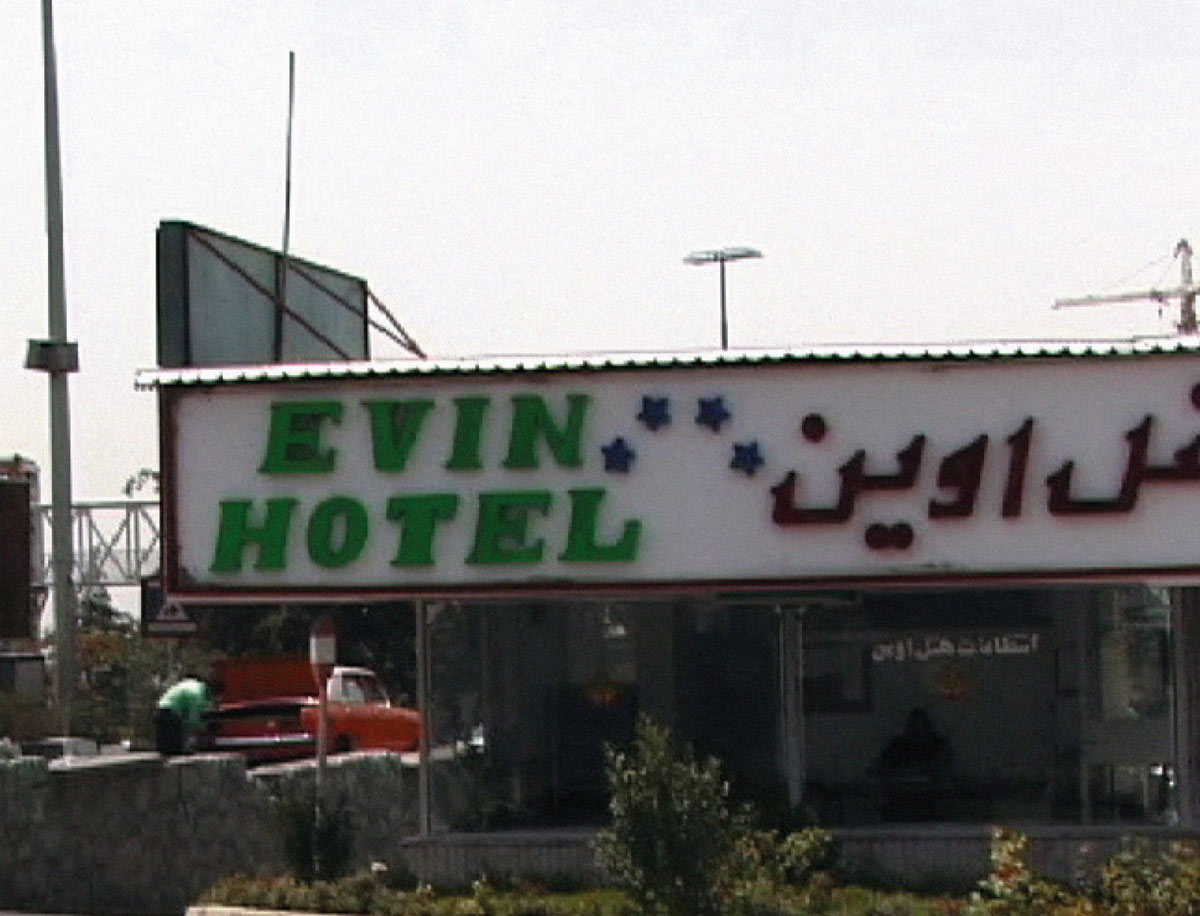
A warden took me by the arm as I put on my blindfold and stepped out of my cell. He led me down several corridors and had me sit down somewhere; then a door swung shut behind me. I peered out from under my blindfold, and saw I was facing the wall, in a concrete cell with no windows. Filming the streets of Tehran for a documentary two days earlier, I’d been arrested on charges of spying, and taken to Evin prison.
Sitting there blindfolded in a tiny concrete cube in perfect silence, waiting for my interrogator, was an extraordinary experience. I’d never been as utterly terrified in my entire life. The word “Evin,” you see, bears heavy connotations—though nobody knows the figures, everyone knows the anecdotes, the many graphic details of how before and after the Islamic Revolution, Evin was the favored locus of systematic torture and countless executions.
The door swung open and shut, then someone pulled up a chair behind me and just sat there, while those many graphic details raced through my mind. He leaned towards me.
“Listen closely now,” he slowly, emphatically crooned into my left ear. “If you tell the truth, we’ll find a solution for you. If you don’t, it will cost you dearly. Is that understood?” “Yes,” I answered. A feeble, high-pitched croak. I sounded like an emasculated water toad.
“So. Tell me something. And don’t try to act smart. Tell the simple truth. Which is better?” He paused. I waited. “Belgium or Iran?” Ever since moving back to Tehran, everyone from the janitor to the plumber to the cab driver has been eager to know how I would personally compare Europe to the Islamic Republic. My interrogator was obviously just as interested. “Actually,” I managed, “until yesterday, I would have said I preferred Iran.” He chuckled to himself, and leaned back in his seat.
As any businessman or backpacker who has been here will tell you, the Western Gaze is a big issue in Iran, and you needn’t be Edward Said to see why. Once the Paris of the Orient, an Aryan haven under the sexy splendor of the Shah and his groovy Queen draped in Yves Saint Laurent, now the land of Gog and Magog, rarely has a country been confronted with as many rich and imposing stereotypes and fabulations. And with life perhaps not imitating, but indeed reacting and overreacting to art, things have become a little muddled, touchy, and strained.
It is, of course, unlikely that an article such as this will be very helpful. Many readers will choose to see Evin as an allegory for Iran itself: gloomy, oppressive, outwardly unchanging, and embroiled in a desperate attempt to look intimidating and civilized at the same time (incidentally, dissident cleric Kadivar not long ago coined a popular phrase by calling Iran “one big prison for reformists”). But the fact of the matter is, an eyewitness account of Evin means international media attention, even career opportunities. All you need is a brief jail term, then you capitalize on the aura of a “tortured” political prisoner by publishing embarrassing, sensationalist muck in the first person singular (“I begged the warden not to kill me.”) These days, I find it easier to shamelessly cater to Western expectations, for with my case still open, and the Intelligence (or “Information”) Ministry scrutinizing me from all angles before reaching a verdict, it is the Iranian Gaze which troubles me more than any other.
On the night of our arrest, we were interrogated for sixteen hours. Being Iranian, but coming from abroad, my colleague and I were a little too eccentric for the ministry’s liking. Why would expatriate Iranians make a documentary on Tehran for a foreign production company, if not for reasons of espionage or sheer slander? Why would anyone be filming highways and office blocks, gas stations and billboards, if not for some ulterior motive?
And yet I wonder whether, on that occasion, the Information Ministry really employed their celebrated, time-honored methods of inquisition.
“What is your opinion of Imam Khomeini?”
“I’d say every human being has weak points and strong points.”
“How interesting. Do tell us his weak points.”
“He had none.”
“I see. So tell me, you disapprove of the theocratic State, don’t you.”
“Why should I disapprove? There was a referendum in 1979.”
“You grew up abroad, and you’re saying you really don’t disapprove?”
And so on.
Earlier, I had looked on as they searched my apartment—family letters, old snapshots of teenage beach parties, a tape collection of 1970s Easy Listening—and was pummeled with even more questions, none of which I could answer convincingly. Particularly when it came to my photographs of Tehran’s concrete wastelands, and my monarchist memorabilia. How to convince a member of the secret service who just ushered you through Tehran handcuffed in a BMW with tinted windows in the middle of the night that the city holds a very photogenic, quasi-neo-modernist flair. How to explain ironic retro-kitsch to an enormous, heavily armed gentleman in a black suit who just assured you you’ve “dug your own grave”?
When arrested, we’d been filming Shariati Street, near the Revolutionary Courthouse. It so happens that the courthouse had been recently bombed by an armed opposition group, the Mojahedin. To make things worse, it so happens the Mojahedin had previously filmed the complex. So our case was a little difficult to explain, as ironically kitsch-retro, and as thoroughly quasi-neo-modernist as Shariati Street may have seemed to us.
In fact, Tehran is practically off-limits for cameras, since there is hardly a street without a police station, a military compound, a headquarters for an Islamic “committee,” or an annex to some Ministry. Even hospitals are considered State secrets, and are not to be filmed. Last year, the municipality finally started urging the army to move out of the center, having determined that military institutions were using 10 percent of the city space.
The irony here is that a tremendous effort to survey and discipline the city has amounted to so little. On the one hand, prostitution, drugs, teenage delinquency, illicit socio-sexual mingling, and hypercritical public debate are all very much out of control. And on the other, much as the gigantic propaganda murals offer easy targets for graffiti and paint bombs, the concentrated mass of government paraphernalia repeatedly falls prey to armed attack on behalf of resistance groups, and has proven an endless source of anxiety and paranoia for the government more than anything else.
Moreover, the city’s disordered, unbridled growth—Tehran’s population has quadrupled since 1980—encourages a certain sense of chaotic repose. At the very least, the sprawling, anonymous urban fabric alleviates what would otherwise be a more pervasive sense of control and supervision. Many of those who have lived in other cities actually speak of a bizarre sense of freedom that is particular to Tehran.
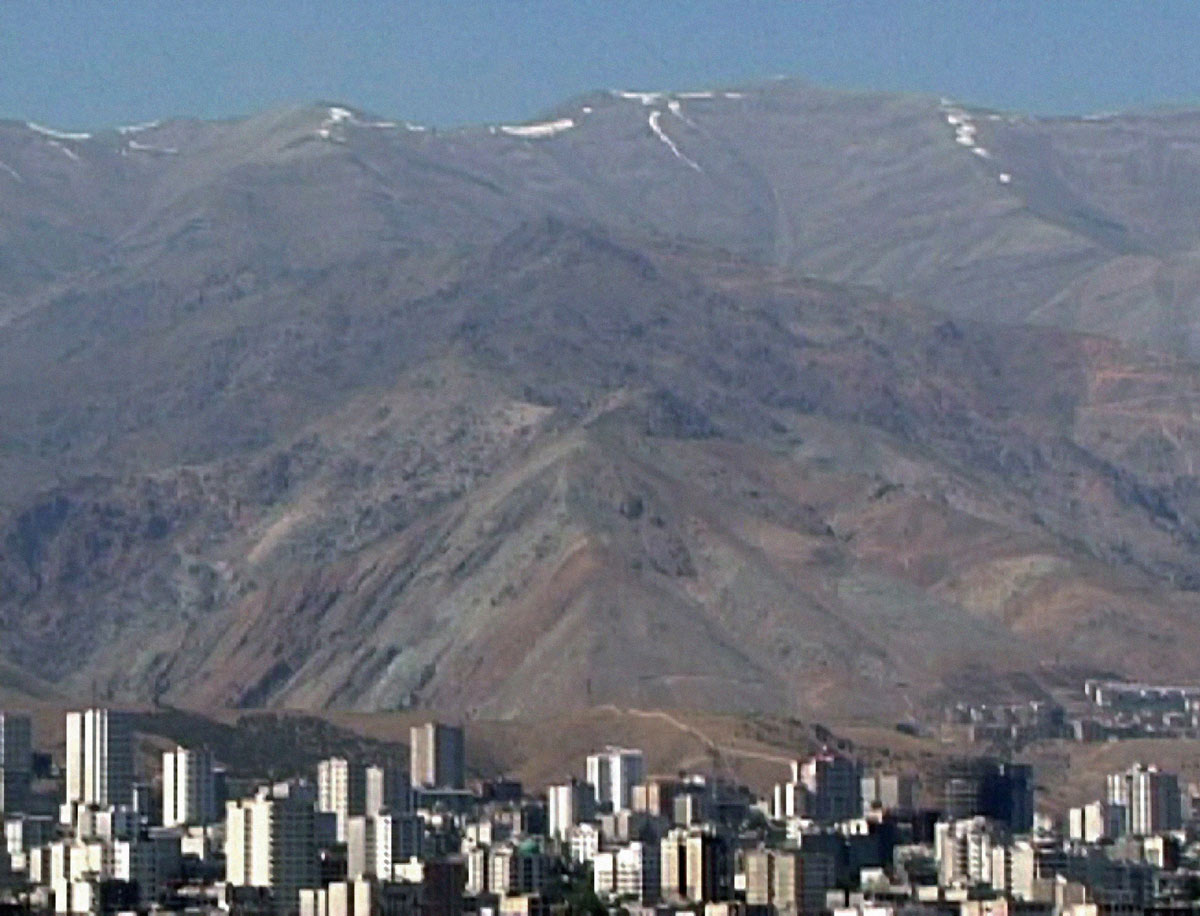
As for Evin prison, as an urban-architectural space, it’s arguably a masterpiece. When Evin is pointed out to the curious visitor, all he or she can make out are dark brown, arid hills along the Alborz mountains, with one slope separated from its surroundings by a fence. Only from certain rooftops, like that of the “Freedom Hotel” (Hotel Azadi) towering over the Evin neighborhood, can one see a handful of buildings belonging to the prison complex. A large part of the prison, however, blends neatly into nature, being built underground, beneath the hills. I cannot think of another landmark that is as elegantly less-is-more and as imposing at the same time. By merging with Tehran’s stately mountainous surroundings, Evin gains an aura of inevitability. It comes with the city.
Listening to my cellmates over tea and tasteless “Montana Lights,” I heard countless cross-comparisons of the many different wards the prison had to offer. Evin is one big carceral Disneyland. With the impressive selection of buildings, rooms, and cellars that can be rearranged at will, anywhere along or beneath the hillside, conditions can be made to vary drastically, according to whether you’re a man, woman, cleric, relative of a cleric, a “political,” “celebrity political,” drug dealer, etc. Although all sections are overcrowded, some cellblocks are filthy, while others are immaculate. Some offer grass, opium and alcohol, while in others even pen and paper are impossible to come by.
As architect Rem Koolhaas has pointed out, nowadays, with pedagogical ideals and agendas replacing each other at high speed, by the time a prison is built, it is usually already out-of-date. The advantage of certain “hypermonumental” prisons, however, lies in their lavish use of space. Thanks to wasteful proportions, they can easily adapt to new philanthropic regimes without any changes in structure, and keep an air of permanence while adapting from within, often covertly betraying the very principles they were founded on. No programmatic break, but an “architecture of revision” from within the penal colony. Such is the allegorical allure of Evin.
More and more figures of the reformist movement are openly admitting that mass incarceration is part and parcel of the reformist bargain. On the eve of the election of President Khatami, mayor of Tehran Gholamhossein Karbastchi (another key reformist figure), laughingly blurted out, “Obviously, this means prison for the likes of us.” Karbastchi was eventually sentenced to two years. And by now, the “Evin Cultural Center,” as it is widely referred to, is so packed with celebrities, it’s the single most glamorous spot in Tehran.
Prison memoirs are presently le dernier cri. Some attempt to analyze recent events in broad brush-strokes, others explain, in detail, the practical, day-to-day workings and prison routines. The titles of the memoirs are telling: One Shouldn’t be Afraid of Evin (Kadivar); Evin isn’t a Bad Place to Be (Ebadi); I Don’t Feel Out of Place in Evin (Safari); Evin Hotel Is a Little Further Down the Road (Lahiji). It seems like intellectuals are joined in a curious effort to demystify what is still Iran’s most legendary dungeon, perhaps even preparing and encouraging people to drop by sometime. “The long road to reforms leads right through Evin,” quips Mr. Kadivar. Playing on the Shah’s onetime promise that every Iranian would own a car, Kadivar suggests every Iranian should be the proud owner of a file in Evin.
A name that is often invoked these days—not least by superstar convict Akbar Ganji, in a recent essay on political imprisonment—is that of Michel Foucault, with his ruminations on surveillance and the ubiquity of power. By contrast, when I first came to Iran three years ago, all the bookstores around campus were displaying translations of Friedrich Nietzsche, a rather more chest-thumping, gung-ho sort of fellow.
As Evin’s place in the Tehran imaginary is shifting, within Evin itself there have been obvious revisions, such as a de-specialization of the prison staff, with recruits being used to run administrative tasks. God bless the recruits. They do their job, but in their reluctant, fuck-am-I-doing-here manner, often openly sympathizing with the prisoners, and, to quote the jailed reporter Baqi, “ostensibly treating the prison staff as inmates.” The intelligence agents are, for their part, also undergoing changes, and are sporting a new sort of élan.
If the New York Gambino Mafia once admitted it was The Godfather that taught them how to walk and talk and look convincing (and if it would be perfectly normal, as it were, for the British MI5 to seek inspiration in the likes of John le Carré or Ian Fleming), it so happens that the Iranian Information Ministry is itself the most promising masculine paradigm of our time, with the strongest cult potential since Don Johnson. A sphere of innocence untouched by the adulterations of media-honed sex appeal, the Information Ministry offers untapped authenticities, a promise of fresh prototypes and tantalizing new styles. Consider an interrogator in a turquoise suit and beige rubber slippers, sporting a four-day stubble and an impeccable blow-dried coif. Through sixteen hours of interrogation he uses the most polite and elegant renditions of Persian etiquette as he brings you tea and sugar and apologizes for smoking. Yet he is also perfectly happy to scream, threaten, and bang his fists on the table in a show of exquisite, virile deftness. And he is but one among many.
In the wake of the ongoing power struggle, the Information Ministry has reportedly been pervaded with bleeding-heart reformists. The hard-core, those who found the liberal, wishy-washy approach revolting and disgraceful, have regrouped under the auspices of the judiciary, which is responsible for the current wide-scale arrests. Be that as it may, for the first time in a long time, political prisoners are no longer subjected to physical torture, which is principally reserved for people in the business of drug dealing and organized crime, and which is performed by the dreaded Agahi, a subdivision of the army. The “politicals” are now tortured psychologically, which is at least as efficient and destructive, but which holds certain advantages: psychological torture doesn’t leave physical traces (apart from weight and hair loss), and it isn’t gritty and juicy enough to stir the public’s sense of imagination. The very fact that Evin now contains non-political prisoners attests to changes in society at large. Iran is as poor as it has been in a long time, and its criminological panorama has shifted accordingly. My own cellblock was a tutti-frutti of all sorts of prisoners who were awaiting sentencing. There was the one-legged army general who had been caught with 250 kilograms of opium. There was an Iranian who had grown up in Hawaii and Tennessee, whom everyone called Billy, and who was caught with his buddy’s stash of heroin. There was a handsome, soft-spoken historian who had written too critically of Iranian wartime policies, and who was psychologically tortured for over a month. (“They try to systematically destroy your every sense of self,” he told me.) Yet another was a conspirator in a two-million-dollar bank scam, who had been hung upside down naked and beaten for days on end by the Agahi until he was a mess of blood and broken bones. Khosro, another cellmate, was a cigarette smuggler from Kurdistan who quietly sang Shirley Bassey songs (“But if you stay / I’ll make you a day / like no day has been / or will be again”). And then there were the three young men from Ahvaz who had made a confused attempt to hijack a small charter plane. “We couldn’t agree on where to go. Some were screaming, ‘Damascus!,’ others were suggesting Dubai, someone was saying Germany,” they explained in raucous Khuzestani accents. Their families had taken part in the attempt, so their mothers and fathers, aunts and uncles were all in Evin awaiting sentencing.
I also met a member of the Mahdavia, an armed opposition group that strives to hasten the arrival of the Hidden Imam (the Shi’i equivalent of the Messiah). Since the Imam is scheduled to appear during a time of unparalleled depravity, the Mahdavia have decided they must topple the very devout and righteous Islamic regime, in the hope of sowing some decent corruption and decadence on this earth. Yet another prisoner was a member of the aforementioned Marxist-Islamic Mojahedin, who are just as pointlessly trigger-happy as the Mahdavia, and who entertain the bizarre idea that they can bomb Iranians into spontaneous upheaval against the government. They lost all the popular support they had when they extensively bombarded their own countrymen during the Iran-Iraq war. When it comes to high-profile opposition groups, one mustn’t forget the Monarchists, with their nouveau-riche frumpiness and their politics of nostalgia. The Monarchists are based in Tehrangeles (the Iranian neighborhoods of LA), from where the exiled “Prince Reza” occasionally fluffs his feathers and beams passionate radio transmissions to his supposedly “countless” followers within Iran. Who wouldn’t rather put up with the long, reformist road through Evin? I feel sorry for any serious revolutionary these days.
Before being transferred to a cellblock shared by forty prisoners, I spent a brief spell in isolation. At one point, my interrogator burst into the cell, holding all my signed statements in one hand. He was upset. I’d forgotten to sign certain pages, and it made him look silly in front of the public prosecutor. As he was excitedly waving the documents in my face, the door slammed shut behind him, and he was trapped in the cell, alone with me.
“Where’s the bell?”
“We don’t have a bell.”
Awkward silence.
“So what do you do to call the warden?”
“Take the blue slip of cardboard and hang it outside the door.”
He followed my advice. Another silence.
“What do you do then?”
“You wait.”
He waited. Then he started calling the warden, gradually getting louder and louder until, finally, he was screaming and violently banging his pudgy fists against the steel door. A wonderful moment. And deeply symbolic, all things considered.
Golmohammad Rahati is a journalist and documentary filmmaker living in Tehran.