


“Picturing Objectivity” /
A Panel Discussion with Peter Galison, Sabine Kastner, Terry Winters, and D. Graham Burnett
Date: Tuesday, 24 November 2009, 7 pm
Location: The Kitchen, 512 W 19th Street, New York
FREE. Limited seats; first come, first served
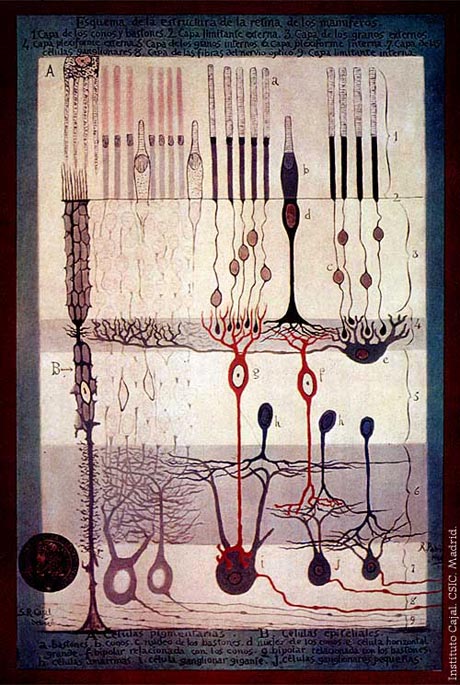
“Picturing Objectivity” features science historian Peter Galison, co-author of the breakthrough book Objectivity, which offers a major re-interpretation of the relationship between the sciences and arts in the nineteenth century. The panel also includes neuroscience expert Sabine Kastner and painter Terry Winters, and will be moderated by Cabinet editor D. Graham Burnett.
Galison, Kastner, and Winters will talk about the historical and analytical place of objectivity and subjectivity in the making of images. More specifically, the discussion will focus on the history and current practices of pictorial representation in the sciences, addressing ways in which such representational changes have influenced and been influenced by surrounding artistic practices. The evening will be centered on “readings”; of a set of paradigmatic paintings, diagrams and drawings spanning the arts and sciences. Topics include, but are not limited to: what it means to make an “objective” image of a natural object, how ideals of fidelity to nature have changed over the last 400 years, and what the implications to visual art have been or could be.
About the Participants
Peter Galison is the Joseph Pellegrino University Professor at Harvard University. He was named a MacArthur Foundation Fellow in 1997 and a Guggenheim Fellow in 2009, and won the Max Planck Prize in 1999. Galison’s work explores the complex interaction between the three principal subcultures of twentieth- and twenty-first-century physics: experimentation, instrumentation and theory. He has written several books, most recently Einstein’s Clocks, Poincare’s Maps: Empires of Time (2003) and, with Lorraine Daston, Objectivity (2007). In addition, Galison has co-edited volumes on the relations between science, art, architecture, philosophy and authorship. With Pamela Hogan, he made Ultimate Weapon: The H-bomb Dilemma (2000), a documentary on the politics of science. His second film, Secrecy (2008), which he made with Robb Moss, is about national security secrecy and democracy; it premiered at Sundance Film Festival in 2008. He is finishing a book, Building Crashing Thinking, about technologies that reform the self, and beginning a new feature documentary film on nuclear landscapes.
Sabine Kastner is a professor of psychology and neuroscience at Princeton University. She has an M.D. from the Heinrich-Heine University of Düsseldorf, Germany, and a Ph.D. in neurophysiology from the Georg-August University, Goettingen, Germany. Kastner studies the neural basis of visual perception, attention, and awareness in the human brain using neuroimaging techniques. Kastner has published more than eighty journal articles and book chapters. Her work has been recognized by several awards, including the Young Investigator Award from the Cognitive Neuroscience Society in 2005. Kastner serves on several editorial boards and is a senior editor for the Journal of Neuroscience. She is currently working on a book on the neural basis of human visual attention.
Terry Winters had his first one-person show in 1982 at Sonnabend, New York. Since then he has exhibited widely in the United States and around the world. Most recently, “Signal to Noise,” a ten-year survey of his paintings and drawings, was held at the Irish Museum of Modern Art, Dublin. He is represented by Matthew Marks Gallery, New York. Winters lives in New York City and Columbia County, New York.
D. Graham Burnett is an editor at Cabinet magazine and professor of history at Princeton University, where he is a member of the Program in History of Science. He is the author of four books, most recently Trying Leviathan, which won the 2007 New York City Book Award. Currently a fellow at the Italian Academy, Columbia University, he is writing about aesthetics.
This program is been made possible with generous support from the Axe-Houghton Foundation and with public funds from the National Endowment for the Arts, the New York City Department of Cultural Affairs and the New York State Council on the Arts, a state agency.