


Listening for the Enemy
The sound mirrors of Dungeness
Brian Dillon
In 1856, in a footnote to his revision of Confessions of an English Opium Eater, Thomas De Quincey recalled a childhood visit to St. Paul’s Cathedral in London, where he and a friend experienced the peculiar acoustic properties of the cathedral’s Whispering Gallery:
To those who have never visited the Whispering Gallery, nor have read any account of it amongst other acoustic phenomena described in scientific treatises, it may be proper to mention, as the distinguishing feature of the case, that a word or question, uttered at one end of the gallery in the gentlest of whispers, is reverberated at the other end in peals of thunder.[1]
This singular acoustic wonder (allowing for De Quincey’s customary metaphoric excess: the distinctly unlikely “peals of thunder”) provides the author with an image of the eternal return of the autobiographical motif: the manner in which memory turns up the volume of a long-lost voice or event.
The location of this revelatory listening experience, suspended above the city’s bustling auditory chaos, was oddly prescient. Eight decades after De Quincey described his acoustic epiphany, in a room of the Post Office building in Carter Lane, between St. Paul’s and the River Thames, representatives of the Air Defence Experimental Establishment awaited telephoned reports of aircraft noise from a series of listening posts which had begun to dot the coast of southeast England—a scattering of modernist whispering galleries where ears were trained not on the deep past but on the immediately threatening future, the increasing likelihood of German bombing or invasion from the air. By the mid-1930s, a vast and varied network of listening devices had been envisaged, enclosing the Thames Estuary and the southeast coast in what Paul Virilio (writing of the German defenses which would later loom along the other side of the English Channel) has called “a carpet of trajectories.” The remnants of this doomed project, the architectural remains of a technology gradually overcome in the late 1930s by experiments with radar and a generalized eruption of the acoustic realm, are still to be seen at certain points along the coast. These long-decaying but still startlingly sculptural structures are monuments to both past and future, their eerie archaeology also a reminder of the whole panoply of technologies of the immaterial that have proliferated in the military sphere, the space of war now dominated by the grotesque intersection of implacable abstraction and fragile flesh.
That history is nowhere more in evidence than at the most isolated, bleakest point to which this acoustic network (part achieved, part fantasized) stretched. At Dungeness, a spur of shingle and sporadic settlement on the southeastern coast of Kent, three of the most substantial constructions of the Air Defence Experimental Establishment still stand, now stranded behind a strip of mid-century housing and surrounded by a lake gouged out of the landscape by decades of gravel-works. Approaching the “sound mirrors” from the coast, the territory is a palimpsest of a century’s technological development. A narrow-gauge railway line still skirts the coastline, while the remains of its earlier trajectory are still visible, rotting and rusting on a route that once supplied the construction site for the sound mirrors. In the distance is the pallid, misty expanse of a nuclear power station, in the foreground the fenced-off spike of a mobile-phone mast adds a layer of wire to the several generations of barbed perimeters that surround, but fail to enclose, the mirror site.
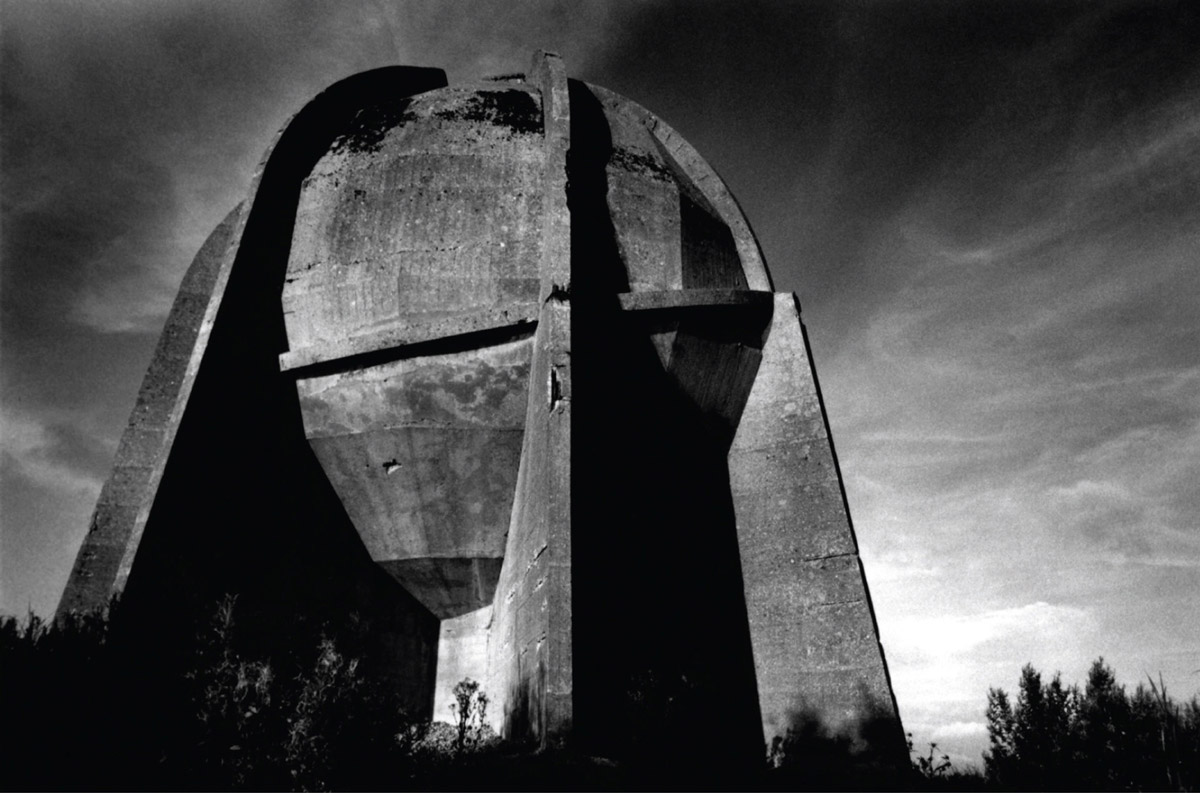
The mirrors themselves are reached after a trek around the lake and through the undergrowth, out onto a pebbled promontory on which stands the most imposing of the three structures. A huge concrete arc 200 feet long and 26 feet high, with crumbling buttresses at the rear and a cracked, sloping forecourt running down to the water and what remains of a protecting wall, it resembles nothing so much as a vast theatrical stage or a truncated version of its architectural and acoustic contemporary, the Hollywood Bowl. Nearby, linked by a narrow strip of land, are two smaller but equally odd edifices: a large bowl turned diagonally towards the Channel skies, and a flatter upright structure, currently titling precariously towards the water.
The sound mirrors at Dungeness are the most tangible echoes of a technological narrative that begins in the trenches of the World War I. As sedulously traced by Richard N. Scarth in his book Echoes From the Sky: A Story of Acoustic Defence, the short history of the acoustic warning system starts with the efforts of the British and French armies to plot the positions of Germans guns.[2] The techniques of “sound ranging” gave rise to two innovations later essential to the development of the massive sound mirrors. First, the use of “listening wells”: deep shafts which would reduce or eliminate all surface noise, allowing a listener situated at the bottom of a shaft to focus on the desired sound. Second, the development in 1916, by William Sansome Tucker, of the hot-wire microphone, a device which could be tuned to register the frequency of the gun, or later aircraft, under surveillance. Tucker was to spend the next two decades perfecting the means of identifying and locating the low-frequency sounds of aircraft and ships. In the primitive earthworks of World War I, he saw the possibility of a more technically precise and (to the eyes, at least, of a contemporary observer of the mirrors’ melancholy presences) more aesthetically astonishing technology. Tucker practiced an art of the curve: “When a solid on which a wave impinges does not exceed about one quarter of a wavelength in diameter, the wave passes round it with little interruption. When the diameter of the barrier exceeds one wavelength, appreciable reflection should occur, and therefore a certain amount of concentration should be obtained by making the surface concave.” After the war, Tucker’s concavities appear in a variety of forms: as parabolic bowls with stethoscopes or microphones attached, and “mirrors” carved into cliff faces and lined with concrete. As Emily Thompson’s Soundscapes of Modernity points out, a range of huge discs was simultaneously developed in Hollywood; the “sound concentrators” and “parabolic reflecting horns,” used by RKO from 1930 onwards, captured the distant voices of actors just as Tucker and his colleagues were trying to catch more sinister frequencies.[3]
The site at Dungeness records three stages in the development of acoustic early warning technology. The smallest mirror, 20 feet in diameter, faces the sea vertically; a simple sound-collecting trumpet ranged over its surface. It was superseded by the 30-foot diameter of the “bowl mirror,” beneath which, in a tiny listening chamber, the operator, equipped with a stethoscope, could expect his concentration to last no more than an hour. The mirrors seem to have required an excruciating degree of aural sensitivity; in tests carried out in the mid-1930s, it was concluded that listeners should alternate every 40 minutes, before “irritation” set in. The perverse mirror image of the urban subject assailed by the cacophony of acoustic modernity, the sound mirror operative was forced to distinguish the most fleeting and fugitive sounds. The use of Tucker’s hot-wire microphones, ranged along the forecourt of the 200-foot mirror, went some way towards alleviating the strain on the human ear. But even this innovation had to be supplemented by sentries patrolling the perimeter: an audience whose listening skills varied greatly and were further compromised by adverse weather conditions.
Despite encouraging test results in 1933, during which Tucker recorded that on a still day it was possible to discern the sound of an aircraft 18 miles away (on a bad day this could be reduced to 10 miles), the Dungeness sound mirrors were beset from the outset by a host of extraneous acoustic phenomena. Local myths about listeners being distracted from the job at hand by a passing milk float or the sounds of trains leaving the station at Calais, are unfounded. In 1931, Tucker had written that the 200-foot mirror “is sensitive to any impulsive sounds which some ill-disposed person might be capable of creating, and would be considerably affected by car traffic.” The site had already been subject to invasion by sightseers and picnic parties (hence the barbed wire); worse, a nearby holiday camp had begun to encroach into the field acoustically surveyed by the largest mirror. Fortunately, the campers went to bed early, but, as Tucker noted, “should a band start up, matters would be different.” The entire acoustic defense project may not have been able to survive the advent of radar (the 200-foot mirror was effectively moribund by 1937), but it is equally difficult to see how it could have weathered the sound-storm of mid-century modernity, the advent of a noisy culture of leisure and private transport that even now sends day-trippers, seeking the spooky silence and solitude of Dungeness, out along the resounding shingle, echoing across the mirror’s fragile aural space.
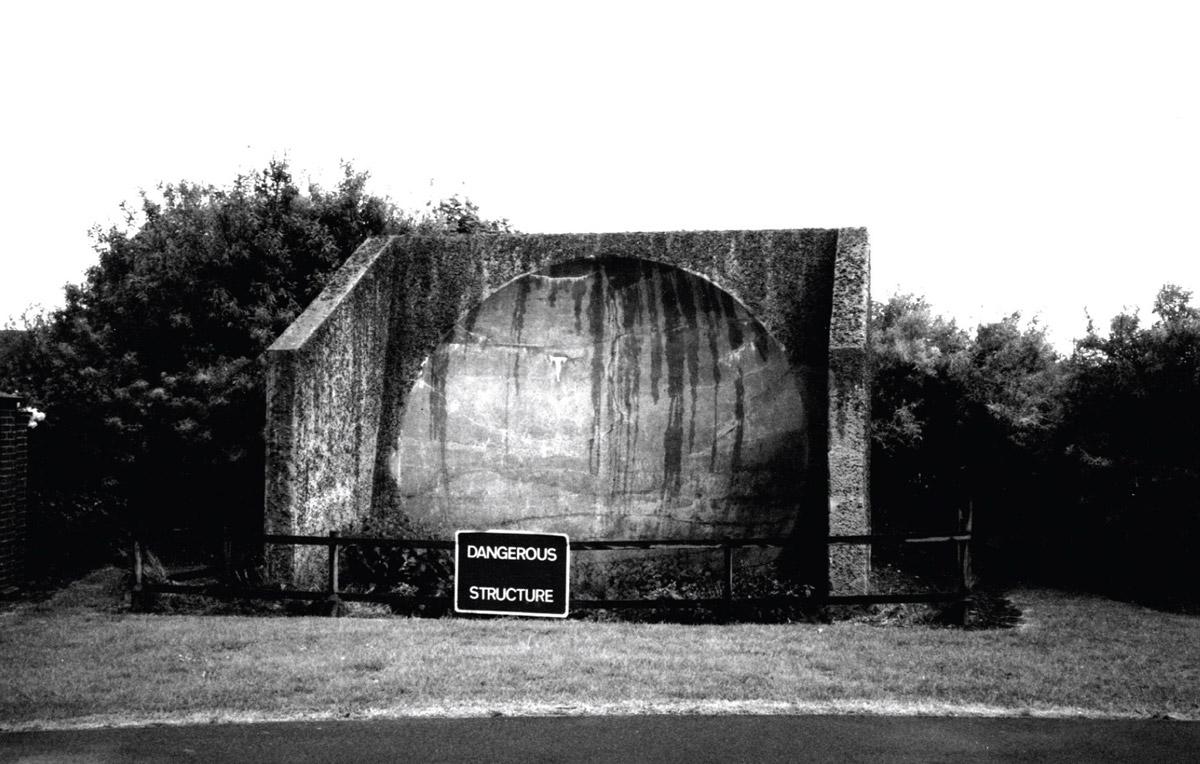
Despite their solidly insistent presence in the landscape, perhaps it is the very fragility of the sound mirrors as technological artifacts which, along with their austere beauty, makes them resonate now. They have accrued the peculiar mystique of the precursor, the dark sublimity of objects whose function has given way to their metaphoric possibilities. In The Antiphony Video Supplement a.k.a. Blackout (1997), a short film directed by Barry Hale and produced as part of a series of linked works by the sound art collective Disinformation, the mirrors appear as spectral remnants of a lost technological moment which has nonetheless returned, ghostlike, in the spread of surveillance technology since World War II.[4] The visual index of the mirrors’ ambiguity lies in the surface of the 200-foot mirror; Hale’s film reveals (in fact, is hypnotized by) the full extent of the structure’s decay, its rusted reinforcement showing through the raddled concrete, the once smooth surface slowly becoming indistinguishable from the surrounding shingle. As Disinformation’s Joe Banks writes in the “Antiphony Architectural Supplement (1999),” “everybody loves a ruin, and, viewing obsolete military architecture from the vantage point of the close of this brutal century, the long-term structural shortcomings of reinforced concrete have manufactured relics which resonate across a timescale that tangibly connects to people’s lives.”[5] In Tacita Dean’s short film Sound Mirrors (1999) they are blankly, eerily monumental. The sound mirrors are both our past and future: they attest to the centrality of sound to our modernity, assuring us of both the obsolescence and persistence of the forms that modernity takes. Like the burial urns of which Sir Thomas Browne wrote in 1658, the sound mirrors are machines for projecting ourselves into past and future: “Time, which antiquates antiquities, and hath an art to make dust of all things, hath yet spared these minor monuments.”
In Lise Autogena and Joshua Portway’s short video as far as the eye can see (2001), a documentary account of the territory surrounding the Dungeness mirrors (produced as part of Autogena’s wider project to document the mirrors, and long-term aim of constructing new mirrors on both sides of the English Channel), the author Richard Scarth, who has done most to record their history, bemoans the graffiti which currently blights the 200-foot mirror. Between two rusted, frayed buttresses, among the declarations of love and lust, is a single startling message: “I hate myself and I want to die.” Whatever the occasion (tragic? comic?) of the inscription, it is impossible not to read it as emanating from the mirror itself: a final, obscure communication from an object which has lived too long, while the catastrophe it was intended to avert has not ceased to arrive.
- Thomas De Quincey, Confessions of an English Opium Eater [1856] (London: Penguin, 1986), p. 175.
- Richard N. Scarth, Echoes From the Sky: A Story of Acoustic Defence (Hythe: Hythe Civic Society, 1999). Scarth’s book is the most thorough published source of information on the sound mirrors; all quotations from W. S. Tucker are from this volume.
- Emily Thompson, Soundscapes of Modernity (Cambridge, Mass.: MIT Press, 2002), pp. 280–281.
- See also Disinformation’s collaborative double CD Antiphony for which the images by Hills used here were taken.
- Joe Banks, “Antiphony Architectural Supplement,” The Sound Projector, no. 6, 1999, p. 60.
Brian Dillon is a writer and critic whose work has recently appeared in Frieze, The Dublin Review, Modern Painters, and The Wire. He is currently writing his first book, In the Dark Room, a study of private and public memory.
Spotted an error? Email us at corrections at cabinetmagazine dot org.
If you’ve enjoyed the free articles that we offer on our site, please consider subscribing to our nonprofit magazine, which includes unlimited access to all our archives.