


Leftovers / Not in Our Backyard: An Interview with Jim Puckett
Your old computer is killing people
Sasha Archibald and Jim Puckett
“Leftovers” is a column that investigates the cultural significance of detritus.
In 1989, the United Nations Environmental Program adopted the Basel Convention on the Control of Transboundary Movements of Hazardous Wastes and their Disposal. The Convention was an initiative of developing countries and green organizations seeking to ban the export of hazardous waste from richer to poorer countries. Due in large part to the aggressive negotiating of the United States, the final treaty succeeded only in banning export to Antarctica and legitimized waste trade to all other countries by simply requiring an authorizing signature (an effortless matter in weaker economies). Even in this pared-down form, the United States refused to ratify the treaty; in this, they were joined only by Haiti and Afghanistan, two of the poorest and most devastated nations in the world.
The Basel Convention was amended in 1994, against the wishes of the United States, to establish what its initiators originally hoped for: a true ban on the export of hazardous wastes from developed to developing countries. Ratified by 50 countries, this ban is well on its way to becoming international law.
Longtime toxics activist Jim Puckett founded the not-for-profit Basel Action Network (BAN) in 1997 to enforce the Basel Convention. A watchdog group, BAN globally monitors and campaigns against the illegal export of e-waste; the organization recently produced an exposé documentary entitled Exporting Harm: The High-Tech Trashing of Asia. In September, Sasha Archibald spoke with Puckett in Seattle, Washington by telephone.
Cabinet: Where is this waste coming from? If I put my old computer on the street for garbage pickup in New York City, does it somehow end up in China?
Jim Puckett: You and I have the right to dump hazardous waste in the local landfill, because in this country, oddly and inappropriately, household waste doesn’t qualify as hazardous waste. However, large users, such as banks, government entities, universities, or hospitals, are not allowed to use landfills in that way. They have to use a “recycler,” most of which are not recyclers at all, but waste distributors. Due to its developed infrastructure but low wages—about $1.50/day and dropping—China is the favored destination of America’s e-waste. The import of toxic waste is illegal in China, but it is extraordinary difficult to enforce import bans, especially in developing countries. Waste traders have told us that if you slap a $100 bill on the inside of your sea-going container, it will go through, no questions asked.
Ironically, one of our biggest challenges is fighting the word “recycling”—a word invented by the green movement and, in theory, a great thing. The word recycling masks a thousand evils, especially when you’re dealing with hazardous waste. Recycling of hazardous substances is no panacea.
What exactly do workers in China do with the waste?
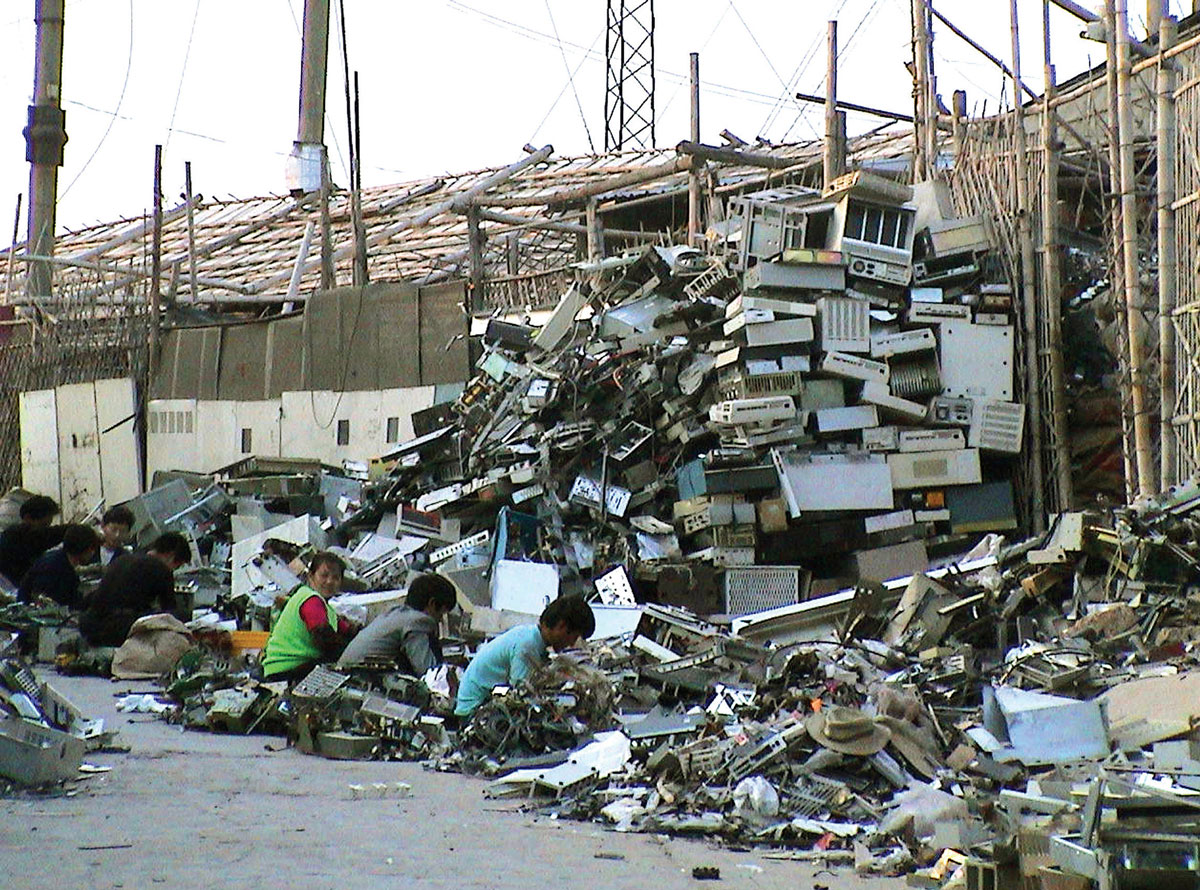
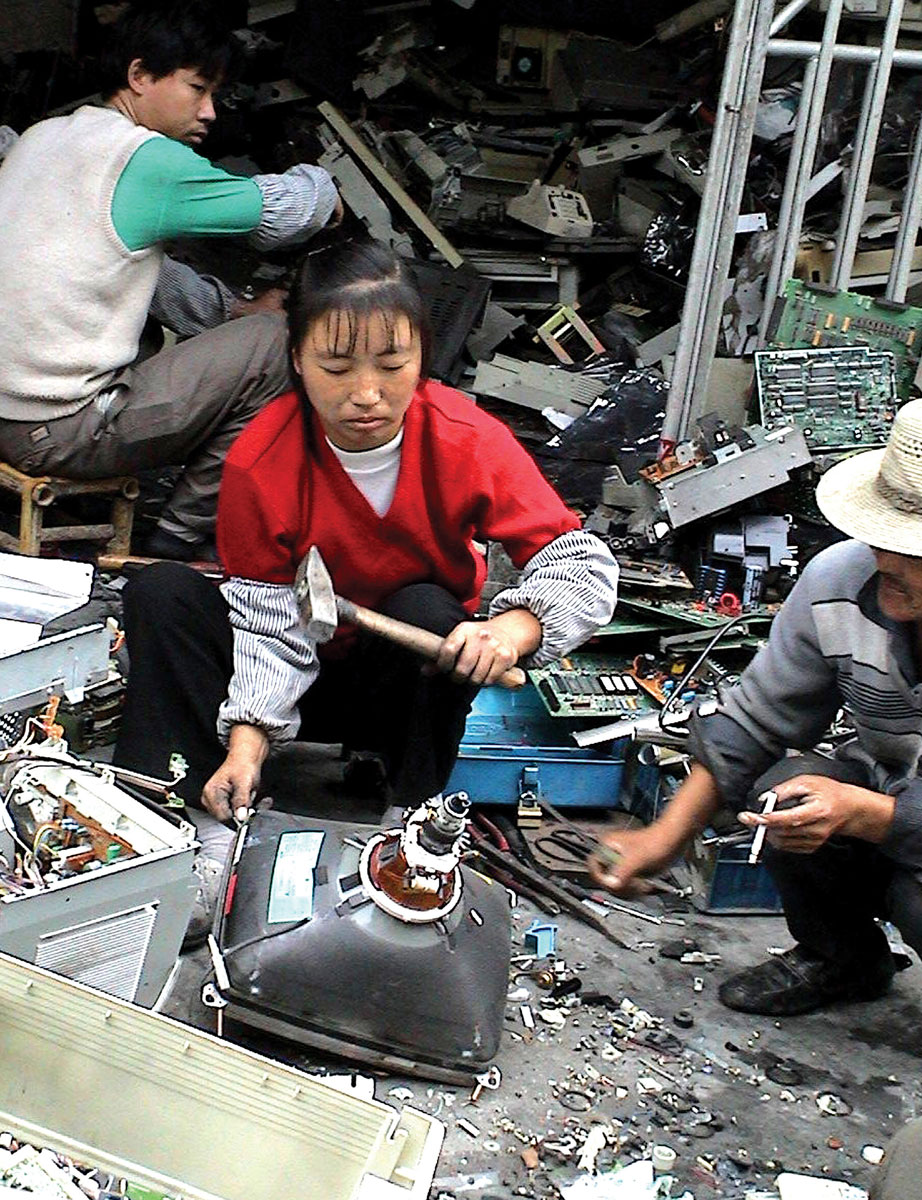
One of the most labor-intensive and time-consuming tasks we witnessed in our investigation of Guiyu, an area in the Chaozhou region of the Guangdong Province, involves stripping circuit boards of their chips. Sometimes these circuit boards have been separated from the rest of the computer in America and shipped on their own, but more often the entire machine is dismantled in China. Bags of circuit boards are delivered to former farmers who heat them one by one over a coal fire burner in a pan that’s like a shallow wok. When the lead solder melts sufficiently, the chips are plucked off by hand. It is a job usually done by women, some of them pregnant, most of them of child-bearing age, and of course, with many children running all around—everyone breathing in lead and other toxic fumes released from the heating of the circuit boards. We tested lead levels 2,400 times the World Health Organization’s drinking water standards. Due to lead contamination, all of Guiyu’s water must be trucked in from outside the area.
Of the pulled chips that aren’t reused in Chinese manufacturing markets (making so-called new computers from old parts), there is value in the small amounts of gold plating used in some circuit board connections. By swirling the chips in aqua regia, a very dangerous toxic mixture of nitric and hydrochloric acid, bits of gold can be extracted. This is done on the banks of the local river and the residue is flushed downstream. The environmental damage is terrible but the occupational risks are just shocking. These people are wearing no protective gear and they’re breathing in hydrosulphide gas, chlorine gas….
Another highly toxic job involves burning the little wires in computers in order to strip the plastic coverings and reclaim the copper. Mountains of these wires are burned in huge bonfires. We saw entire communities of Hunan immigrants living in ash-covered shacks. Ash is all over the ground, around their food, all over their clothes. This is not like ash from a campfire. When you burn the plastic coating that surrounds copper wires, you are releasing highly toxic dioxins from the PVC, cancer-causing polycyclic aromatic hydrocarbons, and metal dust from other types of plastics.
How is the enterprise organized? The photos seem to indicate that there are small communities subsisting off these dumps.
This kind of work dominates the economy of Guiyu and involves thousands of families. It appears that the locals are like little warlords, each of them running multiple small shops. Their laborers are typically displaced farmers, many of them from the Western provinces, such as Hunan province—people who are just really living on the edge, desperate to do any job to get money. As we’ve placed a spotlight on Guiyu, more and more of the work has been outsourced to rural areas around Guang-dong province. Now it’s more likely that when a shipment arrives, trucks deliver bags of waste to the farmers in the countryside, who are not farming, but sitting in their homes processing circuit boards. The workers are easy to find you just drive by with the car windows down. The reek of burning circuit boards is incredibly strong and instantly recognized.
How are you putting pressure on the United States?
With over 160 countries ratifying the original Basel Convention, the United States is glaringly absent. We’re the most wasteful country in the world per capita and we certainly create the most post-consumer waste, such as electronics. But our government is totally blasé about the matter; they have actually said things to us like, “Well, export is part of our electronic waste strategy.” Even Democrats tend to side with industry in arguing that the Basel Convention is inappropriate and the Ban an anathema.
One thing we’ve tried is to implement state-by-state legislation that will impose barriers to this kind of export; this course is difficult, however, because states aren’t supposed to have jurisdiction over foreign trade. More effective perhaps is another of our initiatives: we’re assembling a list of real recyclers, recyclers who have pledged to recycle toxic waste in America with the highest regard for the environment and worker health. Basically, this is an effort to separate the market and drive a wedge between the good guys and the bad guys. We’re trying to pressure large consumer institutions such as Dell Computers or Kaiser Hospitals to only use our pledgers.
On a global scale, one of the most important things we can do is to force the costs of disposal back to the manufacturers, the course taken by the European Union. In the EU, when your machine dies, the company has to take it back at their cost. (These are all the same manufacturers that market here: HP, Sony, etc.) Our industry fought tooth and nail against this legislation, threatened WTO sanctions and all that—but it passed. Forcing the costs back on the manufacturer will finally create a clear incentive to design these machines properly. Right now all the ingenuity of high-tech equipment design goes into the bells and whistles of its operating systems, memory, graphics, etc. We need some of that brain trust focusing on end-of-life issues. We don’t have to use lead solder, for instance. We don’t have to use brominated flame-retardants. With better design, these machines won’t be so hazardous.
More information about BAN is available at their website, www.ban.org.
Sasha Archibald is associate editor of Cabinet and a Helena Rubenstein Curatorial Fellow in the Whitney Museum Independent Study Program.
Jim Puckett is the founder of the Seattle-based Basel Action Network, a nonprofit organization focused on preventing trade in toxic wastes, products and technologies.
Spotted an error? Email us at corrections at cabinetmagazine dot org.
If you’ve enjoyed the free articles that we offer on our site, please consider subscribing to our nonprofit magazine, which includes unlimited access to all our archives.