


In Search of Ancient Astronauts: A Requiem for the Space Age
Architectural techno-transcendentalism in Southern California
Mark Dery
In the Southern California of my childhood, it was always rocket summer.
“Rocket summer” is the heat wave created by Mars-bound rockets in Ray Bradbury’s The Martian Chronicles (1950). “One minute, it was Ohio winter,” writes Bradbury, “icicles fringing every roof...”[1] Then the rockets exhale, turning winter into a puddle of ice water, the “skis and sleds suddenly useless...”[2]
In Chula Vista, the San Diego suburb where I grew up in the sixties and seventies, rocket summer was an unchanging mental season for anyone whose father worked in the aeronautics industry, as my stepdad did. In 1965, he, my mother, and I had headed west in a Volkswagen van, camping our way from New Britain, Connecticut to Southern California, where the commercial and military contracts were ripe for the picking. My stepdad had landed a job as a machinist at Chula Vista’s biggest employer, Rohr Aircraft, and we promptly rented a stucco bungalow and began living the working-class dream.
We were part of a westward expansion that had begun during WWII. “Ten percent of wartime federal spending went to California,” writes the regional historian D. J. Waldie. “Southern California aircraft plants produced 40 percent of the planes flown by the Navy and Army Air Corps. By the end of the war, 600,000 border Southerners had migrated to Southern California to work in defense industries.”[3] After the war, the tide ebbed, but tales of good pay, palm trees, and endless sunshine continued to draw workers to the promised land. The tribes of Aerojet and Convair, Litton and Lear-Siegler, Hughes and Northrop, McDonnell-Douglas and Ford Aerospace, Rockwell and RAND and, among the subcontractors, Rohr, were fruitful and multiplied.
My stepdad worked on the tailfins for the sleek, swept-wing fighter jet that would later knock Tom Cruise out of the spotlight in Top Gun—the legendary Grumman F-14 Tomcat, which entered military service in 1972. He had a hand, too, in the engine nacelles for the DC-10, the 727, and the 737; the thrust reverser for the 747; the exhaust system for the Concorde; and the space shuttle boosters. When my elementary school teachers asked us to introduce ourselves with an autobiographical sentence or two, I upped my coolness quotient with the exotic fact that my stepdad was “the man who makes the parts that make the parts that make airplanes”—a loose translation of his job description as a jig-and-fixture builder.
Little wonder, then, that my mental skies were crisscrossed with the contrails of SSTs and the fiery plumes of ascending moonships. San Diego, after all, was where Ryan Aeronautical built The Spirit of St. Louis (with Fred Rohr as foreman); where Lindbergh took off from North Island, en route to New York for his legendary flight to Paris; and to which he returned in triumph, reassuring a jubilant crowd of 60,000 that “San Diego has always been in the foreground of western aeronautics and San Diego, I believe, always will be in the foreground.”[4] When I was in grade school, schoolkids were still making the obligatory pilgrimage to the musty Aerospace Museum in Balboa Park, to feign a reverential moment before a replica of Lindbergh’s rickety little Spirit.
Back in the real world, the fossil record of man’s evolution into Homo Icarus was all around me. Weekends, my family bodysurfed at Coronado, where in 1911 Glenn Curtiss made history’s first successful seaplane takeoff and landing. Sometimes, we picnicked on the scrubby Chula Vista hill where, in 1883, John Montgomery strapped himself into his seagull-inspired “Gull Glider” and flew 600 feet, “open[ing] for all mankind the ‘great highway of the sky,’” as the Montgomery Memorial’s gently vandalized stone marker proclaims.[5] Occasionally, we would drive out to the Torrey Pines cliffs, near Del Mar, to watch Montgomery’s hang gliding descendants drifting lazily on the updrafts, their wings bright splashes of color against the ocean far below.
I lived with one foot in the future, a parallel dimension where supersonic travel, jetpacks, lunar vacations, and offworld colonies under geodesic domes were already a reality. Disney’s Tomorrowland fueled my fantasies. Once a year, on Rohr night, when the park opened its gates to Rohr employees only, I thrilled to the space-jock jargon and simulated microgravity of the Flight to the Moon (brought to you by McDonnell-Douglas) and the Incredible Shrinking Man–effects of the Adventure Through Inner Space (brought to you by Monsanto). By moonlight, Tomorrowland’s aerodynamically cool monorail and spaceport architecture made the master-planned technocracies and interstellar odysseys in my stepdad’s Isaac Asimov novels and Popular Science magazines seem suddenly, thrillingly real.
But Tomorrowland only literalized the Visions of Things to Come floating around in postwar America. Space evangelists such as Willy Ley, Wernher von Braun, and Lester Del Rey spread the gospel of space exploration and colonization through children’s books that were equal parts edutainment, pulp SF, and boys’ adventure story. Ley’s inspiring tract, The Conquest of Space (1949), cut the die for the genre: ringingly romantic evocations of space travel, brought to life by the superreal clarity of Chesley Bonestell’s artwork. Bonestell’s views of Saturn Seen From Titan, The Surface of Mercury, and Exploring the Moon were stills from a movie not yet made, one that every schoolkid was certain he would one day star in. “The younger generation of rocket engineers is just beginning,” wrote Ley, in 1951. “They are of the new generation to which space travel is not going to be a dream of the future but an everyday job with everyday worries in which they will be engaged.”[6]
While my stepdad built the casings for the boosters that launched the moon rockets, I climbed Bonestell’s dramatically lit lunar ridges, plumbed the depths of their shadowed craters. I teleoperated the spiderlike robots in Ley’s Space Stations (1958), assembling a huge, ring-shaped spacelab high above the earth. I flew through the cosmic void in Lester Del Rey’s Space Flight: The Coming Exploration of the Universe (1959), propelled by the jetpack in my weirdly medieval metal spacesuit, mechanical claws sprouting from my gloves and boots.
Like the rest of my generation, I was itching for liftoff. Tang was in our mother’s milk; the course of our fantasies was plotted by books like Mae and Ira Freeman’s You Will Go to the Moon (1959), whose perky text managed to make lunar colonies sound as cozily familiar as the suburbs:
You
can see more from the top of this hill.
Look! Do you see that house?
That is the moon house.
That is where you will live on the moon.[7]
On July 20, 1969, I watched, enthralled, with half a billion other earthlings, as Apollo 11 Commander Neil Armstrong took that momentous first step onto the moon. I marveled at the astronauts’ near-weightlessness in the moon’s microgravity, and strained to make out the desolate, meteor-bombed landscape around them in the ghostly TV transmission.
As everyone knew, Armstrong’s “giant leap for mankind” was only the first step. Within two weeks of the moon landing, von Braun was exhorting a presidential task group to pursue an Integrated Space Program that would establish a permanent moon base and space stations, springboards for a nuclear-powered mission to Mars.[8]
Space exploration was about more than scientific curiosity, more than a second chance for a lucky few if Mutually Assured Destruction ever became an apocalyptic reality: It was our evolutionary destiny. Homo sapiens was about to witness childhood’s end, as Arthur C. Clarke prophesied in his Teilhard de Chardinian fable, 2001: A Space Odyssey. Apotheosis into Clarke’s radiant “starchild” awaited us, somewhere out there. Hadn’t von Braun, the high priest of rocket science in a country that regarded the space program with religious awe, framed the 1969 moon landing in explicitly evolutionary terms, calling it “equal in importance to that moment in evolution when aquatic life came crawling up on the land”?[9] We were stardust, and to stardust we would return, voyaging “beyond the infinite,” in the words of the “event” movie of 1968, Stanley Kubrick’s adaptation of Clarke’s 2001.
And then, as soon as it began, the future was over. Partying in Los Angeles with President Richard Nixon after Armstrong and his crewmates had gotten out of quarantine, a drunken astronaut raised his glass in a sardonic—and prophetic—toast: “Here’s to the Apollo program. It’s all over.”[10]
He was right. Apollo 11, the capstone of the Space Age, turned out to be its tombstone. After 1969, America began to lose faith in the gospel of von Braun. My Lai, Kent State, and Watergate steadily eroded the Father Knows Best trust in authority that had written JFK a blank check to land a man on the moon and return him safely to the earth. To many, the space program looked like a costly boondoggle (Apollo alone had cost a staggering $24 billion), diverting the nation’s attention from more pressing matters on the ground: Vietnam, racial tensions, urban blight, and the environment.[11] When the last of the moon missions, Apollo 17, splashed down on 19 December 1972, the world barely noticed. “We held a televised press conference, but apparently were already yesterday’s news, for the networks didn’t find time to put us on the air,” Commander Eugene Cernan noted ruefully in his memoir The Last Man on the Moon.[12]
• • •
To those of us who lived through the downsizing of America’s rocket dreams, the only thing more extraordinary than those memories of human beings standing in the Sea of Tranquility or the Ocean of Storms is the suddenness with which we seemed to forget it. Had it all been a Moonage Daydream? To anyone born after Apollo, Cape Canaveral was a Petrified Forest for futurists, its buzz-cut mission controllers and Bible-quoting astronauts relics of a more earnest America.
NASA stumbled on, but the escalating war in Vietnam was a sucking chest wound in the federal budget, forcing drastic cutbacks in funding for the once all-powerful agency. Then, too, NASA’s painfully public SNAFUs, from the near-fatal explosion that brought Apollo 13 limping back to Earth in 1970 to Skylab’s premature wipeout in 1979, made the mass of Americans increasingly uneasy about the cost, in national nightmares (and taxpayer billions), of aiming for the stars. The unmanned Viking spacecraft’s discovery in 1975 that Mars was a dead rock, utterly inhospitable to human life, extinguished dreams of colonizing the red planet. Skylab’s unscheduled crash only reinforced what the historian Peter N. Carroll calls our “sense of earthboundedness.”[13]
As “the energy, the faith, the devotion” of the Kennedy years faded into the long national nightmare of the Nixon era, the transcendental impulses that once found expression in the space program sought new outlets. True believers continued to bear witness to the von Braunian gospel: Timothy Leary, the Neil Armstrong of the acid flashback, exhorted his flock to prepare for “space migration;” the physicist Gerard K. O’Neill built castles in the air—solar-powered orbital cities, some 20-million strong—in his 1977 book High Frontier: Human Colonies in Space. But most seventies seekers embarked on inner-space odysseys, solo flights to self-actualization guided by the star charts of the Aquarian Age.
Even some of the astronauts saw the light. Rolling with the zeitgeist, they reconciled Space Age and New Age in harmonic convergences all their own. For Apollo 14 astronaut Edgar Mitchell, seeing the fragile lifeboat Earth adrift in space inspired a Saul-on-the-road-to-Damascus revelation: in a flash, Mitchell understood that the universe is suffused, at the subatomic level, with a cosmic intelligence that connects all things. In 1973, he founded a New Age thinktank, the Institute of Noetic Sciences, in Palo Alto, California, to fish in the waters where the crosscurrents of science and mysticism meet. Others took more conventional flight paths: Russell Schweickart (Apollo 9) embraced Zen Buddhism, Story Musgrave (Skylab) struggled to make sense of the “noble, magnificent” music he heard in space, and Jim Irwin (Apollo 15) became a born-again Christian, leaving NASA to launch the evangelical High Flight Foundation.[14]
Meanwhile, in Southern California, the techno-transcendentalism of the receding Space Age intersected with mainline Christianity’s age-old dreams of spiritual liftoff from the world, the flesh, and the devil. These trajectories converged in a church architecture that was equal parts earthship and mothership, aerodynamic yet close to the Earth. The church I attended as a boy, in Chula Vista, is a pyramid-shaped artifact of this period aesthetic. St. Mark’s Lutheran resembles a redwood treehouse idling on a concrete launchpad. Designed in 1966 by Robert Des Lauriers, St. Mark’s serves two masters: the Rousseauian back-to-naturism of the ecology movement, and a rocket-finned futurism cultural runoff from the aeronautics industry.
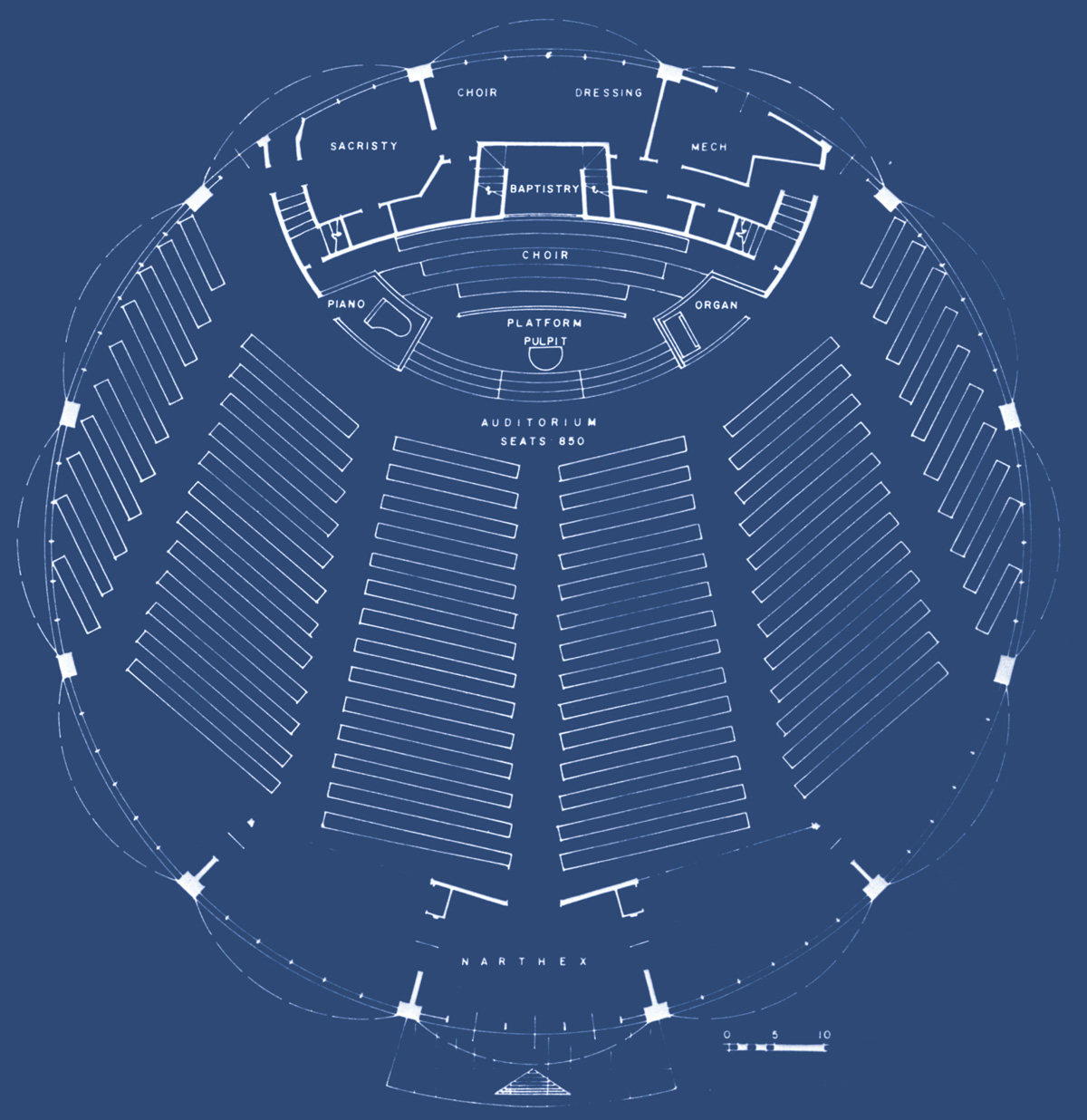
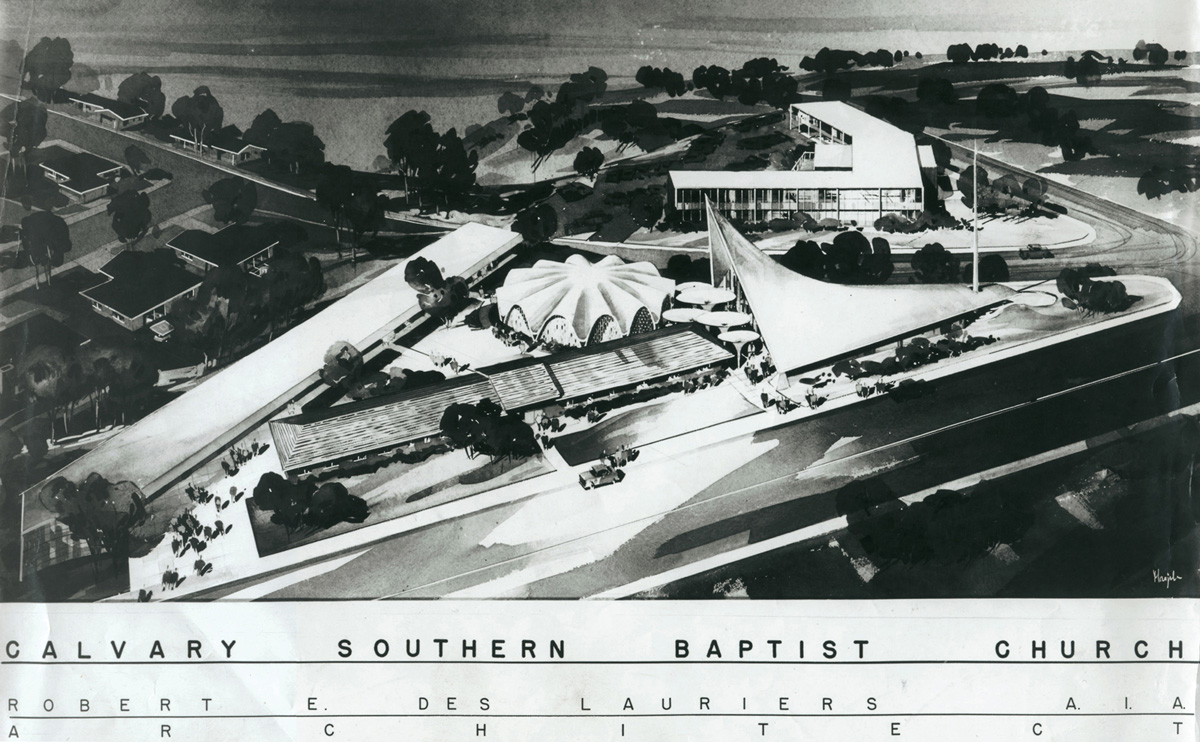
Des Lauriers made a name for himself as the architect of more than sixty strikingly modernist churches throughout Southern California, all but a few in San Diego county. His flirtations with the aesthetic reached their apogee in the Carlton Hills Lutheran Church in San Diego’s Santee suburb, a Jetsonian traffic-stopper whose “flying effects” (his words) exploit the hyperbolic paraboloid. For inspiration, he drew on the Mexican modernist Felix Candela (from whom he borrowed the paraboloid), Le Corbusier, Wright, and his own deeply felt Christian faith.
Of course, he recalls, “everybody was thinking of doing space things” in the late sixties and early seventies.[15] For the First Assembly of God church in the San Diego suburb of Mission Hills, Des Lauriers crossed the Spanish contemporary aesthetic with an “aeronautical design,” based on “the trajectories of rockets.” The church’s parabolic arch evoked Noah’s rainbow in visual rhetoric an aerospace culture could understand. As Des Laurier proclaimed, in a statement of aesthetic principles he wrote, “Man is looking for a soaring attitude. We [architects] can partially achieve this with our new forms. The aerospace industry can take credit for some of this thinking.” At the same time, he stressed, his was an “innovative architecture with traditional roots—Gothic, Romanesque, and Renaissance.”
Which brings us full circle, historically: With its gantry-like flying buttresses and dizzy verticality, the Gothic cathedral itself suggests a medieval premonition of the Space Age: a sacred ark, eager to be airborne. Inversely, the launch towers at Cape Canaveral were, for the Italian journalist Oriana Fallaci, “the cathedrals of an age that...has substituted technology for liturgy.”[16] And, like the Gothic cathedrals, our Cold War race to plant the flag on the moon before the Russkies did was at heart symbolic—“an act of faith and vision,” conceded Kennedy, “for we do not now know what benefits await us.”[17]
• • •
Driving through San Diego’s inland suburbs one furnace-hot August recently, on a pilgrimage to Des Lauriers’s churches, I wondered what benefits we had reaped from our lunar crusade. Inevitably, footage of Apollo 14’s Alan Shepard golfing in the moon’s Fra Mauro highlands, or Apollo 17’s Harrison Schmitt singing “I was strolling on the moon one day” in the Taurus-Littrow valley, makes boomers like me wonder: What did it all mean?
The lunar missions pushed the envelope of knowledge, though they would have pushed it far further if Schmitt hadn’t been the only scientist NASA sent up. For politicians, of course, the benefits of the space program were clear: JFK’s stirring declaration, “We choose to go to the moon in this decade and do the other things, not because they are easy, but because they are hard,” covered the dashing young president in moondust and glory—and facilitated his political resurrection, after the embarrassment of Sputnik and the Bay of Pigs.[18]
For the rest of us, the moonshots were sacred events, robed in religious rhetoric: In the seconds before Apollo 11 lifted off, an expectant Norman Mailer realized that he “was like a penitent who had prayed in the wilderness for sixteen days, and was now expecting a sign.”[19] Then, his prayers were answered: “White as the shrine of Madonna in half the churches of the world, this slim angelic mysterious ship of stages rose without sound out of its incarnation of flame and began to ascend slowly into the sky...”[20]
These days, the Kennedy Space Center at Cape Canaveral is a shrine to fading glories. In Rocket Dreams: How the Space Age Shaped Our Vision of a World Beyond, the cultural critic Marina Benjamin describes the Atlas, Titan, Gemini, and Redstone missiles at the KSC Visitor Complex’s “Rocket Garden” as “so lackluster, so tired, they speak only of yesterday. And yesterday is where the Space Center and its surrounding attractions are for the most part stuck, caught up in a loop of reminiscence for Apollo.”[21] Despite the overly insistent title of the Center’s IMAX movie The Dream is Alive, NASA is the Vatican of the Space Age, reverently preserving the sanctified fragments of futures past. (Not for nothing does the KSC website proudly announce that “NASA’s Lunar Sample Laboratory Facility is home to the most cherished...relics of the Apollo program.”[22])
True, NASA continues to launch satellites and unmanned missions, while the International Space Station and Space Shuttle programs limp along. In 2004, George W. Bush had a Buzz Lightyear moment: Delivering an uplifting homily that sounded, at times, like a reading from the Book of von Braun, the president dreamed aloud of a $15 billion “Crew Exploration Vehicle,” a lunar base, and sometime after 2020, a manned mission to Mars. To infinity—and beyond!
But building popular support for the megabillion-dollar program will be an even tougher sell, in a country bled white by Operation Iraqi Freedom, than it was during the Vietnam war. After the horror of the Challenger and Columbia disasters, not to mention more laughable pratfalls, such as the 1999 screw-up that sent the $125 million Mars Climate Orbiter kamikaze-ing into the red planet (NASA had failed to convert English measures to metric values), much of the nation seems convinced that boldly going where no man has gone before just isn’t worth it.
Their redwood beams dried and cracking after decades of rocket summers, Des Lauriers’s sixties and seventies churches reminded me of J. G. Ballard’s elegies for yesterday’s tomorrows. The stories in Memories of the Space Age are set in a melancholy future where dead astronauts circle the Earth, entombed in their lost capsules, and Cape Canaveral lies abandoned, “its gantries rising from the deserted dunes.”[23]
Sand has come in across the Banana River, filling the creeks and turning the old space complex into a wilderness of swamps and broken concrete. [...] Beyond Cocoa Beach, where I stopped the car, the ruined motels were half hidden in the saw grass. The launching towers rose into the evening air like the rusting ciphers of some forgotten algebra of the sky.
At the dawn of the twenty-first century, we inhabit Ballard’s metaphor. The Space Age is ancient history. Why not admit, then, that its greatest contribution to American culture is the rich fund of symbolism it has given us? The twentieth century’s greatest myth, space exploration is the only truly new religion since the Bronze Age. Christianity gave us the unforgettable fable of the alien messiah who touched down on planet Earth, assumed human form, sacrificed himself in order to save the species, then rose from the dead and returned to the stars.
The Space Age offers a new cosmology, better suited to our age of technological wonder and terror, scientific miracles and monsters. NASA has given us martyrs, saints, and icons, proof positive that there are more things in heaven and earth than were dreamt of in our old-time religion: Gemini 4’s spacewalking Edward White, savoring the sheer ecstasy of unfettered freedom as he tumbles weightlessly over the Gulf of Mexico at 17,500 miles per hour. Bootprints in lunar soil, like traces of the last human on some post-apocalyptic beach—prints that will likely remain sharply etched for a million years or more. A snapshot of Apollo 16 astronaut Charlie Duke’s family in their Houston backyard, left by Duke on the sands of the moon’s Descartes Highlands—an image of almost unbearable loneliness. And, at the other end of the emotional scale, the awful grandeur of a thirty-six-story Saturn V rocket, shattering gravity’s shackles in a mighty blast. “I didn’t think my heart could take it,” said one observer. “It was such an intense experience. I felt it in every bone in my body. It was an exalted feeling.”[24] The image of technological transcendence par excellence, a Saturn V blasting off was the twentieth-century version of Burke’s sublime, with 7.5 million pounds of thrust.
Space exploration has taught us new parables, too, most hauntingly Charlie Duke’s dream, six months before he went to the moon:
In my dream, we were driving the [lunar] rover up to the [North Ray crater]...It was untouched, the serenity of it, had a pristine purity about it. We crossed a hill. I felt, “Gosh, I’ve been here before!” And, uh, there was a set of tracks out in front of us, so we asked Houston if we could follow the tracks and they said yes, so we turned and followed the tracks. Within an hour or so, we found this vehicle, it looked just like the rover, with two people in it, and they looked like me and John [Young]. They’d been there for thousands of years. It was not a nightmare-type situation, nothing like that. It was probably one of the most real experiences in my life.[25]
Duke’s dream felt so premonitory that he found himself scanning the North Ray crater for tire tracks as he descended onto the moon in the lunar module Orion. Perhaps it was a prophetic glimpse of the end of the Space Age—a moment symbolized by a pair of ancient astronauts, on the highlands of the moon, waiting for a future that will never come.
See press about “In Search of Ancient Astronauts: A Requiem for the Space Age” in the Utne Reader.
- Ray Bradbury, The Martian Chronicles (New York: Bantam Books, 1979), p. 1.
- Ibid.
- D. J. Waldie, Holy Land: A Suburban Memoir (New York: W. W. Norton & Company, 1996), p. 163.
- Gerald A. Shepherd, “When the Lone Eagle Returned to San Diego,” The Journal of San Diego History, vol. 40, no. 1 and 2, (Winter 1994). Available at
. [link defunct—Eds.]. - See “John J. Montgomery (1858–1911)” in the “San Diego biographies” section of the San Diego Historical Society website, www.sandiegohistory.org/bio/montgomery/montgomery.htm [link defunct—Eds.]. See, also, “John Montgomery,” online historical resources of the University of San Diego, history.sandiego.edu/gen/local/montgomery.html [link defunct—Eds.].
- Quoted in John Sisson, “Dreams of Space,” sun3.lib.uci.edu/%7Ejsisson/john.htm [link defunct—Eds.].
- Mae and Ira Freeman, You Will Go to the Moon (1959 edition), sun3.lib.uci.edu/%7Ejsisson/youmoon.htm [link defunct—Eds.].
- David West Reynolds, Apollo: The Epic Journey to the Moon (San Diego: Harcourt, Inc./Tehabi Books, 2002), p. 246.
- Marina Benjamin, Rocket Dreams: How the Space Age Shaped Our Vision of a World Beyond (New York: Free Press, 2003), p. 57.
- Andrew Chaikin, A Man on the Moon: The Voyages of the Apollo Astronauts (New York: Viking, 1994), p. 231.
- “a staggering $24 billion”: David E. Nye, American Technological Sublime (Cambridge, MA: MIT Press, 1994), p. 250.
- Eugene Cernan with Don Davis, The Last Man on the Moon (New York: St. Martin’s Press, 1999), p. 340.
- Peter N. Carroll, It Seemed Like Nothing Happened: America in the 1970s (New Brunswick, NJ: Rutgers University Press, 1982), p. 301.
- Quoted in Benjamin, Rocket Dreams, ibid., p. 51.
- All Des Lauriers quotes from an interview with the author, August 2004.
- Quoted in Benjamin, p. 12.
- Ibid.
- Ibid.
- Norman Mailer, Of a Fire on the Moon (London: Weidenfeld and Nicholson, 1970), pp. 79–81, 180.
- Ibid.
- Benjamin, p. 12.
- NASA/Kennedy Space Center website, “Multimedia Gallery,” mediaarchive.ksc.nasa.gov/detail.cfm?mediaid=23550. Italics mine.
- J. G. Ballard, “The Dead Astronaut” in Memories of the Space Age, ibid., p. 67.
- Quoted in Nye, p. 239.
- Interview with Charlie Duke, For All Mankind (National Geographic video, 1992). Chaikin gives an expanded version of Duke’s dream in A Man on the Moon, pp. 485–486.
Mark Dery is a cultural critic. The author of Escape Velocity: Cyberculture at the End of the Century (Grove press, 1997) and The Pyrotechnic Insanitarium: American Culture on the Brink (Grove press, 1999), he is at work on “Don Henley Must Die,” a series of essays on the cultural psyche of Southern California, specifically the badlands and borderlands of San Diego, where he grew up. He teaches at New York University in the Department of Journalism.
Spotted an error? Email us at corrections at cabinetmagazine dot org.
If you’ve enjoyed the free articles that we offer on our site, please consider subscribing to our nonprofit magazine, which includes unlimited access to all our archives.