


New Foundlands
How many countries are there in the world?
George Pendle
On 21 June 1972, the world’s heaviest monarch, King Taufa’ahau Tupou IV of Tonga, accompanied by members of the Tonga Defense Force, a convict work detail and a four-piece brass band, set sail from his archipelago kingdom aboard the royal yacht Olovaba. On the king’s stately mind was one thought—the invasion of the Republic of Minerva, located 270 miles to the west of his country’s capital, Nuku’alofa.
The Republic of Minerva had done little to warrant the four-hundred-pound sovereign’s considerable wrath. It lay outside of Tongan territorial waters; it had been in existence for less than six months and, other than crustaceans and limpets, it had no inhabitants. Indeed, seeing as the Republic was situated upon the hazardous Minerva reefs, whose surface was completely submerged at high tide, it hardly seemed conducive to sustaining any human population whatsoever.
Yet the Republic was not entirely lacking the impress of humanity. Some of the reefs had been piled high with sand, and a small stone platform jutted through the waves. From this edifice flew the flag of the Republic of Minerva—a white torch on a blue background—clearly signaling dominion over the amphibious territory. But while this lone construction had survived the attentions of the tides, it could not hold out against the attentions of its new visitors. As the brass band played the Tongan national anthem (rough translation: “Hear our prayer, for though unseen / We know that Thou hast blessed our land. / Grant our earnest supplication, / and save Tupou our King”), King Tupou himself tore the scurrilous flag down and read a proclamation of sovereignty over the reefs. Within a few hours the platform had been dismantled, and the Republic of Minerva had been annexed without so much as a whimper.
Well, almost without a whimper. One curious footnote to this incident states that as the convict work detail set about removing all trace of Minerva from existence, a fight broke out between two of its members. By the time it could be stopped, one man lay slain on the reef. So it was that when the Tongan forces finally sailed for home, back to their presidential palace and prison cells, they left the former Minervan Republic with the remarkable statistic of having a murder rate higher than that of its population.
• • •
How many countries are there in the world? The question is not as simple as it seems. The United Nations claims 191 members; the United States Department of State supposes 192 independent countries, while the CIA World Factbook spreads its net even further by suggesting 268 nations, dependent areas, and other entities. But leaving aside whether territories or colonies such as Puerto Rico or Bermuda should be included (not to mention the political status of such “non-countries” as Palestine, Tibet, and Taiwan) there are a vast number of claims from other, less well-known nations asserting their independent status.
Call them micronations, model countries, ephemeral states, or new country projects, the world is surprisingly full of entities that display all the trappings of established independent states, yet garner none of the respect. The Republic of Counani, Furstentum Castellania, Palmyra, the Hutt River Province, and the Empire of Randania may sound fantastical, but they are a far cry from authorial inventions, like C. S. Lewis’s Narnia or Swift’s Laputa. For while uncertain territories like the Realm of Redonda might not be locatable in your atlas, they do claim a genuine existence in reality, maintaining geographical boundaries, flaunting governmental structures, and displaying the ultimate necessity for any new nation: flags. Admittedly, they may be little more than loose threads on the patchwork of nations, but these micronations offer their founders a much sought-after prize—sovereignty.
Such idiosyncratic nation-building can trace its roots to the early nineteenth century, when even the mightiest empire had yet to consolidate its grip on the more far-flung regions of the world. The swampland of the Mosquito Coast was just such an untouched area, and it was here that the Scottish adventurer Gregor MacGregor decided to found his new kingdom—the Territory of Poyais. The Scot might never have been heard from again had he chosen to live out his life in his small and inhospitable nation, but MacGregor was keen to transmute sovereignty into sovereigns.
Granting himself the title “His Highness Gregor, Cazique of Poyais,” MacGregor traveled to Britain in 1821 and was received with all the hoopla that accompanies a visiting head of state. With the aid of a fictitious guidebook and hundreds of doctored maps, he proceeded to amaze the general public with tales of Poyais’s European-style capital city and enlightened government (for a fuller appreciation of the scam, read David Sinclair’s The Land That Never Was). Poyais land offices were set up in London, Edinburgh, and Glasgow, and he even managed to charm the London Stock exchange into advancing him a £200,000 loan for investment in the new state.
The hoax was exposed only when 250 Scottish investors who had been won over by tales of the bucolic and resource-rich country chartered a boat to take them to Poyais. They were greeted by the untamed jungle. Those who tried to eke out a living on the inhospitable coast swiftly died from disease. Others managed to escape to more temperate climes. MacGregor, however, grew rich from the scheme and lived out the rest of his days in Venezuela where, upon his death, he was accorded a state funeral fit for a monarch.
The Territory of Poyais displayed many of the themes that would appear in micronations for the next century and a half: Firstly, that the love of money is usually a significant incentive in a micronation’s foundation. Secondly, that a micro-nation’s founders will always bestow upon themselves thoroughly dramatic titles. Thirdly, that since all the world’s good spots have been taken, micronations are usually gifted with dire and hazardous geography. And finally, should any other country inquire into the status of a micronation, it is liable to collapse.
For example, take the Republic of Indian Stream, a self-declared republic in North America that existed from 1832 to 1835. An ambiguous border treaty between Britain and the US had created a five-hundred-square-mile legal loophole between Canada and the state of New Hampshire. Three hundred enterprising American citizens, all hoping to avoid federal taxes, quickly established a government and constitution and declared Indian Stream a sovereign state. The Republic went unchallenged, but when one of its members was arrested for unpaid debts and taken to serve time in a debtors’ prison in Canada, the Republic of Indian Stream swiftly planned a counterstrike. Crossing the border into Canada, they shot up a local judge’s house, broke their fellow “Streamer” out of prison, and returned triumphantly home. This bravado did not last for long. By the next morning, doubts about the attack were mustering; British retaliation was feared, and before long the Republic voted to be annexed by the New Hampshire militia. Indian Stream was soon incorporated into the state, where its libertarian longing would continue to be nurtured for years to come.
There have, of course, been some exceptions to the avaricious underpinnings of micronations. In 1860 a French lawyer named Orelie-Antoine de Tounens traveled to South America to live among the Mapuche Indians. Horrified by their treatment at the hands of the Chilean and Argentine authorities, de Tounens argued that the Mapuche’s lands did not automatically belong to either Chile or Argentina. With the apparent consent of his Indian hosts, he immediately declared himself King Orelie-Antonie of the Kingdom of Araucania and Patagonia, wrote a national hymn, designed a flag, and posted notices in the Chilean newspapers telling of the foundation of the new Araucanian kingdom. Despite his best efforts, he was roundly ignored.
In an effort to be taken seriously, de Tounens began to formulate plans for the Mapuche to attack the Chilean army. However, before he could send his subjects into glorious combat, he was betrayed to the Chilean authorities, declared insane, and deported. He would return to his realm on numerous occasions over the following years, traveling under false identities and bringing arms and ammunition to aid the Indians in their struggle. Each time, he would be captured or turned over to the authorities. He eventually died in France in 1878, penniless and thousands of miles from his kingdom. (The Kingdom of Araucania and Patagonia was briefly revived in the 1880s, when it was claimed as a real country in an import/export scam perpetrated in Morocco. Thus, despite de Tounen’s idealism, his country never totally escaped the micropatrological lust for money.)
Micronations rose and fell over the next sixty years. But by 1945, it seemed as if the consolidation of boundaries following the two world wars would somewhat stem their growth. Occasional micronations were still being formed, but they seemed a little more frivolous than those of the previous century. In 1948, the Principality of Outer Baldonia was founded on a four-acre rocky island sixteen miles off the coast of Nova Scotia by Russell Arundel, self-proclaimed “Prince of Princes” and president of the Pepsi-Cola Bottling Company. With its governmental charter and sixty-nine admirals of the Baldonian Navy (fishermen who harvested tuna in the surrounding ocean), Outer Baldonia bore all the hallmarks of what would become an increasingly common type of micronation—the whimsical state. Its governmental charter insisted that citizens swear, drink, and lie about the size of fish they had caught, yet Outer Baldonia showed that even a joke country could punch above its weight when Arundel declared war on the Soviet Union. It took some time for this news to reach the USSR—diplomatic channels had yet to be formed between the two nations—but when it did, a coruscating article in a state-controlled Soviet publication condemned Baldonia’s war-mad “fuehrer” and declared that Outer Baldonia’s constitution had the aim of “turning his subjects into savages.”
It was not until the 1960s and 1970s that a true renaissance of the ephemeral state took place. As Erwin Strauss recounts in his seminal How To Start Your Own Country, these seemed inspired most dramatically by the writings of Ayn Rand. The nineteenth-century adventurer had transformed into the twentieth-century libertarian. Filled with the prickly passion of libertarianism, many of these new nation-builders seemed edgier and more fanatical than their predecessors, as if the ever-increasing spread of legitimate nations had made their quest all the more desperate. Although charlatans, jokers, and a few idealists could still be found setting up new nations, they were now joined by survivalists and neo-Nazis wanting to start their own countries (such as Aryana and the Aryan Nation). Many of this new breed were thinking of more rigorous ways to ensure their sovereign rights.
One of the major problems in founding a new country, second only to being ignored, is the threat of invasion by a more legitimate nation. As a result, when a group of Ayn Rand disciples tried, in 1969, to set up a new country named Oceana, defense of the realm was paramount. Even though the exact location for Oceana had not been definitely fixed, boot camps were organized for all those who wanted to live there. Most ominously of all, plans were made to steal a nuclear missile, the ultimate deterrent should another country come knocking on their door. Fortunately, the group was disorganized and lacking in funds, and when the ringleaders decided to rob a bar to fund their project, the hapless group was promptly arrested and their startling story discovered.
Perhaps the most persistent character to emerge from this era of ephemeral states is Michael J. Oliver. A concentration camp survivor, coin dealer, and land developer, Oliver wrote the treatise A New Constitution for a New Country (1968) in which he created a model constitution for a nation whose extremely limited government could be financed voluntarily. Along with his sinister-sounding group, the Phoenix Foundation—whose members included John Hospers, the Libertarian Party’s first presidential candidate—Oliver would spend the next decade in an emphatic quest for his tax-free independent state.
It was Oliver who, in 1972, had hired a dredging ship to deliver tons of sand to the Minerva reefs as part of a plan to build a resort there named Sea City. Before the Tongan intervention, he had hoped that Minerva would one day attract a population of thirty thousand, who would have “no taxation, welfare, subsidies, or any form of economic interventionism.” A few years after the Minervan debacle, Oliver was at it again, this time aiding separatist movements on both the Bahamian island of Abac and the South Pacific Island of Vanuatu, in the hopes that the new governments would be sympathetic to his libertarian cause. But Oliver had overreached himself. Despite having provided financial support to 800 separatists on Vanuatu, his revolt was quickly crushed by the arrival of troops from Australia and Papua New Guinea. Oliver denied any wrongdoing, but by now the Phoenix Foundation had caught the eye of the FBI. With charges threatened against him for violating the Logan Act, which prohibits private citizens from interfering in US relations with foreign powers, the Phoenix Foundation slowly melted away. Oliver, unfortunately for those interested in his monomaniacal quest, has not been heard from since.
• • •
The United States Office of the Geographer stresses that five factors are needed to become a country: space, population, economic activity, government structure, and recognition from other countries. Of these, it is the last that has always been the hardest to attain. However, one micronation has perhaps come closer to fulfilling these requirements than any other. Founded by a former “pirate” radio operator, Paddy Roy Bates, Sealand is situated on an abandoned World War II anti-aircraft tower seven miles off the British coast. Consisting of 550 square meters of solid steel, it was declared independent by “Prince” Roy in 1967. (The country’s initial economic activity consisted largely of selling passports and minted coins—both common practices amongst modern micronations out to make a quick buck).
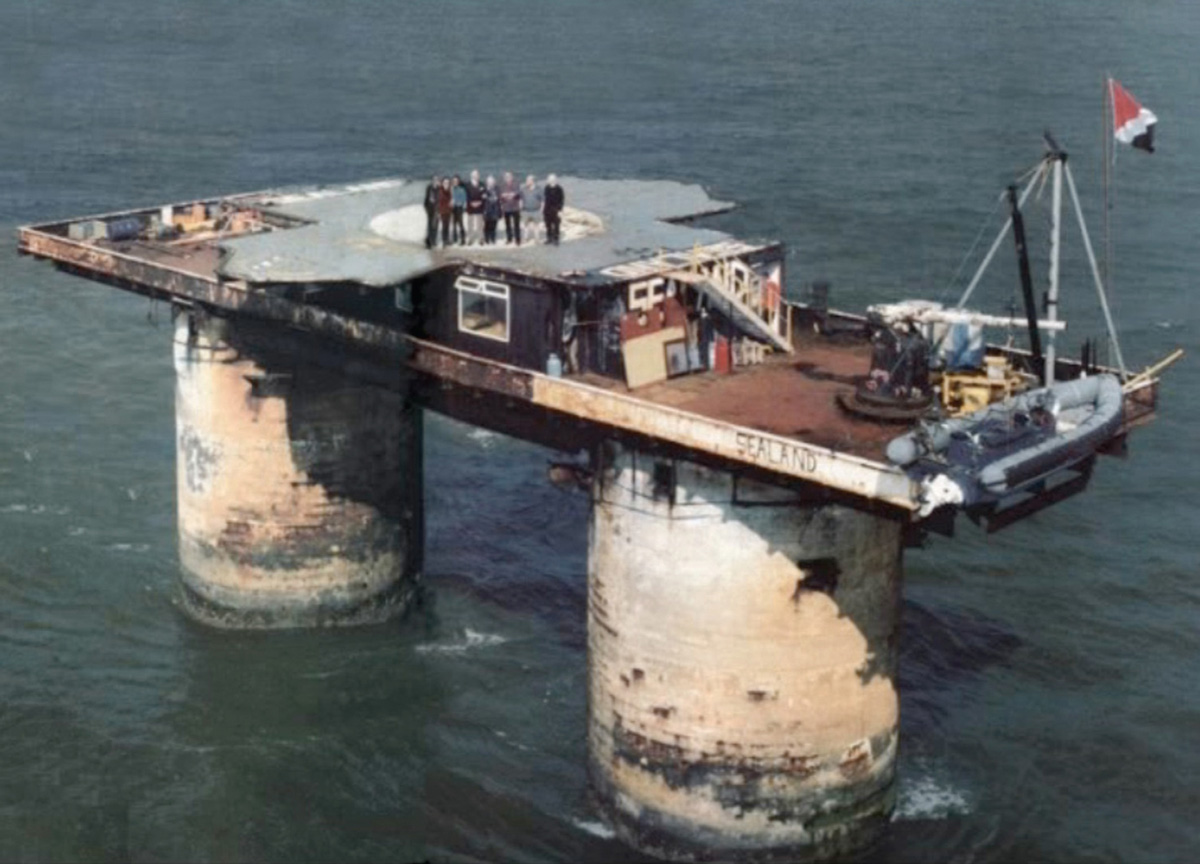
The first step in gaining international recognition came in 1968, when Roy’s son, the Prince Regent Michael, was ordered to a British court for firing his rifle at a Royal Navy vessel that had come too close to the platform (he claimed they were planning an invasion). However, the court decreed that since the incident occurred outside British territorial waters, it had no jurisdiction in the matter. The second step came in 1978, when Alexander G. Achenbach, a German professor whom Prince Roy had named as prime minister of Sealand, staged a coup d’etat and invaded the platform with the help of some Dutch heavies. A furious Prince Roy hired a helicopter and retook the platform within a day, holding his invaders captive. Although he released the Dutch miscreants, he claimed Achenbach was guilty of high treason and imprisoned him indefinitely on the island.
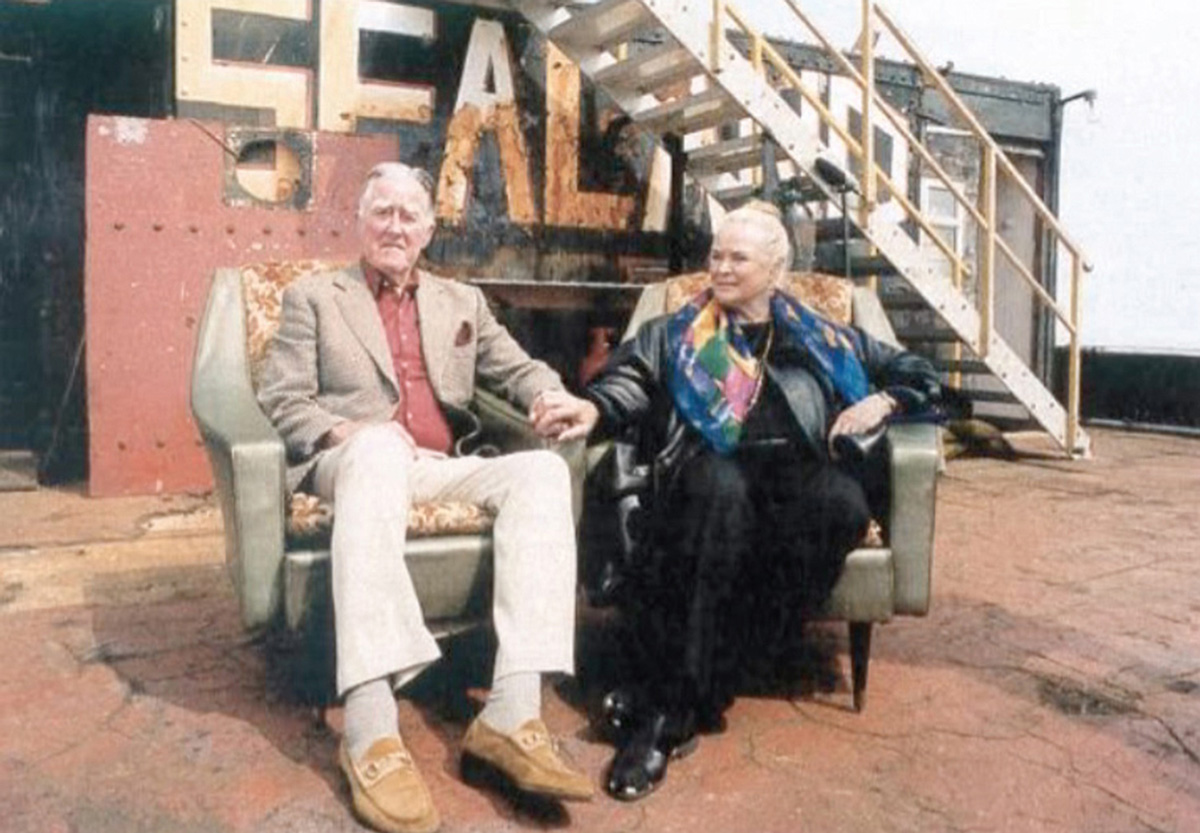
Hearing of this strange event, the German authorities petitioned the British government for Achenbach’s release. But the British government, citing the court decision of 1968, disavowed all responsibility for Prince Roy. Eventually, Germany was forced to send a diplomat to Sealand to negotiate with the monarch, allowing a delighted Prince Roy to claim that this official visit amounted to de facto recognition by the German government (the German government strongly denied this). Sealand’s status remains uncertain, but it still exists to this day. Its latest guise has it acting as an offshore data haven, hosting secure web servers that are free from all international registration requirements.
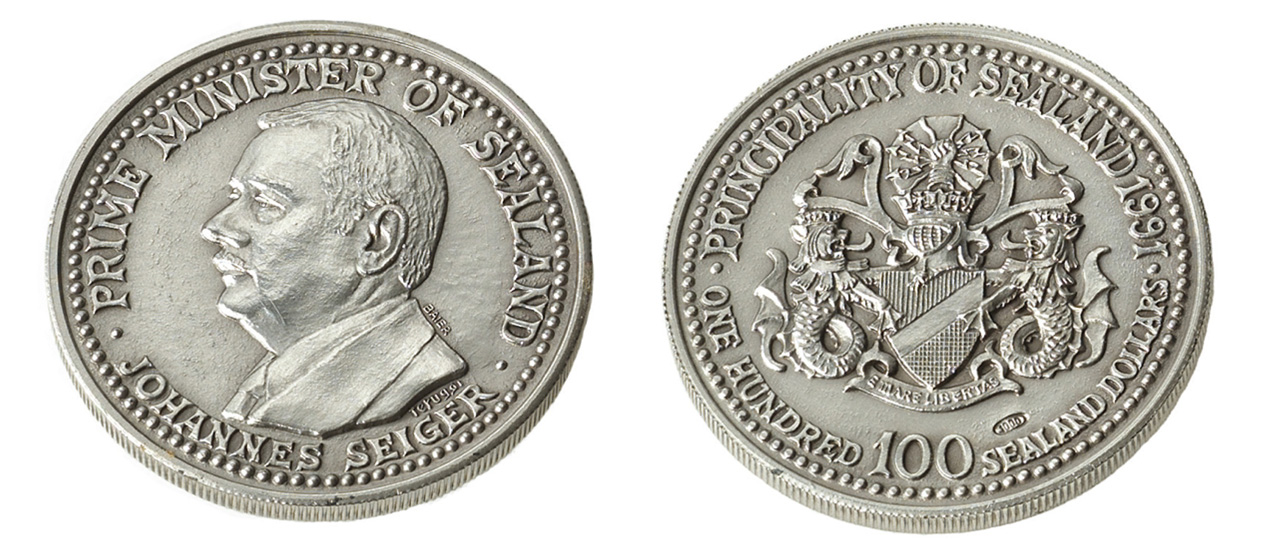
Just as Sealand now plays host to the Internet, it is the Internet that has revealed itself as the host for a whole new generation of fictional state projects. As the libertarian fetish for micronations weakens, the virtual geography of the Internet grants a modicum of affordable tangibility to new micronations, without any of the traditional perils associated with abandoned anti-aircraft platforms or disputed South Pacific atolls. The Institut Français de Micropatrologie does its best to keep track of them all, but these new micronations can be formed in little more than a day of battering at the keyboard. This new breed of countries does not try to make any actual claims on statehood, preferring instead to act as vehicles of whimsy and wonder.
Take the website for the Republic of Howland, Baker and Jarvis. It claims to comprise a group of small islands that do actually exist (they can be found about six hundred miles north of Tuvalu). Yet read the Republic’s official history and you soon find that all is not as it seems. On 2 July 1937, Amelia Earhart is reported to have landed on Howland Island on her famed around-the-world trip. However, this was the leg of Earhart’s journey on which she went missing, never to be heard from again. The founders of the Republic take this one fantastic moment as the starting point for a wonderfully convincing alternate history that shows how Earhart’s brief visit to the island led to the growth of a modern nation-state.
In comparison, the Royal Kingdom of Elgaland-Vargaland (KREV) has no pull on believability. Although it claims physical territory, it insanely suggests that this consists of all the border frontier areas between all countries on earth. In doing so, the joint kings of KREV (for even these postmodern micronations can rarely resist the traditional attraction of a royal title) seem to be taking the artist Gordon Matta-Clark’s Fake Estates project—in which Matta-Clark bought small, inaccessible, and unusable lots of land, situated between buildings—to its furthest logical extension. KREV is a country made up of the intersections between real countries, a nation of negative space—a micronation that is best to debate rather than to visit.
While these new nations rarely dare to enforce their claims to nationhood, it seems to be their unspoken hope that they will, one day, break out into the real world. In Jorge Luis Borges’s short story “Tlön, Uqbar, Orbis Tertius,” the author describes finding an entry in an encyclopedia for a country named Uqbar. No such country exists, but the author slowly comes to see it as the first indication of a massive conspiracy of intellectuals to imagine a whole new world named Tlön. Slowly but surely, the world of Tlön begins to seep into the real world, first in mentions in encyclopedias, then with the appearance of actual objects from Tlön, until the world of the narrator slowly and inexorably becomes Tlön itself. How long before a micronation makes this fateful leap into actuality?
George Pendle has written for the Times (London), the Sunday Times, the Financial Times, and Frieze. His first book, Strange Angel: The Otherworldly Life of Rocket Scientist John Whiteside Parsons, was published by Harcourt in February 2005.
Spotted an error? Email us at corrections at cabinetmagazine dot org.
If you’ve enjoyed the free articles that we offer on our site, please consider subscribing to our nonprofit magazine, which includes unlimited access to all our archives.