


Brigído Lara: Post-pre-Columbian Ceramicist
Making the old anew
Jesse Lerner
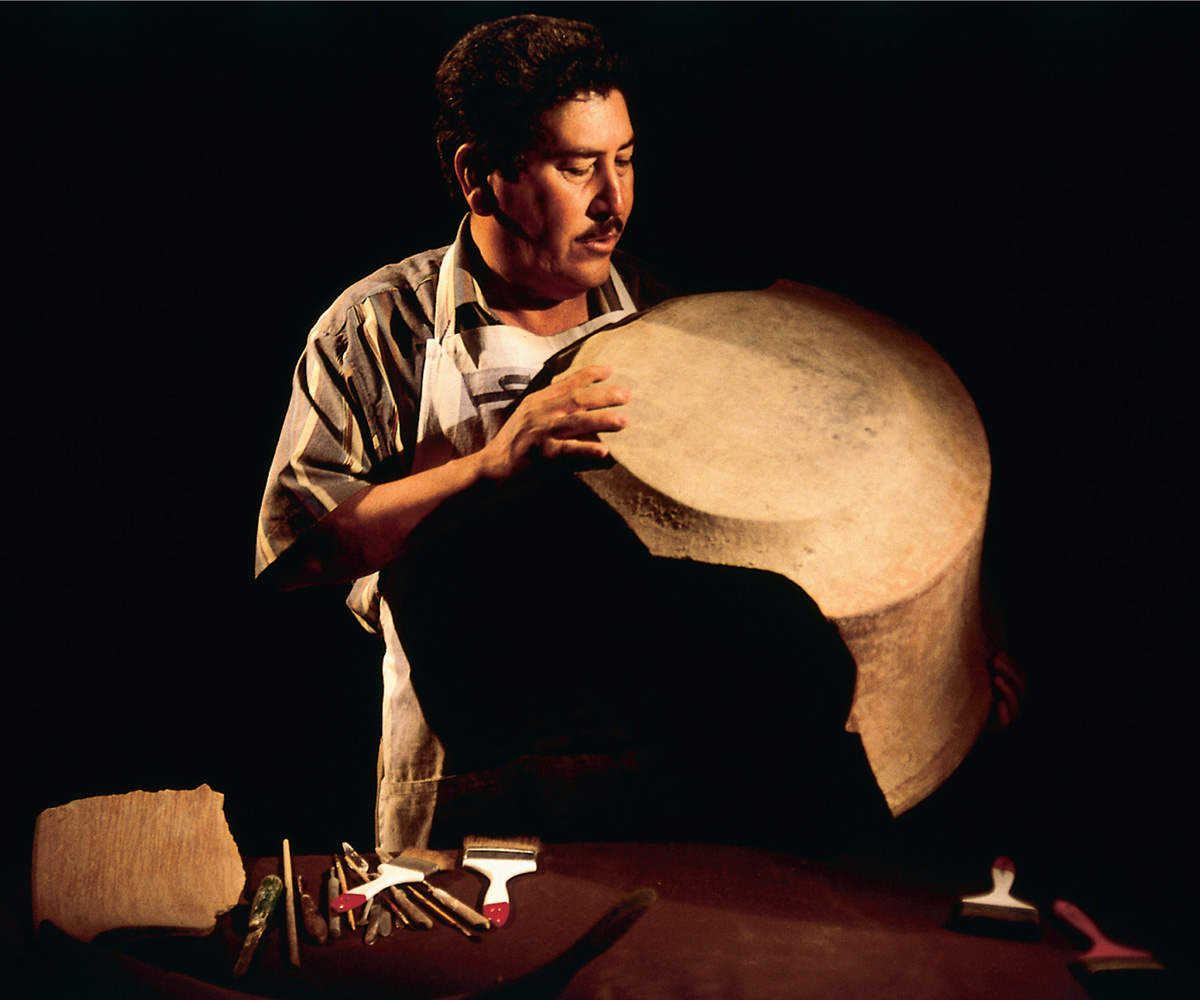
In July 1974, Mexican police arrested and imprisoned a group of individuals from the Gulf Coast State of Veracruz for the possession of a collection of what appeared to be looted Pre-Columbian ceramics. Though such objects have long been protected as national patrimony, the high prices they fetch in the auction houses and galleries of New York and Europe fuel a contraband traffic in antiquities. At the trial of the accused, archeologists from the Instituto Nacional de Antropologia e Historia (INAH) testified that the ceramics had been taken from ancient sites in the Cempoala region, in the central part of the state of Veracruz. Convicted largely on the basis of this testimony, the individuals were sent to prison for their role in this illegal trade in looted objects.
From his cell, one of the convicted individuals, Brigído Lara, made an unusual demand. At his request, clay was brought to the jail. From within his cell Lara then proceeded to create indisputable proof of his innocence—identical reproductions of the pieces that had sent him to jail. He was not a looter at all, it turned out, but a wrongfully accused forger, an accomplished imitator of ancient styles. For the past twenty years he had been fabricating contemporary copies of ancient ceramics. Though he worked in many styles including Aztec and Mayan, his specialty was the ceramic wares of the ancient Totonac, a population that inhabited Veracruz and flourished between the seventh and twelfth centuries A.D. The replicas were taken from the jail and once again shown to the same experts from the INAH whose testimony had led to the convictions. Once again the verdict was rendered: These too were judged to be ancient pieces from Cempoala.
Cleared of the charges of looting, Lara was released from jail in January, 1975. He was subsequently employed by the state Anthropology Museum in Xalapa, second in the country only to the National Museum in Mexico City, to restore ancient pieces and to review the collection for forgeries. Lara continues to sculpt what look like ancient objects, pieces which he prefers to call “original interpretations.” He has since been licensed as a maker of replicas by the Instituto Nacional de Antropologia e Historia, the very institution that once con-demned him as a looter, and he now signs all of his ceramics.
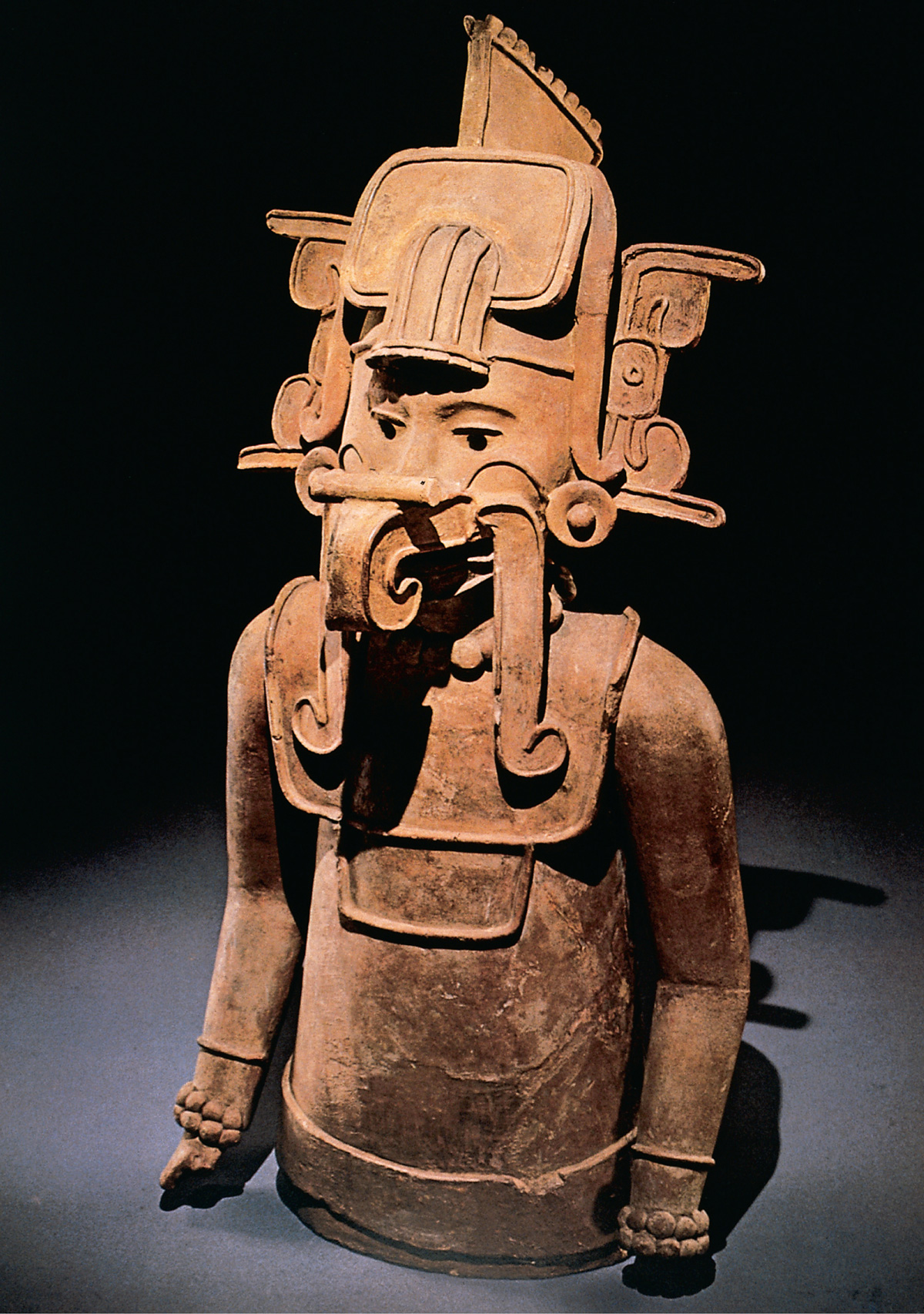
A decade after his release from jail, Lara began to learn something of the fate of the approximately 40,000 pieces he claims to have made prior to his arrest and reform. Agustín Acosta Lagunes, then governor of Veracruz, spent considerable sums over-seas in order to purchase and repatriate numerous ancient objects for a pet project, the Xalapa Anthropology Museum. After the governor returned with a number of purchases made at Sotheby’s in New York, Lara came forward with a dramatic announcement. He had made these ceramic pieces. Further investigations revealed more and more of Lara’s objects all over the world. Some had become part of prestigious international collections. The Dallas Museum of Art, the Morton May collection at the Saint Louis Art Museum, New York’s Metropolitan Museum, and important collections in France, Australia, Spain, and Belgium all contained pieces that Lara claims to have made. In fact, Lara may have been so prolific that he had a hand in shaping what is today understood as the classic Totonac style. In 1971, the Los Angeles County Museum of Natural History presented a large exhibition entitled “Ancient Art of Veracruz.” Today, it appears that at least a dozen of the objects exhibited there were made by Lara. While cautious about any expression of pride in his accomplishments, Lara is equally uncomfortable with the designation “forgeries.” He prefers to think of them as his “own originals.”[1]
As remarkable as his tale is, Lara is certainly not alone in his efforts to forge ancient Mesoamerican sculptures. The elevated prices these objects fetch, the availability of the raw materials, and Mexico’s relative poverty all fuel the black market trade in forged antiquities. The business is veiled in secrecy, for obvious reasons, but the history of forgery seems to be long and complex. The trade has been traced back to colonial times. Some have speculated that during the Conquest artisans sought to preserve older religious objects by providing the Spaniards with an unending supply of forgeries to destroy. This dynamic changed when Mexico gained its independence from Spain, but the cottage industry continued to flourish, spurred by new developments. One such development is noted in an 1886 article in the magazine Science, in which William Henry Holmes links the arrival of the railroad to the burgeoning market in ancient objects of dubious authenticity:
It is very easy for the native artisan to imitate any of the older forms of ware; and there is no doubt that in many cases he has done so for the purposes of deceiving. A renewed impetus has been given to this fraudulent practice by the influx of tourists consequent upon the completion of numerous railways.[2]
Another development that fostered forgery was photography. The late 19th century was a time in which the circulation of photographs and other accurate likenesses of authentic Pre-Columbian objects was relatively limited. In spite of archeology’s central role in nineteenth century Mexican photography (Desire Charnay, Frederick Catherwood, and the LePlongeons are protagonists in both of these histories), distorted reproductions were common-place. Guillermo Dupaix, Luciano Castañeda, Frédéric de Waldeck, and the other travelers and adventurers published their impressions of the Pre-Columbian ruins, often accompanying these texts with fanciful images bearing little resemblance to anything Mesoamerican. It is likely that these contributed to the proclivity to manufacture bad fakes, objects singularly unconvincing. Notorious among these is the sculpture known as the “Dying Aztec,” which looks less like a Mexica object than a mediocre knock-off of a Frederic Remington sculpture. That these kinds of egregious distortions were understood and exhibited as authentic objects suggests that Westerners could not grasp the Pre-Columbian æsthetic. Its rules and conventions utterly alien to anything with European traditions, the Mesoamerican æsthetic clearly escaped the anonymous craftsman responsible for the “Dying Aztec,” just as it escaped the illustrated magazines that produced such distorted reproductions.
The contrast with Lara’s work could not be more dramatic. Not only do his ceramics achieve an æsthetic level that, according to Lara, at least, leads some collectors to prefer them to authentic objects, but they are also unusually credible, to the extent that some of his claims have been questioned. Corroborating Lara’s claims of authorship has proven no simple matter. The Metropolitan Museum’s Michael C. Rockefeller Memorial Collection of Art of Africa, Oceania, and the Americas possesses a spectacular, three-foot tall hollow ceramic figure of Ehecatl, the Mesoamerican wind god. Fluoroluminescence and other laboratory tests attempting to date the artifact have yielded ambiguous results, and expert assessments of the object based on style achieve no consensus. Lara, who has never been to New York, knows a great deal about the piece and its construction, enough to suggest that at the very least he was witness to its manufacture. But other details seem to contradict this conclusion. Before being donated to the Metropolitan, the object was exhibited in New York’s now-defunct Museum of Primitive Art. Before that, it was part of Nelson Rockefeller’s private collection. When Rockefeller purchased the object Lara was eight years old. It does not look like the work of an eight-year-old. When pressed for details, Lara explains that he made the Ehecatl figure “many years ago.” Could Lara have been the apprentice to an older, master forger, making him the latest, most notorious representative of a tradition of later-day Totonac ceramicists? Lara emphatically denies this, claiming to be an autodidact. His training was in the fields as a child in Loma Bonita, Oaxaca, and Mixtequilla, Veracruz, where he grew up—areas rich in archeological artifacts. He would study the fragments of ancient objects that peasant farmers would turn up while plowing their fields. From these he would extrapolate the form of the entire object. Meanwhile the Metropolitan Muse-um has taken the piece off display. Whether the Met’s Ehecatl is a fake fake, that is, an authentic object falsely labeled as a forgery, remains an open question.
Lara’s success points to certain weaknesses within the archeological establishment, which has paid a great deal of attention to iconography and the identification of divinities and royalty. Only relatively recently has it started to examine the raw materials used to create the objects. Lara’s expertise lies precisely in this area. In his studio is a vast assortment of clays from the region, each with a different hue and set of characteristics, and each serving diverse functions in the forger’s repertoire. Archeologists know more about the worldview that the objects give us access to than Lara does. Not being an eleventh century Totonac, he does not know which elements are associated with which gods. One can imagine that if a member of that ancient culture had a chance to evaluate Lara’s creations, they would have rejected them, just as William Henry Holmes dismisses some of the more inept forgeries he encounters: “compositions made up of unrelated parts (derived, maybe, from ancient art), and thrown together without rhyme or reason.”[3] To the extent that archeologists have used his objects to draw inferences about the ancient world, Lara is guilty of adding misleading data to the pool of available evidence. The degree to which Lara’s creations have been disseminated make it difficult to share Holmes’s assuredness when he writes: “Doubtless in time most of the spurious objects will be detected and thrown out.”[4]
In 1910, Leopoldo Batres published his Antiquedades Mejicanas Falsificadas: Falsificacion y Falsificadores, the first book-length study of forgery in Mexican antiques. The book presents reproductions of numerous objects of dubious authenticity, supporting Batres’s claim that certain celebrated objects are inauthentic. It also offers an eyewitness account of a work-shop of forgers located near the pyramids of Teotihuacan.[5] Batres’s depiction of the forger is an unflattering one, typically as both a victim of unscrupulous middlemen and an alcoholic “who spends his time in taverns.”[6]
Though information on the subject is scarce, Batres’s evident contempt is consistent with most accounts of forgers and their motivations. Almost without exception, the most celebrated and accomplished forgers of the twentieth century—Lara’s peers—are depicted as despicable people. Cleared of accusations of collaborating with the Nazis, Hans Van Meegeren has nevertheless gone down in history as a resentful failure, stung by the critical rejection of his own mediocre paintings, kitschy oils of fawns and overblown allegorical scenes exhibited under his own name in his youth. More recently, John Myatt, forger of Picassos, Matisses, and Giacomettis, is invariably portrayed as a hapless loser, manipulated and bullied by his own collaborator, the more intelligent and conniving John Drewe. Lara, however, does not fit this profile. An affable, modest man from a poor rural area, he expresses a sincere admiration for the Pre-Columbian cultures that he mimics, and regrets not having lived in those times. No longer beholden to the imposed vow of silence of the forger, he signs all of his “original interpretations,” and is insistent on his authorship. This points to the dilemma of the forger, for whom the greatest success implies anonymity, the reverse of the experience of any other artist. Perhaps, before his arrest, Lara craved the recognition that could only come at the price of exposure. If this is so, then the upshot must be a disappointment. Re-categorized as contemporary replicas, the market value of his creations has plummeted, and rather than exhibiting in the Metropolitan, he now shows at events like the Veracruz State Fair. In art world terms, this is an unquestionable step down, though the objects he created have not changed. The question we may ask here is the following: do the authentic Totonac objects express a worldview now otherwise lost to us, while Lara’s only mimic this worldview? Are Lara’s not an equally authentic expression of what Hillel Schwartz calls “the culture of the copy”?[7]
Though he makes no such claims, it is tempting to view Lara’s story as some sort of a comeuppance. Looters continue to carve up archeological ruins, raid tombs, and ship off the spoils for sale on foreign markets. Today, the black market for antiquities makes it easier for forgers to operate by discouraging collectors from inquiring into an object’s provenance. Before the institution of laws protecting national patrimony, museums, universities, and other scientific institutions engaged in these activities unhindered. Even after the institution of these protective laws, Edward H. Thompson smuggled objects from Chichen Itza to Harvard’s Peabody Museum.[8] In the light of all this, there is, it seems, a kind of poetic justice in the fact that a peasant artisan with a grammar school education seems to have fooled not only dozens of collectors, but some of the world’s leading archeologists and curators. Lara’s success does not simply call into question the expertise of the authorities, but subverts that neo-colonial project which continues to drain Latin America of its cultural heritage.
Jesse Lerner’s documentary film Ruinas contains a section on Lara. For more information, see www.ruinas.org [link defunct—Eds.].
- Interview with Brigído Lara, Xalapa, Veracruz, 31 May 1996.
- William Henry Holmes, “The Trade in Spurious Mexican Antiquities,” Science, vol. VII, no. 159, p. 170.
- Ibid., p. 172.
- Ibid., p. 170.
- Leopoldo Bartres, Antiguedades Mejicanas Falsificadas: Falsificacion y Falsificadores (Mexico, D.F.: Imprenta de Fidencio S. Soria, 1910), p. 14.
- Ibid., p. 15.
- Hillel Schwartz, The Culture of the Copy (New York: Zone Books, 1996).
- A brief account of this notorious incident is provided in Leo Deuel, Conquistadors Without Swords (New York: St. Martin’s Press, 1967), p. 268.
Jesse Lerner is a filmmaker currently working on The American Egypt, an experimental documentary about the history of the Yucatan.
Spotted an error? Email us at corrections at cabinetmagazine dot org.
If you’ve enjoyed the free articles that we offer on our site, please consider subscribing to our nonprofit magazine, which includes unlimited access to all our archives.