01.
Suppose there is a business in your neighborhood called The Cave™. It offers, for a small hourly fee, access to game consoles in a darkened room. Suppose it is part of a chain. The consoles form a local area network, and also link to other such networks elsewhere in the chain. Suppose you are a gamer in The Cave™. You test your skills against other gamers. You have played in The Cave™ since childhood. Your eyes see only the monitor before you. Your ears hear only through the headphones that encase them. Your hands clutch only the controllers with which you blast away at the digital figures who shoot back at you on the screen. Here gamers see the images and hear the sounds and say to each other: “Why, these images are just shadows! These sounds are just echoes! The real world is out there somewhere.” The existence of another, more real world of which The Cave™ provides mere copies is assumed, but nobody thinks much of it.
02.
Perhaps you are not just any gamer. You are the one who decides to investigate the assumption of another world. You turn away from the screen and unplug the headphones. You get up and stagger out of the darkened room, toward the light outside. You are so dazzled by the light that the people and things out there in the bright world seem less real than the images and sounds of The Cave™. You turn away from this blinding new world, which seems, strangely, unreal. You return to the screen and the headphones and the darkness of being a gamer in The Cave™.
03.
Suppose someone, a parent maybe, a teacher or some other guardian, drags you back out into the light and makes you stay there. It would still be blinding. You could not look directly at things. Maybe the guardian prints out some pics of your family or maybe a map of the neighborhood, to acclimate you, before you can look at things. Gradually you see the people around you, and what it is that they do. Then perhaps you remember the immense, immersive games of The Cave™, and what passes for wisdom amongst those still stuck there. And so you returns to The Cave™, to talk or text to the other gamers about this world outside.
04. You communicate to fellow gamers in The Cave™ about the outside world of which The Cave™ is just a shadow. Or try to. Plato: “And if the cave-dwellers had established, down there in the cave, certain prizes and distinctions for those who were most keen-sighted in seeing the passing shadows, and who were best able to remember what came before, and after, and simultaneously with what, thus best able to predict future appearances in the shadow-world, will our released prisoner hanker after these prizes or envy this power or honor?”
1 You bet! The Cave™ is a world of pure agon, of competitive striving after distinction. But suppose you are that rare, stray, thoughtful gamer who decides to try this new game of getting beyond the game again? Suppose you emerge from The Cave™ and decide to take stock of the world beyond? You find that this other world is in some curious ways rather like The Cave™. The pics of family, the map of the ‘hood—seem made of the same digital stuff as your favorites games inside The Cave™. If there is a difference, it may not be quite what it seems.
05.
Here is what you observe about the world outside The Cave™: the whole of life appears as a vast accumulation of commodities and spectacles, of things wrapped in images and images sold as things. Images appear as prizes, and call us to play the game in which they are all that is at stake. You observe that world after world, cave after cave, what prevails is the same digital, agonistic logic of one versus the other, ending in victory or defeat. Everything has value only when ranked against another; everyone has value only when ranked against another. Every situation is win-lose, unless it is win-win—a situation where players are free to collaborate only because they seek prizes in different games.
06. The real world appears as a fun park divided into many and varied games. Work is a rat race. Politics is a horse race. The economy is a casino. Even the utopian justice to come in the afterlife is foreclosed:
He who dies with the most toys wins. Games are no longer a pastime, outside or alongside of life. They are now the very form of life, and death, and time, itself. These games are no joke. When the screen flashes the legend “Game Over,” you are either dead, or defeated, or at best out of quarters.
07. The game has colonized its rivals within the cultural realm, from the spectacle of cinema to the simulations of television. Narrative is no longer a question of an imaginary reconciliation of real problems. The story just recounts the steps by which someone beat someone else—a real victory for imaginary stakes. The game has not just colonized reality; it is also the sole remaining ideal. Gamespace proclaims its legitimacy through victory over all rivals. The reigning ideology imagines the world as a
level playing field, upon which all men are equal before God, the great game designer. History, politics, culture—gamespace dynamites everything that is not in the game, like an out-dated Vegas casino.
08. Ever get the feeling you are playing some vast and useless game to
which you don’t know the goal, and can’t remember the rules? Ever get the fierce desire to quit, to resign, to forfeit, only to discover there’s no umpire, no referee, no regulatory body to whom to announce your capitulation? Ever get the vague dread that while you have no choice but to play the game, you can’t win it, can’t even know the score, or who keeps it? Ever suspect that you don’t even know who your real opponent might be? Ever get mad over the obvious fact that the dice are loaded, the deck stacked, the table rigged, and the fix in? Welcome to gamespace, where we cross our fingers when we roll the dice.
2

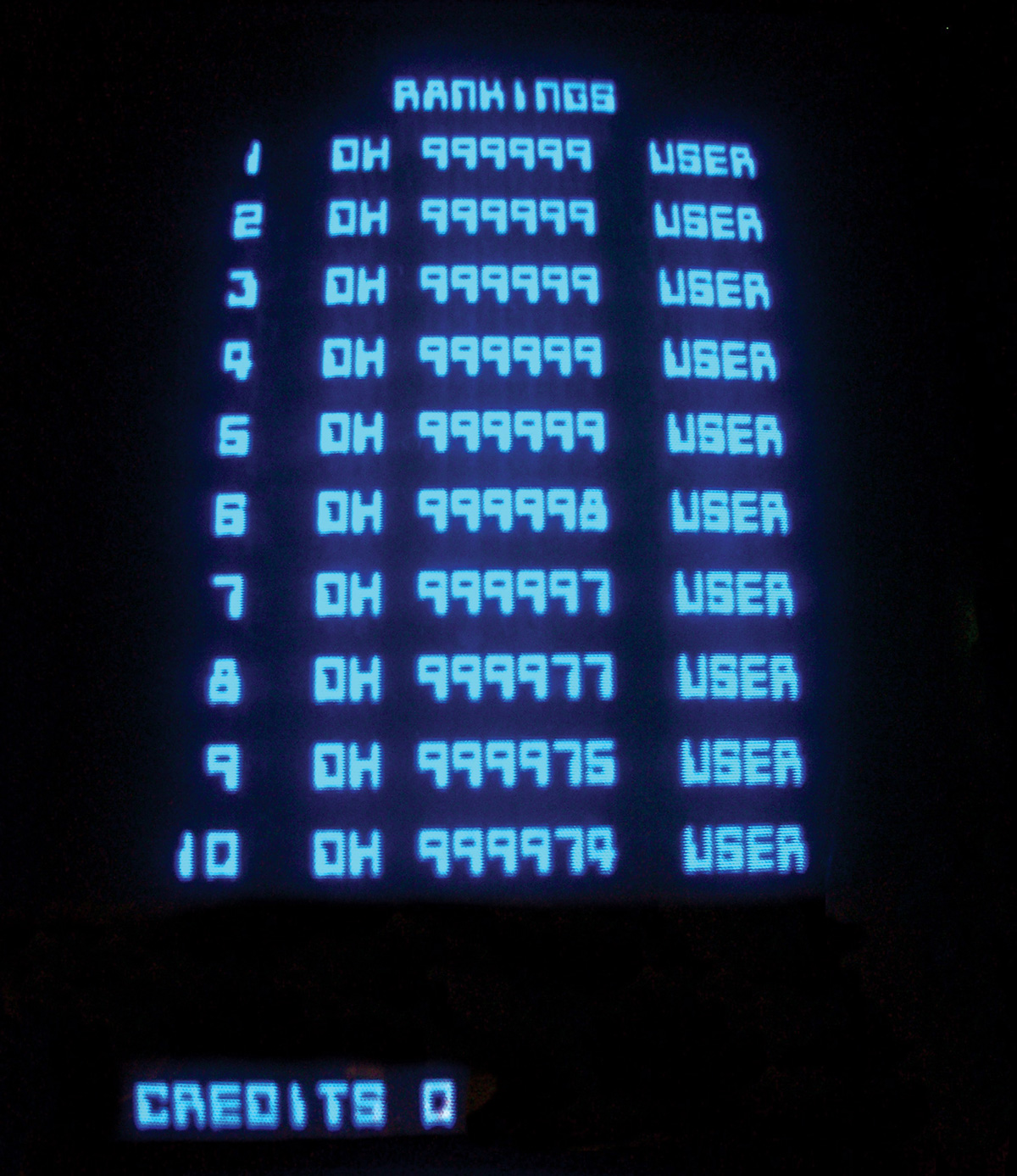
Donald Hayes’s record-breaking scores for the arcade game Tron.
Courtesy of Twin Galaxies Intergalactic Scoreboard.
09.
All that counts here is the score. As for who owns
the teams and who runs the league, best not to ask. As for who is
excluded from the big leagues and high scores, best not to ask. As for
who keeps the score and who makes the rules, best not to ask. As for
what ruling body does the handicapping and on what basis, best not to
ask. All is for the best in the best—and only—possible world. There
is—to give it a name—a military entertainment complex, and it rules. Its triumphs affirm the rule of the game and the rules of the game.
10.
Everything
the military entertainment complex touches turns to digits. Everything
is digital and yet the digital is as nothing. It just beeps and blinks
and reports itself in glowing alphanumerics, spouting stock quotes on
your cell phone. Sure, there may be vivid 3-D graphics. There may be
pie charts and bar graphs. There may be swirls and whorls of brightly
colored polygons blazing from screen to screen. But these are just
decoration. The jitter of your thumb on the button or the flicker of
your wrist on the mouse connect directly to an invisible, intangible
gamespace of pure contest, pure agon. It doesn’t matter if your
cave comes equipped with a Playstation or Bloomberg terminal. It is all
just an algorithm with enough unknowns to make a game of it.
11.
Once
games required an actual place to play them, whether on the chessboard
or the football field. Even wars had battlefields. Now global
positioning satellites grid the whole earth and put all of space and
time in play. Warfare, they say, now looks like video games. Well,
don’t kid yourself. War is a video game—for the military entertainment
complex. To them, it doesn’t matter what happens “on the ground.” The
ground—the old-fashioned battlefield itself—is just a necessary
externality to the game. Zizek: “It is thus not the fantasy of a purely
aseptic war run as a video game behind computer screens that protects
us from the reality of the face-to-face killing of another person; on
the contrary it is this fantasy of face-to-face encounter with an enemy
killed bloodily that we construct in order to escape the Real of the
depersonalized war turned into an anonymous technological operation.”3
12.
The
old class antagonisms have not gone away, but are hidden beneath levels
of rank, where each measures their worth against others in the size and
price of their house, the size and price of their vehicle, and where,
perversely, working longer and longer hours is a sign of winning the
game. Work becomes play. Work demands not just one’s mind and body but
also one’s soul. You have to be a team player. Your work has to be creative, inventive, playful—ludic, but not ludicrous.
13.
No
games are freely chosen any more. Not least for children, who if they
are to be the successful offspring of successful parents, find
themselves drafted into endless evening shifts of team sport. The
purpose of which is to build character, of course. Which character? The
character of the good sport. Character for what? For the
workplace, with its team camaraderie and peer-enforced discipline. For
others, work is still just dull, repetitive work, but the dream is to
escape into the commerce of play—to make it into the major leagues, or
compete for record deals as a diva or a playa in the rap game.
And for still others, there is only the game of survival. Biggie: “If I
wasn’t in the rap game / I’d probably have a key knee-deep in the crack
game.”4 Play becomes everything to which it was once opposed. It is work, it is serious, it is morality, it is necessity.
14.
The
old identities peter out. Nobody has the time. The gamer is not
interested in playing the citizen. The gamer elects to choose sides
only for the purpose of the game. This week it might be as the Germans
vs. the Americans. Next week it might be as a gangster against the law.
If the gamer chooses to be a soldier and play with real weapons, it is
as an Army of One, testing and refining personal skill points.
The shrill and constant patriotic noise you hear through the speakers
masks the slow erosion of any coherent fellow feeling within the
remnants of a national space. This gamespace escapes all borders. All
that is left of the nation is an everywhere that is nowhere, an atopia
of noisy, righteous victories and quiet, sinister failures. Manifest
destiny—the right to rule through virtue—gives way to its latent
destiny—the virtue of right through rule.
15.
The
gamer is not really interested in faith, although a heightened rhetoric
of faith may fill the void carved out in the soul by the insinuations
of gamespace. The gamer’s God is a game designer. He implants in
everything a hidden algorithm. Faith is a matter of the ability to
intuit the parameters of this intelligent design and score accordingly.
All that is righteous wins; all that wins is righteous. To be a loser or a lamer
is the mark of damnation. Gamers confront each other in games of skill
that reveal who has been chosen by the game as the one who has most
fully internalized its algorithm. For those who despair of their
abilities, there are games of chance, where grace reveals itself in the
roll of the dice. Caillois: “Chance is courted because hard work and
personal qualifications are powerless to bring such success about.”5 The gambler may know what the gamer’s faith refuses to countenance.
16.
To be a gamer is to live by nothing but level,
which has meaning only in relation to the levels ranked above or below.
Identity loses its qualitative dimension. Gamespace leaves its mark on
the gamer in the reduction of self to score. Questions of ethnicity,
sexuality, gender, or race, nation, tribe, or even species become
purely arbitrary. Play as whoever or whatever you like. Choose your
skin. Gamers don’t care. It’s all an agon of competing abilities, and
abilities all have their measure. It all ends in a summary decision: That’s Hot! One hopes, or if not, You’re Fired! Got questions about qualities of Being? Whatever.
17.
So
this is the world as it appears to the gamer: a matrix of endlessly
varying games, all reducible to the same principles, all producing the
same kind of subject who belongs to this gamespace in the same way—as a
gamer to a game. What would it mean to lift one’s eye from the target,
to pause on the trigger, to unclench one’s ever-clicking finger? Is it
even possible to think outside The Cave™? Perhaps with the triumph of
gamespace, what the gamer as theorist needs is to reconstruct the
deleted files on those who opposed gamespace with their revolutionary
playdates. Debord, for example, who declared: “I have scarcely begun to
make you understand that I don’t intend to play the game.”6 Now there was a player unconcerned with an exit strategy.
18.
“Play”
was once a great slogan of liberation. Neville: “The new beautiful
freaks will teach us all how to play again (and they’ll suffer
society’s penalty).”7 Play was once the battering ram to
break down the Chinese walls of alienated work, of divided labor. Only
look at what has become of play. Play is no longer a counter to work.
Play becomes work; work becomes play. Play outside of work found itself
captured by the rise of the digital game, which responds to the boredom
of the player with endless games of repetition, level after level of
difference as more of the same. Play no longer functions as a fulcrum
for a critical theory. The utopian dream of liberating play from the
game, of a pure play beyond the game, merely opened the way for the
extension of gamespace into every aspect of everyday life.
19.
What
then has the gamer seen in that bright world, that gamespace, beyond
The Cave™? You see people hunched over screens, their hands
compulsively jerking controllers. Each sits alone, and talks or texts
to unseen others, dazzled by images that seem to come from nowhere,
awash in pulsing and beeping sounds. The enlightened gamer sees how the
world beyond the games of The Cave™ seems like an array of more or less
similar caves, all digital, each an agon with its own rules, some
arbitrary blend of chance and competition. And beyond that? Not much.
The real has become a mere epiphenomenon without which gamespace cannot
exist, but which is losing, bit by bit, any form or substance or spirit
or history that is not sucked into and transformed by gamespace. Beyond
gamespace are only the nameless fragments of the real.
20.
The
gamer arrives at the beginnings of a reflective life, a gamer theory,
by stepping out of The Cave™—and returning back to it. If the gamer is
to hold gamespace to account in terms of something other than itself,
it might not be that mere shadow of a shadow of the real—murky,
formless, a residue in the corners. It might instead be the game
proper, as it is played in The Cave.™ There at least the game shadows
the pure form of the algorithm. There at least the digital logic to
which gamespace merely aspires is actually realized. The challenge
is—ah, but even to phrase it thus is to fall back into the game—to play
at play itself, but from within the game. The gamer as theorist has to
choose between two strategies for playing against gamespace. One is to
play for the real. But the real is nothing but a heap of broken images.
The other is to play for the game. Play within the game, but against
gamespace. The digital game plays up everything that gamespace merely
pretends to be: a fair fight, a level playing field, free competition.
21.
No
wonder digital games are the cultural form of the times. The times have
themselves become just a series of less perfect games. Games like those
played in The Cave™ present them in a pure state, as a realm where
justice—of a sort—reigns. The beginnings of a gamer theory might lie
not in holding games accountable as failed representations of the
world, but quite the reverse. The world outside is a gamespace that
appears as an imperfect form of the game. The gamer is an archeologist
of The Cave™. The digital games that the gamer finds there are the
ruins, not of a lost past, but of a lost future. Gamespace is built on
the ruins of a future it proclaims in theory yet disavows in practice.
22.
Of
all the kinds of belonging that contend for allegiance—as workers
against the boss, as citizens against the enemy, as believers against
the infidel—all now have to compete with one which makes agon its first
and only principle. Gamespace wants us all to believe we are nothing
but gamers now, competing not against enemies of class or faith or
nation, but only against other gamers. A new historical persona stalks
the earth. All of the previous such persona had many breviaries and
manuals, and so what’s needed is some primers for gamers. Not strategy
guides for how to improve one’s score or hone one’s trigger finger.
Primers, rather, in thinking about a world made over as a gamespace,
made over as an imperfect copy of the game. The game might not be
utopia, but it might be the only thing left with which to play against
gamespace.

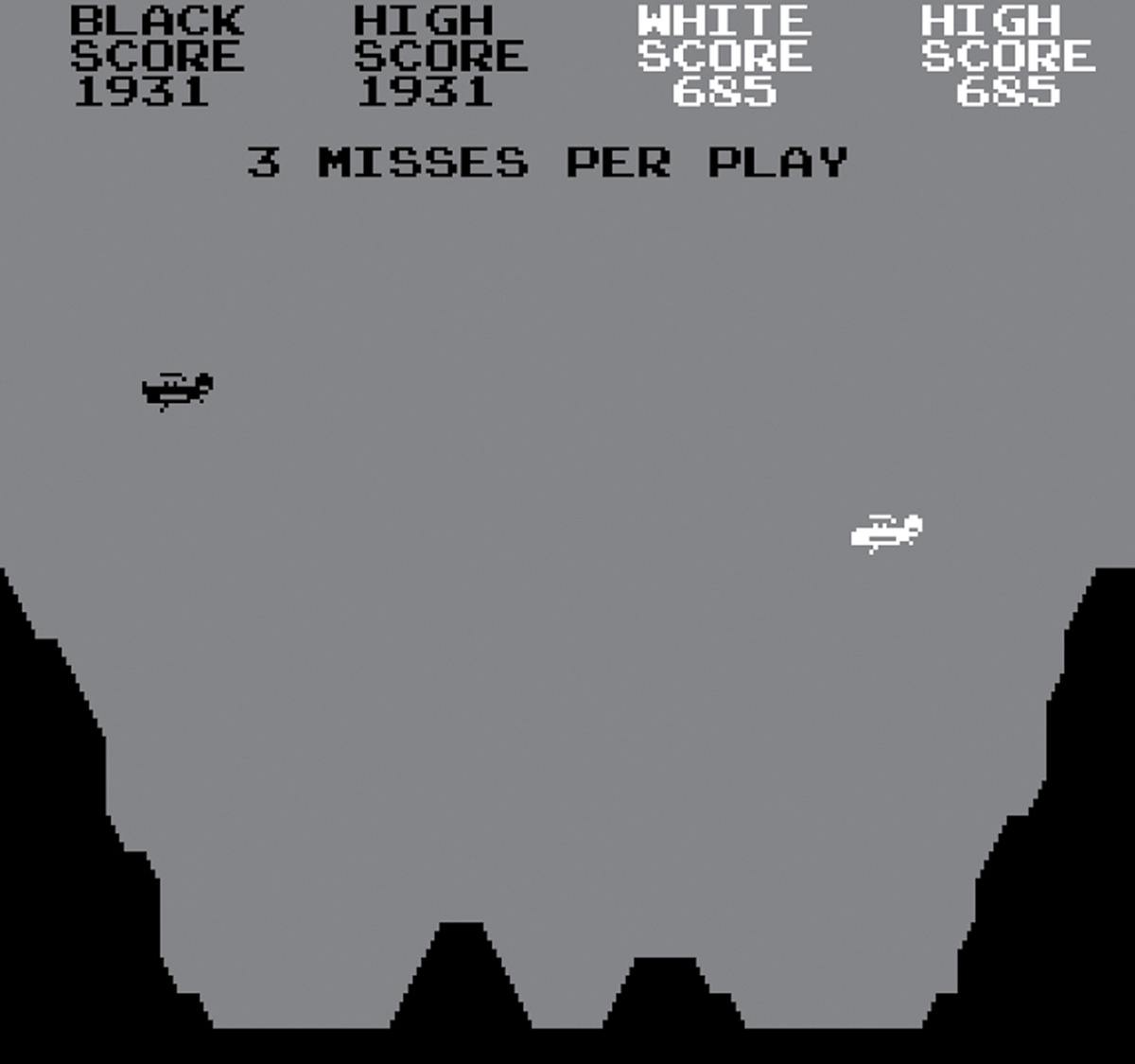
Screenshot of Atari’s 1977 game, Canyon Bomber. Courtesy of Twin
Galaxies Intergalactic Scoreboard.
“To the Vector the Spoils” is adapted from GAM3R 7H30RY, a “networked book” project designed by McKenzie Wark in collaboration with the Institute for the Future of the Book. It can be found at www.futureofthebook.org/gamertheory. It will be published as Gamer Theory in print form in spring 2007.
- Quoted in Martin Heidegger, The Essence of Truth (London: Continuum, 2002), p. 31.
- Leonard Cohen, “Everybody Knows,” from I’m Your Man, Sony, 1998.
- Slavoj Zizek, The Fragile Absolute (London: Verso, 2000), p. 77.
- Notorious B.I.G., “Things Done Changed,” from Ready To Die (Remastered), Bad Boy Records, 2004.
- Roger Caillois, Man, Play and Games (Urbana: University of Illinois Press, 2001), p. 114.
- Guy Debord, Society of the Spectacle and Other Films (London: Rebel Press, 1992).
- Richard Neville, Play Power: Exploring the International Underground (New York:
Random House, 1970), p. 278.
McKenzie Wark is the author of A Hacker Manifesto (Harvard University Press,
2004) and various other things. “To the Vector the Spoils” is an extract from his
forthcoming book Gamer Theory. He teaches at Eugene Lang College and the
New School for Social Research. His website is www.ludiccrew.org [link defunct—Eds.].
Cabinet is a non-profit organization supported by the Lambent Foundation, the Orphiflamme Foundation, the New York Council on the Arts, the NYC Department of Cultural Affairs, the National Endowment for the Arts, the Andy Warhol Foundation for the Visual Arts, the Katchadourian Family Foundation, Goldman Sachs Gives, the Danielson Foundation, and many generous individuals. Please consider making a tax-deductible donation by visiting
here.