


Sacred Bones
What remains
Mark C. Taylor
Throughout much of human history, bones have been associated not with death but with life. In many cultures, people actually believe bones are the seat of the vital principle or even the soul. As the locus of life, bones have mystic powers ranging from cure and divination to birth and rebirth. In the Hebrew Bible, Eve is born from Adam’s rib: “bone from my bones” (Genesis 2:21–22). In other biblical texts, bones appear to be conscious and even able to speak. The Psalmist declares:
My very bones cry out,
‘Lord, who is like thee?—
thou savior of the poor from those too strong for them,
the poor and wretched from those who prey on them.’
(Psalm 35:10–11)
The most important and widely held belief is that bones can be reanimated and therefore are essential to rebirth. This conviction is especially common among people in northern Eurasia as well in parts of Asia and can also be found in the myths of Germany, the Caucasus, Africa, South America, Oceania, and Australia. Ancient civilizations in Iran, Egypt, Mesopotamia, and Ugarit also believed in the reanimation of bones.[1] One of the most remarkable accounts of the resurrection of bones appears in the book of Ezekiel.
The hand of the Lord came upon me, and he carried me out by his spirit and put me down in a plain full of bones. He made me go to and fro across them until I had been round them all; they covered the plain, countless numbers of them, and they were very dry. He said to me, ‘Man, can these bones live again?’ I answered, ‘Only thou knowest that, Lord God.’ He said to me, ‘Prophesy over these bones and say to them, O dry bones, hear the word of the Lord. This is the word of the Lord God to these bones: I will put breath into you, and you shall live. I will fasten sinews on you, bring flesh upon you, overlay you with skin, and put breath in you, and you shall live; and you shall know that I am the Lord.’ I began to prophesy as he had bidden me, and as I prophesied, there was a rustling sound and the bones fitted themselves together. As I looked, sinews appeared upon them, flesh covered them, and they were overlaid with skin, but there was no breath in them. Then he said to me, ‘Prophesy to the wind, prophesy, man, and say to it, These are the words of the Lord God: Come, O wind, come from every quarter and breathe into these slain that they may come to life.’ I began to prophesy as he had bidden me: breath came into them; they came to life and rose to their feet. (Ezekiel 37:1–10)
Where there is belief in reanimation, bones are often preserved after the flesh has decayed and are treated with special care. In some cases, they are given a separate burial or are preserved as objects of worship.
It is not only human bones that are surrounded with an aura of sacrality, but often the bones of certain animals as well. Joseph Beuys, whose art draws upon and even reenacts spiritual traditions many regard as primitive, explains the abiding significance of animals: “Why do I work with animals to express invisible powers?—You can make these energies very clear if you enter another kingdom that people have forgotten, and where vast powers survive as big personalities. And when I try to speak with the spiritual existences of this totality of animals, the question arises of whether one could not speak with these higher existences too, with these deities and elemental spirits.”[2] Though many animals have been venerated over the years, three of the most important are cattle, deer, and elk. The myths and rituals associated with a variety of animals are remarkably consistent. Beuys continues, “There are many proscriptions against breaking or in any way harming the bones of animals (especially bears, reindeer, and other animals which are hunted); such bones are to be carefully collected and disposed of. They are buried, or exposed in trees or on platforms, or wrapped in the bark of trees or covered with stones, brush, and so on. Such practices are attested especially for northern Eurasia and North America.”[3]
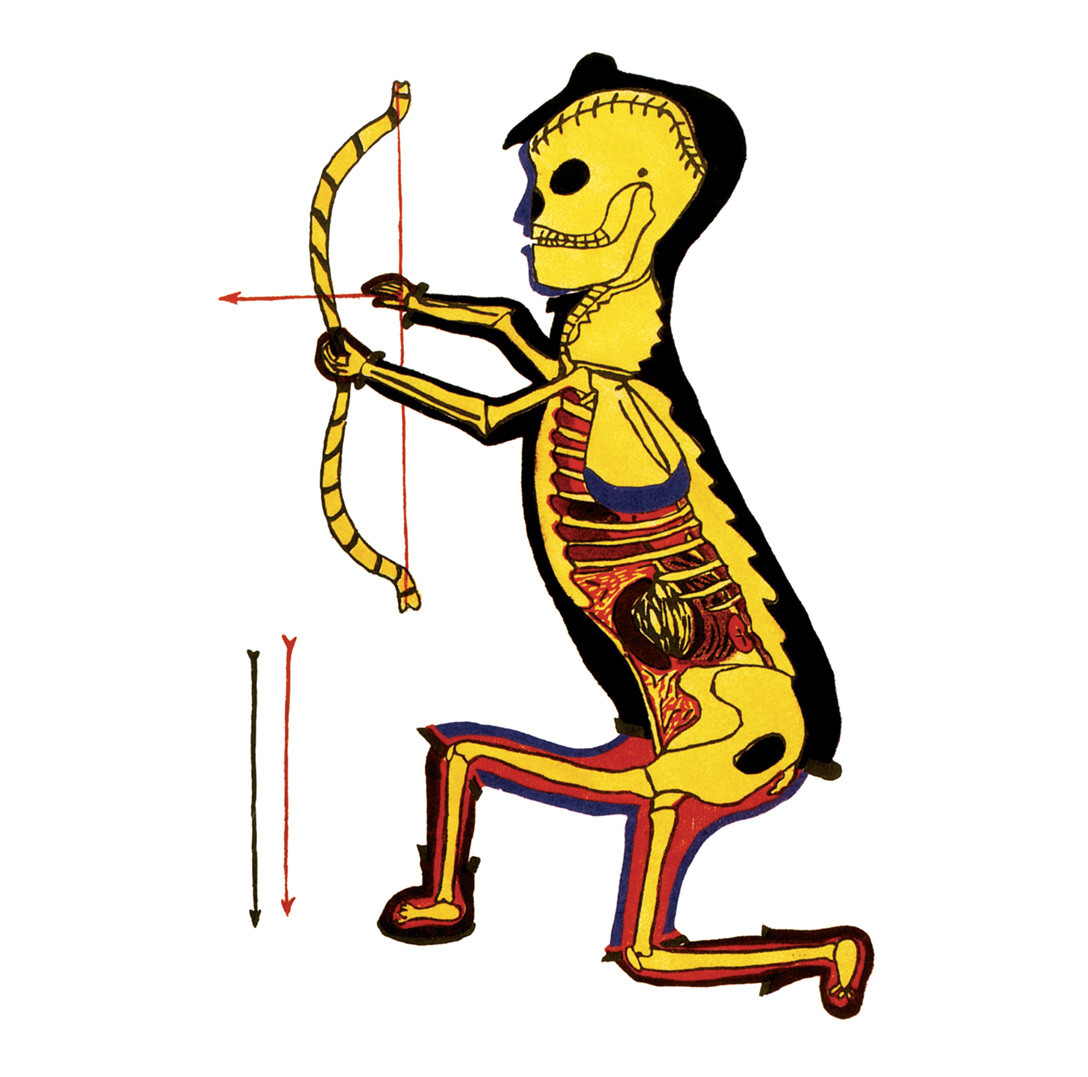
All bones, however, are not created equal. In different traditions, skulls, vertebrae, and shoulder blades (scapulae) are believed to harbor special powers that lend them ritual significance. The conviction that bones are living leads to the belief that they can communicate. One of the bones used widely in divination is the scapula. The practice of scapulomancy (also known as spatulamancy) is a form of divination that involves studying the pattern of cracks and fissures in bones that have been heated over an open fire. Though it dates back to ancient Babylon and is still practiced from Asia and India to Europe, one of the most intriguing instances of scapulomancy is practiced by the Montagnais-Naskapi on the Labradorean Peninsula in North America. Omar Moore describes the ritual:
Animal bones and various other objects are used in divination. The shoulder blade of the caribou is held by them to be especially “truthful.” When it is to be employed for this purpose the meat is pared away, and the bone is boiled and wiped clean; it is hung up to dry, and finally a small piece of wood is split and attached to the bone to form a handle. In a divinatory ritual the shoulder blade, thus prepared, is held over hot coals for a short time. The heat causes cracks and burnt spots to form, and these are then “read.” The Naskapi have a system for interpreting the cracks and the spots, and in this way they find answers to important questions. One class of questions for which shoulder-blade augury provides answers is: What direction should hunters take in locating game? This is a critical matter, for the failure of a hunt may bring privation or even death.[4]
Cracks in bones, it seems, are hieroglyphs for those who know the code. The Montagnais-Naskapi read in the cracks the topography of the territory where they hunt.
The use of bones for divination is a common part of many shamanistic rituals. Shamanism is, as Mircea Eliade calls it, an “archaic technique of ecstasy.” Since bones can be reanimated, they play a critical role in the ritual of the death and rebirth of the holy man. Eliade describes a pattern that is found in several cultures:
The skeleton present in the shaman’s costume summarizes and reactualizes the drama of his initiation, that is, the drama of death and resurrection. It is of small importance whether it is supposed to represent a human or an animal skeleton. In either case what is involved is the life-substance, the primal matter preserved by the mythical ancestors. The human skeleton in a manner represents the archetype of the shaman, since it is believed to represent the family from which the ancestral shamans were successively born. … A similar theory underlies the cases in which the skeleton—or the mask—transforms the shaman into some other animal (stag, etc.). For the mythical animal ancestor is conceived as the inexhaustible matrix of the life of the species and this matrix is found in these animals’ bones. One hesitates to speak of totemism. Rather, it is a matter of mystical relations between man and his prey, relations that are fundamental for hunting societies.[5]
To complete the process of rebirth, the initiate must experience a mystical vision in which he imagines his body stripped of its flesh and names and numbers his own bones. The shaman cannot experience rebirth until he “becomes” his skeleton.
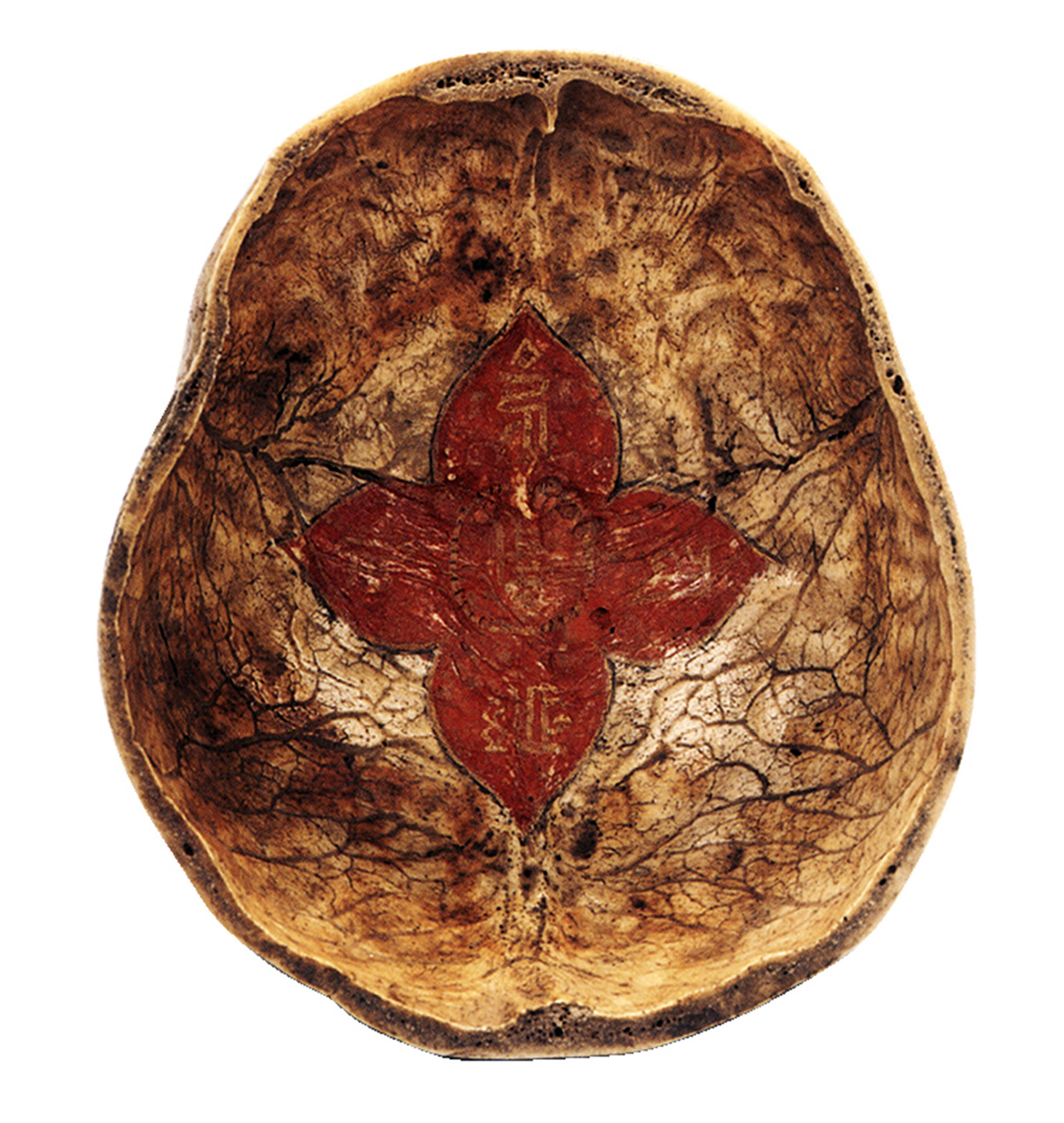
Nowhere is the ritual use of bones more important than in Tibetan Buddhism, where human skulls play a critical role in Lamaist ceremonies. There is considerable evidence suggesting that these customs were adapted from Indian practices in which Shiva as Kapalabhrta or Mahakals, the Great Destroyer, is frequently depicted wearing a wreath of human skulls as a necklace. In the Prabodha Chandrodaya, performed in 1065 C.E., one of the participants declares: “My necklace and ornaments are of human bones; I dwell among the ashes of the dead and eat my food in human skulls. … We drink liquor out of the skulls of Brahmans; our sacred fires are fed with the brains and lungs of men mixed up with their flesh, and human victims covered with the fresh blood gushing from the dreadful wound in their throats, are the offerings by which we appease the terrible god [Maha Bhairava].”[6] The skull used for wine and other libations offered to the gods is known as a kapala. Through a long etymological excursus, this word eventually issues in the German kopf (head) and English cup.[7] In one of the few examinations of this practice, Berthold Laufer notes:
Some of these skull-bowls are elaborate mounted and decorated, lined with brass or gilded copper and covered with a convex, oval lid that is finely chased and surmounted by a knob in the shape of a thunderbolt …, the symbol of Indra, which is in constant use in nearly all Lamaist ceremonies. The skull itself rests on a triangular stand, cut out with a design of flames, at each corner of which is a human head. These settings are frequently very costly, being in gold or silver, and studded with turquoise and coral.[8]
Since the efficacy of the rituals depends on the quality of the skull, Lamas have developed an elaborate system of evaluation reminiscent of nineteenth-century phrenology. The shape, contour, and color of the skull reveal whether the person was religious, wise, and noble. For the karmic power of the skull to become effective, it must be prepared according to strict religious procedures. In some cases, the kapala appeared to be so powerful that it became the object of worship. In addition to using skulls to make kapala, Lamas fashioned tambourines for religious ceremonies from skullcaps, and used the thigh bones of criminals who died a violent death to make trumpets that can both solicit and frighten demons. Commenting on these practices, one Lama reports: “The people, at hearing of such trumpets, cannot fail to be mindful of death. For the same reason we avail ourselves of bones of the dead for rosary beads. Finally, in order to be still more imbued with this melancholy and sad remembrance, we drink from the cranium.”[9] Once again the ambiguity of bones is clear: they are a memento mori that also hold the promise of spiritual renewal.
The figure of the skull also plays a pivotal role in the Christian drama of death and rebirth. According to biblical accounts, Jesus was crucified on Golgotha, which means “skull” in Aramaic. Though some commentators have argued that the crucifixion site was named Golgotha because of the skulls accumulated from previous executions, a more likely explanation is that the rock formations on the hill resemble a human skull. From the earliest days of Christianity, skulls and bones have been objects of meditation, veneration, and speculation. It is not only Shakespeare’s Hamlet who finds lessons in a skull. In his formidable Phenomenology of Spirit, Hegel goes so far as to claim: “The skull-bone does have in general the significance of being the immediate actuality of Spirit.” In Hegel’s comprehensive vision, the entire natural and historical world is the embodiment or, in theological terms, the incarnation of spirit. The immaterial and the material are not separate and opposite but are alternative revelations of the same reality.
If now the brain and spinal cord together constitute that corporal being-for-self of Spirit, the skull and vertebral column form the other extreme to it, an extreme which is separated off, viz., the solid, inert Thing. When, however, anyone thinks of the proper location of Spirit’s outer existence, it is not the back that comes to mind but only the head.[10]
Here the philosopher who defines modernity echoes the ancient shamanistic belief in the mystic power of bones.
Christian faith and practice are not only bound to bones by Golgotha. During the Roman Empire, Christians held worship services surrounded by bodies and bones. To escape persecutions, Christians commonly met around tombs and in catacombs to honor the dead. Since the burial grounds provided seclusion from the vigilant eyes of the Roman authorities, these gatherings eventually became the occasion for full-blown religious services. Though the situation of the Christians changed dramatically after the conversion of Constantine, the association of religious ceremonies with the place of the dead can still be discerned in major churches and cathedrals, which, beginning with the basilicas of Saint Peter in the Vatican and Saint Paul on the Via Ostia, were built over the graves of martyrs. In later centuries, this practice spread throughout Europe until basilicas and cathedrals eventually became necropolises where proximity to the altar was determined by religious prestige and social rank. The church is literally built on the bones of martyrs and believers.
During the Middle Ages, these bones were often on display. While most bones were remnants of anonymous believers and non-believers, some were purported to be the remains of martyrs. By this time, the custom of individual burial had, for most people, given way to internment in mass unmarked graves. As the urban population grew and burial space became a problem, it became customary to dig up the bones and display them in galleries and ossuaries called charnels or charnel houses. Rather than a permanent resting place, graves became pits where flesh could rot—the faster, the better. In the late Middle Ages, if the body had to be transported, it was boiled to separate flesh and bone. In his monumental work, The Hour of Our Death, Philippe Ariès reports: “The flesh was buried at the place of death, which provided an excuse for an initial tomb. The bones were saved for the most desirable burial place and the most impressive monuments, for the dry bones were regarded as the noblest part of the body, no doubt because they were the most durable.”[11] Elsewhere Ariès cites a Breton hymn that encourages the faithful to ponder the bones stacked in charnels.
Let us to the charnel, Christians, let us see the bones
Of our brothers…
Let us see the pitiful state that they have come to…
You see them broken, crumbled into dust…
Listen to their lessons, listen well…
“It was important to see,” Ariès explains. “The charnels were exhibits. Originally, no doubt, they were no more than improvised storage areas where the exhumed bones were placed simply to get them out of the way, with no particular desire to display them. But later, after the fourteenth century, under the influence of a sensibility oriented toward the macabre, there was an interest in the spectacle for its own sake.”[12]
When bones are not anonymous, their power derives from the lives of the dead. The belief in the miraculous power of bones eventually led to their veneration as holy relics. The word relic derives from the Latin reliquiae, which originally meant any mortal remains. In the Catholic tradition, relic eventually came to designate the saint’s body and objects that had direct contact with it during his or her lifetime. While clothing and items used in worship were important, the most prized relics were actual body parts like hair, skin, and bones. The worship of relics is not limited to Catholicism; indeed, relics associated with the Buddha, Mohammed, and Confucius are also enshrined and adored. In whatever tradition it occurs, belief in the effectiveness of relics involves what might be described as “the metaphysics of presence” in which physical proximity bestows benefits and provides protection. The martyr effectively inhabits the relic, which is capable of transmitting grace, virtue, and even life itself. As belief in the power of relics spread in eastern as well as western Christendom, demand for them grew, and bones became big business. Their draw was not only spiritual but also political and even economic. From the time of Charlemagne, no church could be consecrated without a relic. Competition for relics and the prestige they brought frequently resulted in bodies being moved and even stolen. When the relocation of the corpse was legitimate, it took place according to a ritual known as translation. By the fifth century, the demand for bones and body parts was so great that the practice of exhuming, dismembering, and distributing the bodies of saints became widely accepted. Amputated fingers, hands, feet, heads and, of course, bones circulated throughout Europe. The more important the saint, the greater the power the remains bestowed. With increase in demand, supply became a problem, and a profitable market in relics emerged. In the ninth century, a group of enterprising entrepreneurs formed a corporation that specialized in the discovery, sale, and transport of relics throughout Europe. Neither ambitious churchmen nor credulous believers and pilgrims seemed to care that many of these relics had to be fake.
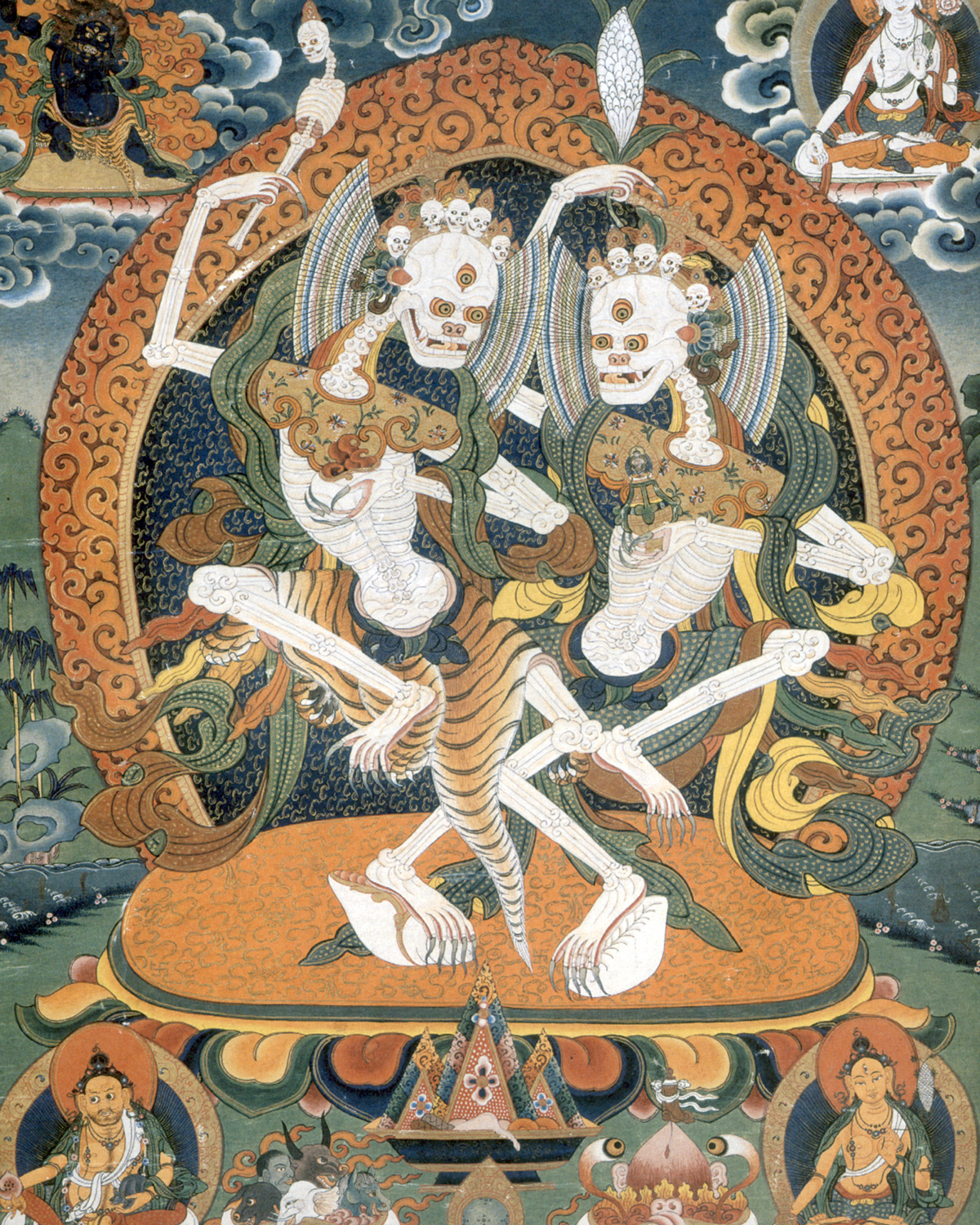
Through the centuries and across cultures, what makes bones so powerful is that they last. When all else is gone, bones remain, and in their remains we see traces of those who once lived. To our society obsessed with denying death by hiding it from sight and mind, the fascination with bones might seem a morbid vestige of a primitive mentality from another era. Practices once deemed holy now appear grotesque. But things are never so simple; bones continue to haunt us. Paradoxically, we are always drawn to that which we struggle to avoid because the repressed never simply disappears but merely slips underground where it continues to preoccupy those who claim to deny it. There is no escape from bones; their shadows prefigure our future.
This text is an edited excerpt from Mark C. Taylor’s photo-essay book Mystic Bones published in 2007 by the University of Chicago Press.
- Joseph Henninger, “Bones,” The Encyclopedia of Religion, ed. Mircea Eliade (New York: Macmillan and Free Press, 1987), vol. 2, p. 284.
- Carin Kuoni, ed., The Energy Plan for Western Man: Joseph Beuys in America (New York: Four Walls Eight Windows, 1990), p. 142.
- Ibid.
- Omar Khayyam Moore, “Divination—A New Perspective,” American Anthropologist, vol. 59, no. 1 (February 1957), p. 70.
- Mircea Eliade, Shamanism: Archaic Techniques of Ecstasy (Princeton: Princeton University Press, 1972), pp. 159–160.
- Mircea Eliade, Yoga: Immortality and Freedom, trans. Willard Trask (New York: Pantheon Books, 1958), p. 298.
- Berthold Laufer concludes his highly informative article with the following observation: “Finally, there is a visible survival of the ancient custom still preserved in our language. German kopf (‘head’) corresponds to English cup (Anglo-Saxon cuppe), both being derived from Latin cuppa (‘cup’). In Italian, coppa means a ‘cup;’ but in Provençal the same word in the form of cobs means a ‘skull.’ Latin testa refers to a pottery vessel or sherd, as well as to the brain-pain and head. In Provençal, testa signifies a ‘nut-shell;’ in Spanish, testa denotes ‘head’ and ‘bottom of a barrel.’ In Sanskrit, kāpala means both ‘skull’ and a ‘bowl.’ This correlation is still extant in many other Indo-European languages.” See “Use of Human Skulls and Bones in Tibet,” (Chicago: Field Museum of Natural History, 1923), pamphlet no. 10, p. 24. I have drawn many of the details of Tibetan rituals from Laufer’s informative study.
- Ibid., p. 1.
- Ibid., p. 13.
- G. W. F. Hegel, Phenomenology of Spirit, trans. A. V. Miller (New York: Oxford University Press, 1977), pp. 200, 197.
- Philippe Ariès, The Hour of Our Death, trans. Helen Weaver (New York: Random House, 1982), p. 262.
- Ibid., p. 61.
Mark C. Taylor is the chair of the Department of Religion at Columbia University. His most recent books are Confidence Games: Money and Markets in a World without Redemption and After God (both University of Chicago Press, 2004).
Spotted an error? Email us at corrections at cabinetmagazine dot org.
If you’ve enjoyed the free articles that we offer on our site, please consider subscribing to our nonprofit magazine. You get twelve online issues and unlimited access to all our archives.