


Between the Country and the Telo
The architecture of controlled invisibility in neo-liberal Argentina
Federico Windhausen
Among the many sordid political figures populating the modern history of the Argentinean province of Tucumán, perhaps none has emphasized the importance of social visibility as much as General Antonio Domingo Bussi. In 1976, the country’s new military regime sent Bussi to Tucumán, a small, poor province that had come under military law the previous year. Bussi quickly took control of an area that had come to be identified with the threat of leftist radicalism in the form of guerrilla operations and student/laborer activism. During the many detentions, tortures, and assassinations that followed, Bussi was known for his reliable attendance record at the executions carried out in Tucumán’s El Arsenal concentration camp. Bussi’s oversight of the extermination process was literal as well as symbolic: he made a point of seeing for himself the “invisible” acts that defined the “Dirty War.”
During a period of Argentine history when the most repressive power structures were supported by leaders within the Catholic Church, the highest levels of the business community, and government officials, Bussi saw himself as carrying out a decidedly moral project, promoting the values of the conservative Catholic middle class. The general was a strategic strongman who understood which values have a place in the public arena and which are accepted but hidden. The local stories about Bussi are seemingly innumerable. According to one, Bussi is said to have conducted raids on the old telos, the hourly tryst motels of Tucumán. Motel clients would be taken out of their rooms, and their spouses or parents would be notified of their presence at the telo. In another story, just as familiar to residents who lived through the era, Bussi addressed the problem of shantytowns in Tucumán by constructing walls to make them invisible to the general public. Many of the stories show that Bussi’s awareness of the issue of social visibility, combined with his authoritarian promise of social order, made him a distinguished figure for a large segment of the Tucumán electorate.
Four years after the end of the “Dirty War,” the general was voted back into power in Tucumán. In a country where the military emerges from and represents the middle class, where carrying out and managing violence have become specialized tasks for middle class professionals, the general’s presence came to symbolize, for a large portion of the provincial populace, the return of effectively militaristic interventionism, intended to restore cohesion and stability to a perpetually threatened group.
That group, the middle class in Tucumán, is the focus of my essay which explores the emergence of two types of structures, the private residential neighborhoods, called los country, and the new type of telos, tailored to the needs of amorous couples with automobiles, in the local context of the province. Generally speaking, neither are unique structures when viewed outside their specific place within an Argentinean province with a particular history of repression. Yet both the country and the telo suggest important issues facing the new, “neo-liberal” Argentina.
• • •
Since the free-market reforms of the 1990s, the province’s capital city, also named Tucumán, and its surrounding towns have been witnessing the emergence of private residential neighborhoods for its higher income families. During the same period of time, near the highways leading to the city, a handful of upscale hourly motels, designed to be entered and exited in automobiles, have been erected. The country and the telo, or mueble, are architectural structures developed in the car culture of the United States, first imported into Argentina through Buenos Aires. Transplanted to Tucumán, both the country and the telo serve an important function for the upper class and for the more affluent segments of the middle class, insofar as they assist, through their design, in the management of social visibility. Both the small group of provincial residents who can afford lots in a country and the larger group who can afford to visit a telo are demanding structures that give them more control over the visible and the “invisible” aspects of their public identity. The city of Tucumán and its immediate outskirts comprise roughly 6.5% of the territory of the province of Tucumán, yet it must accommodate 65% of the provincial population, over half a million residents.[1] Burdened with high unemployment (20% in 2000), Tucumán has never recovered from the accelerated de-industrialization that began in the mid-1960s, when military leaders ended the federal subsidy system originally devised to keep the province’s bloated and uncompetitive sugar cane industry alive. Located 600 miles northwest of Buenos Aires, the city of Tucumán attracts people who migrate from the poorer towns in the province, from other northwestern provinces, and from nearby countries, all creating a constant demand for housing. Consequently, the unregulated, unplanned growth of the city advances in proportion to the worsening of the province’s longstanding economic crisis.
It seems apparent that, for the foreseeable future, an informal annex will continue to develop around the official city. As the informal city expands in a ringlike, concentric pattern of growth, the private sector attempts to control the outer regions, while the state fails to respond dynamically. In this highly exclusionary situation, irregular settlement by a desperate underclass is a constant threat to formal production and to the land market. As part of the kind of urban and suburban sprawl developing in Tucumán, interstitial areas of poverty form within and around higher income neighborhoods. For many, being middle class in Tucumán means living with the fear that the shantytowns, or villas miserias, will begin to appear much too close to home.
This fear is bound up with a heightened awareness, within the lower middle class, of the regressive pull of the Argentine economy. The $36 billion privatization program initiated by former President Carlos Menem in the early 1990s modernized only some sectors of the economy, while allowing for market “liberalization” to proceed recklessly, without long-term planning or responsible regulatory reform. During the last decade, the inequality between the richest and the poorest Argentines expanded as much as the nation’s economy. In the midst of this striking process of income redistribution, Argentina finds itself burdened with a new kind of empobrecimiento, or pauperizacion, a process whereby formerly middle class workers become members of the “new poor.” Today, the Argentine middle class knows that it is more vulnerable than ever. For those who live in the provincial centers, this economic anxiety is linked to another fear, rarely seen in Buenos Aires, of the city’s regression into the pueblo, into the underdeveloped town with only a partial social structure.
• • •
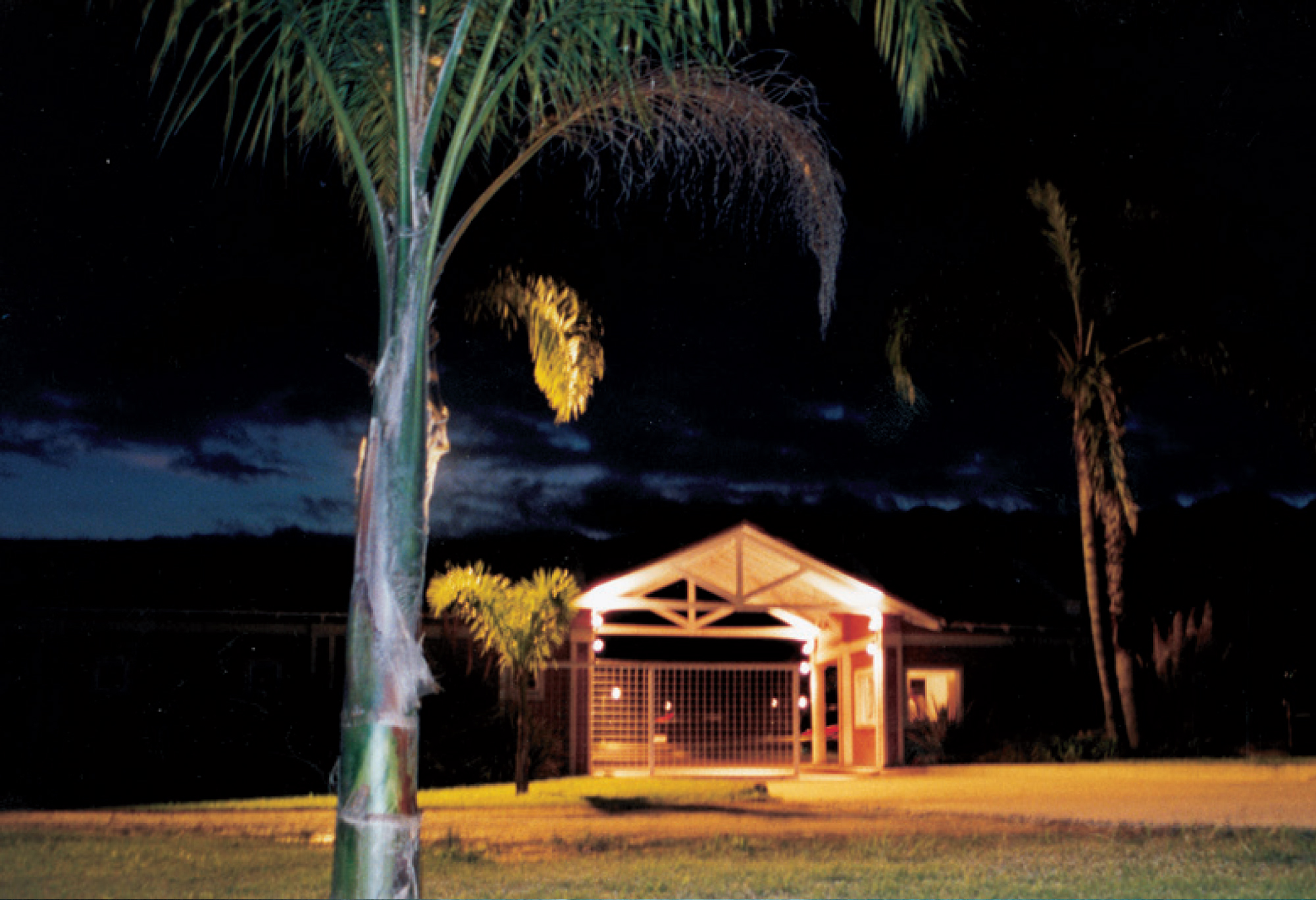
Within this context, the country can be viewed as an exceptionally controlled enclave located inside an intensely unstable environment. Each country in Tucumán is bordered by walls, fences, or tall hedges, with guards at its exits and entrances. The country’s residential lots—varying in size depending upon the overall spread—have houses surrounded by trees and lawns, each meeting pre-determined requirements. Each country also has a recreational center, with a cafe or restaurant, a pool, tennis courts, soccer fields, play rooms, and gymnasiums. In an extremely polluted, perpetually crime-ridden province, these restricted neighborhoods offer privacy and security, the semblance of a natural environment, and a community based largely on class solidarity.
Between the center of the capital city and the mountains that enclose the interior of the province, the middle and upper classes have relatively little space in which to build their neighborhoods. In addition, given the lack of contemporary criteria for urban planning and development in Tucumán, it is not surprising to find country neighborhoods in close proximity to slums and other low income areas. In the formal city, the streets offer familiar aggregations of deteriorating colonial houses and newer apartment buildings. In the areas shaped by suburban sprawl, where building facades are being replaced by gates and fences, the stark juxtapositions between housing structures are now visible across a larger expanse, not from one building to the next, but from neighborhood to neighborhood. The residents of the country neighborhoods are generally willing to accept the presence of lower income barrios nearby, as long as those areas do not grow at an accelerated rate, and, more importantly, as long as the country’s tough security measures are maintained as strictly as possible.
The country neighborhoods fulfill one function exceedingly well: they provide its residents with the sense that their turbulent and diverse region is somehow ordered, if only within their immediate environs. Unlike the rest of the province, the country is a manageable, homogeneous space, with clear borders, access restrictions, and design regulations. Its structure suggests that the need to maintain the appearance of an orderly environment is playing an increasingly important role within the provincial value system. This increased need for protection emerged after the Dirty War, after the armed forces were forced to relinquish their self-appointed powers. Once the military fell under the control of the state, it was subjected to processes of professionalization that made it into a middle-class institution not unlike large-scale business organizations. The military lost its ability to police the everyday life of residents, as well as its status as the dominant symbol of violent power in the provinces. Military personnel living in suburban neighborhoods now shared with the civilians in the upper and middle classes a need to safeguard themselves against the threat of violent crimes, commonly carried out by the underclass. Having lost the military as protectors and gained some economic stability in the 1990s, the Argentine professional relied upon architecture: the home as self-enclosed fortress.
The average visitor to Tucumán is likely to discover that the new country neighborhoods are a common topic of conversation. The country is usually presented as a sign of provincial modernization, something to set against the prevailing image of a small, outdated city where the shops still close between 1 pm and 4 pm for the siesta period. But only among more liberal circles will the discussion turn to the teloas another significant sign of change in contemporary Tucumán. Most residents know that the telos have been improved, that they are new modern structures hidden in plain sight for obvious reasons. The new telo is designed to protect the privacy of clients who are aberrants, not nonconformists, clients who are seeking a temporary release from their social roles while attempting to maintain their public respectability. In Tucumán, it is generally understood that the telos’ main clientele are older men with mistresses and younger couples who still live with their parents—members of the economically stable family unit commonly found in the country complexes. The telo’s theater of privacy is considered to be most necessary for the older men. In a modern Catholic country like Argentina, sexual behavior among young, unmarried couples can be tolerated as an invisible activity, as long as it marks a step toward the inevitable affirmation of the institution of marriage. Adultery, however, must always be rejected within conventional morality and needs to remain invisible. Homosexual behavior is also subject to unyielding disapproval, but most residents who discuss the telos seem to believe that heterosexual activity in the motels is far more prevalent. During the short-lived boom economy of the ’90s, the model for telos in Tucumán was upgraded from nondescript concrete buildings in the city to single-level, ranch-style complexes on the outskirts. Today, there are four prominent telos in Tucumán. Three of these—the Ovni, the Privé, and the Halley—have the same owner. The fourth, called El Dorado, was renovated in order to cater to the newly discovered middle and upper class clientele of neo-liberal Argentina.
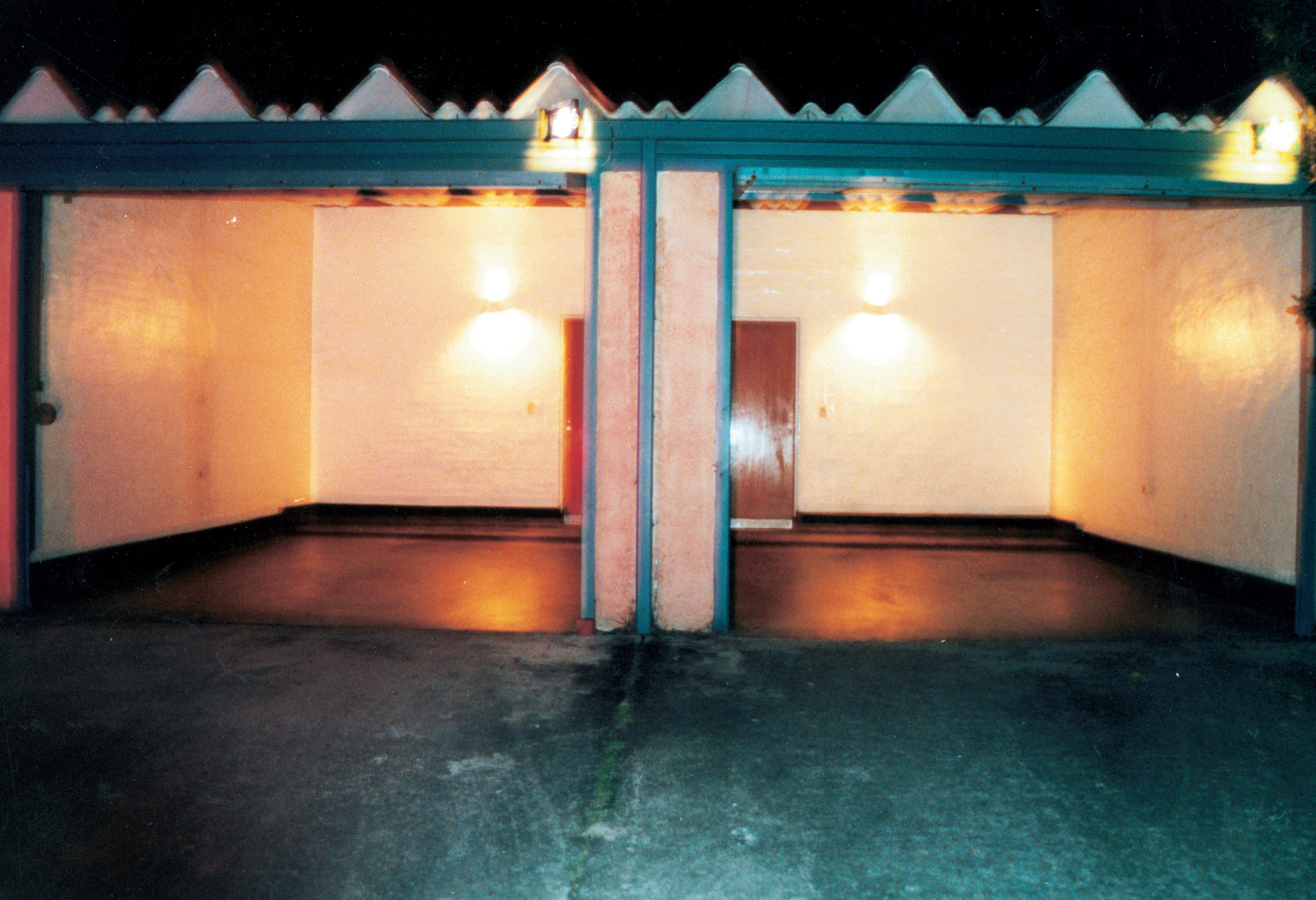
The El Dorado telo shares with many US motels a layout that facilitates a high degree of privacy for clients (who always arrive and leave by car). Constructing an experience in which the architecture is a dominant, guiding presence, the telo completely evacuates every trace of human contact from the clandestine sex scenario.[2] Clients must pull up to a low gate, at the bottom of a small hill, where the driver is addressed through an intercom. The driver can either request a particular room or simply accept the room offered by the clerk. After the driver is given a cabin number, the mechanized gate is opened automatically. As the car follows the enclosing wall, which is lit by low lights embedded in the curved, paved path, it moves up through a smooth series of entrance elevations. Constituting the first of a number of abstract forms and surfaces that are animated solely by the couple’s movement through the space, the steep entrance path ends in front of a row of roughly fifteen numbered garages, each equipped with curtains that conceal the parked automobiles. As the couple pulls into their allotted garage, the door from the garage to the motel room is opened by an unseen employee.
Once inside the cabins, clients are not required to register their names, nor are they obliged to interact with the staff directly. A revolving dumbwaiter, behind a cabinet door in each room, is used for any and all transactions. Rooms are equipped with a bathroom, television (playing pornographic videos), large bed, and table. Most cabins display the simple geometrical shapes of standard motel rooms. However, a handful of cabins, notable for having been designed as theme rooms, command the highest rates. At the El Dorado, at $60 for two hours, the African and Japanese rooms cost $20 more than the regular room.
When the couple is prepared to leave, a telephone call to the staff sets off the coordination process designed for each client exit. Their car must travel around the entire complex, ending up next to a guard’s booth, in front of another mechanized gate. Since the car will inevitably pass the entrance gate on its way out, a motel employee who is watching both gates from a booth at the center of the complex will decide when to release the exiting clients. Like the country, the telo furnishes for its clients a sheltered, restricted space, where those who can afford access are guaranteed a different kind of security. The highly structured and choreographed nature of the telo experience is, for the client, the strongest indication that the motel is complying with an assumed social contract.
• • •
Recently, the novelist Tomás Eloy Martínez began an op-ed essay on depression and despair in contemporary Argentine society by asserting that “We Argentines tend toward complaint, disillusion, rapid disenchantment, as indicated in the lyrics of the tangos and the astonishing demand for psychoanalysis.”[3] For Martínez, the complaint, the melancholy verse, and the talking cure are signs that, in Argentina, disillusionment discloses itself through the language of lived experience. In much of the print commentary on late- century Argentina, this kind of emotive interpretation of the national character usually emerges within a discussion of the paradoxical unraveling of a once-wealthy nation state. Militarism, populism, and authoritarianism are commonly seen as the most significant internal precipitates of the country’s decline after the 1920s.
Yet the familiar examples of tango and psychoanalysis employed by Martínez are not applicable, in a general and equal sense, to the various strata within contemporary society. Both the tango and psychoanalysis are distinctly bonaerense, rooted in the urban experience of Buenos Aires, each attached to distinct class origins. The federal district of Buenos Aires is the nation’s largest province, containing a third of the electorate, and its capital city is South America’s wealthiest. When the brothel’s song and dance form and the burguesia’s sex treatment were exported to the other 23 provinces in Argen tina, they became national markers of self-identity, most of which tend to be based in either the lower or the middle classes. This transfer of culture moves from the symbolic center of the nation to its less developed areas, where provincial Argentines tend to be highly conscious of class-based divisions and their local impact on rural or urban areas. This essay shares a broad question with writers like Martínez who ask how Argentina is changing in the face of neo-liberal privatization and economic “austerity measures.” Yet it is also predicated on the assumption that the construction of the national character is a perpetual problem for a territory as diverse as Argentina. Hence, it is focused on a province where one is first a tucumáno, and only secondly an Argentine. In Tucumán, where stratification is commonly accepted as a social necessity, the order of local life is always being threatened, always on the verge of being torn asunder, by the oppositions and extremes—social, political, economic—that seem to define the nation. More specifically, Tucumán is a province where anxieties regarding the middle class value system have been linked, historically, to the acceptance of authoritarian methods for ordering society. It is a province where the middle class’s desire to segregate itself, while seeking “role releases” from the values it promotes, has created a landscape where much is hidden from sight.
Within these local and national contexts, the country and the telo have deeper political implications. The country and the telo are structures of controlled invisibility developed in a place that has not proved itself capable of resolving the problem of middle class complicity with silent, mass extermination. These specific examples are just two kinds of sites that seem to have no place in the national discourse on failure and melancholy, nor in the continually renewed image of a self-analyzing society, based in middle-class values. How would the familiar generalizations about the national character have to be modified or extended if more studies of local, provincial identity were taken into account? How would the historical picture change if the structures created by the provincial middle class were not separated so severely from a local history of class attitudes?
In 1968 a collective project called “Tucumán Arde” [Tucumán Burns] presented the findings of a group of artists, social researchers, and activists, who had been investigating the decline of the sugar-dominated province.[4] Within a site-specific exhibition, the event offered extensive information on the class-based problems of a rural province. The project introduced in this essay shares with that earlier undertaking a basic conviction: certain conditions of existence in Tucumán (and similar provinces) have been continually excluded not only from national discourse but also from the public sphere of the province itself. In place of a sustained sociological analysis, the country-telo project locates, in the highly visible architectural structures of contemporary Tucumán, a continuing need to maintain and manage invisibility. It is perhaps in the provinces that we can see most clearly the specter of the Dirty War’s middle class, the group for whom everyday life was marked by unseen deaths. And it is perhaps in these locales, where silent forms of maintenance and management are cultivated and developed through everyday structures, that we can see the shape of its future.
Thanks to the younger generation of Tucumán residents who helped with the project, especially Agustina Mussari and Fernanda Doz Costa.
For more background information on contemporary Argentina, see Latin American Perspectives, vol. 24, no. 6 (November 1997) and NACLA Report on the Americas, vol. 31, no. 6 (July–August 1997), both of which are special issues on Argentina after the Dirty War.
- Statistical information on Argentina was appropriated from INDEC, the National Institute of Statistics and Censuses. Available at www.indec.gov.ar/el-indec-eng.asp. [link defunct—Eds.]
- There are very few social research studies available on hourly motels. None have been undertaken in Argentina and only a small handful have emerged out of the United States. The most interesting of these is almost 20 years old: J. Robert Lilly and Richard A. Ball, “No-Tell Motel: The Management of Social Invisibility,” Urban Life, vol. 10, no. 2 (July 1981).
- The article by Tomás Eloy Martínez cited in this essay is “La desesperanza argentina,” La Nación, 8 August 2000. The translation is mine.
- For an English translation of the “Tucumán Arde” manifesto, see Alexander Alberro and Blake Stimson, eds., Conceptual Art: A Critical Anthology (Cambridge, MA.: MIT Press, 1999). For a Spanish-language analysis of “Tucumán Arde,” see the article by Fernando Farina on the RosariARTE website here.
Federico Windhausen is a doctoral candidate in the Department of Cinema Studies at New York University. His dissertation focuses on American experimental film and video art since the 1960s.
Spotted an error? Email us at corrections at cabinetmagazine dot org.
If you’ve enjoyed the free articles that we offer on our site, please consider subscribing to our nonprofit magazine. You get twelve online issues and unlimited access to all our archives.