


Recollecting the Slaughterhouse
A history of the abattoir
Dorothee Brantz
What comes to mind when thinking about slaughterhouses? Meat hooks, blood, knives, animals and people engaged in a deadly spectacle and carnivore feast. Noise and the unmistakable sweet noxious smell of blood mixed with effluvia, disinfectants, and lots of steam. In the slaughterhouse flesh becomes meat in a mechanized and literally bone-chilling production. They may be vile, repulsive, and hideous, but slaughterhouses also hold great fascination. Before there were theme parks and movie theaters, people flocked to slaughterhouses in order to quench their thirst for thrills derived from horror. When the World Columbian Exposition was held in Chicago in 1893, more visitors went to the stockyards than to any of the Exposition’s own attractions. In turn-of-the-century Berlin, visits to the slaughterhouse were so popular that special tour books were printed to guide visitors through the facility. Even in the 1950s, one still could take a tour through the Chicago stockyards five times a day.
Animal slaughter is entrenched in tradition, cultural determination, and historical specificity. This is readily apparent in the kinds of animals we eat and the species we avoid. Holy in India, cows qualify as prime cuts in the West, where dog meat is taboo, even though in Korea it is widely accepted. In many cultures, pork serves as “the other white meat,” while Muslims and Jews reject it as filthy and unkosher. The practice of eating animals is an expression of culture, but it is also dependent on historical circumstance. In times of crisis, such as war, almost any animal can become food. For example, during the Prussian occupation of Paris in 1871, rats became a regular staple. During World War Two, most zoo animals in Berlin were slaughtered to supplement the meager scraps of available food. Slaughter is deeply embedded in history, offering a glimpse at how everyday practice has evolved and transformed.
The art of slaying and flaying a large animal is an ancient craft reaching back to the advent of civilization. Throughout history, the butchering of animals has played a crucial role in provisioning people. For centuries, meat eating was considered a symbol of status and a measure of living standards. At the same time, butchering was seen as a demoralizing practice that brutalized those who were exposed to it. Even in Thomas More’s utopian society, “the slaughtering of livestock and cleaning of carcasses is done by slaves [criminals sentenced to hard labor]. They don’t let ordinary people get used to cutting up animals, because they think it tends to destroy one’s natural feelings of humanity.”[1] Butchering was always a somewhat tainted practice, and the level of public repugnance have risen over time. As sensibilities softened and turned bourgeois, the animalistic was banned from allegedly civilized life. Distanciation became the prevalent mode of existence. As the German sociologist Norbert Elias has argued, this distanciation occurred in the household, where the carving of meat was moved behind the scenes to the kitchen so as to avoid any reminders of the animal from which it had come. The same was true for the slaughterhouse. It, too, was absorbed by the peculiar civilizing process of the West. Slaughter reflects the course of civilization, both its continuity and change.
Are slaughterhouses the perfect embodiment of modernity, or even human civilization more generally? Especially in the modern period, abattoirs have come to signify the extent to which such distanciation has led to the rationalization of everyday life and to the instrumentalization of death. During the nineteenth century, the close relationship between consumption and death made slaughterhouses emblematic of the rise of mass-production and the amalgamation of science, technology, and state politics. The proportions of this change were nowhere more visible than in the city, and the nineteenth-century city in particular is unthinkable without the slaughterhouse. As Denis Hollier has put it, abattoirs are part and parcel of “the logic of the modernization of urban space.”[2] This logic is most strikingly exemplified by two very different modern cities: Paris and Chicago.
In late eighteenth-century Paris, animals were slaughtered right in the back of butcher shops all over the city, and especially in the city’s center at Châtelet, which Louis-Sébastien Mercier, one of Paris’s most avid observers, described as “by far the worst-smelling place in the whole world.”[3] And Mercier was not alone. Many Parisians complained about the pestilent stench, disturbing noises, and continuous flow of blood in the streets. Attesting to the changing sensibilities that accompanied the onset of Paris’s urban growth, bystanders increasingly criticized the public display of slaughter. Mercier asked: “What can be more revolting and distasteful than the butchering of animals and the dismantling of their bodies in public view?”[4] Most critics agreed that slaughtering needed to be removed from the streets of Paris to clean up the environment and to protect the health and morality of the public. Numerous reformers demanded that slaughterhouses be relocated, preferably to the outskirts of town. However, nothing was implemented during the ancien règime, in part because the government was unwilling to take an initiative, but also because Paris’s powerful butchers guild strongly opposed any such interventions into their business. In the course of the French Revolution, all guilds were abolished to grant freedom of commerce. Yet this mandate produced unintended side effects. Meat could be sold anywhere, and animals were slaughtered right in the streets without supervision or any kind of inspection. Meat had become the domain of the people, but also the curse of the city.
When after a decade of revolutionary turmoil Napoléon Bonaparte arrived in Paris in 1799, he vowed to establish order and to rebuild the city. Napoléon initiated a staggering building program that included monuments like the Arc de Triomphe and the Place Vendôme as well as public works projects like sewers, markets, and slaughterhouses. Monuments would beautify Paris while public works projects would increase the city’s utility. Reviving the reform initiatives of the 1780s, Napoléon ordered that five municipal abattoirs be built in a ring around the city. Construction began in 1810, but was quickly caught up in the financial havoc caused by Napoléon’s wars of expansion. Consequently, the abattoirs, along with most other Parisian building projects, were not completed during Napoléon’s reign. However, the Bourbon Restoration that followed recognized the need for such facilities, and construction continued. When they finally opened in 1818, these public abattoirs were the first of their kind in Europe. Operated by the municipality, located away from Paris’s populated districts, and hidden behind walls, they provided a model for the spatial refacilitation of slaughter, a model that would be followed all over Europe in the course of the nineteenth century. Yet, the Napoléonic abattoirs reformed rather than revolutionized slaughter.
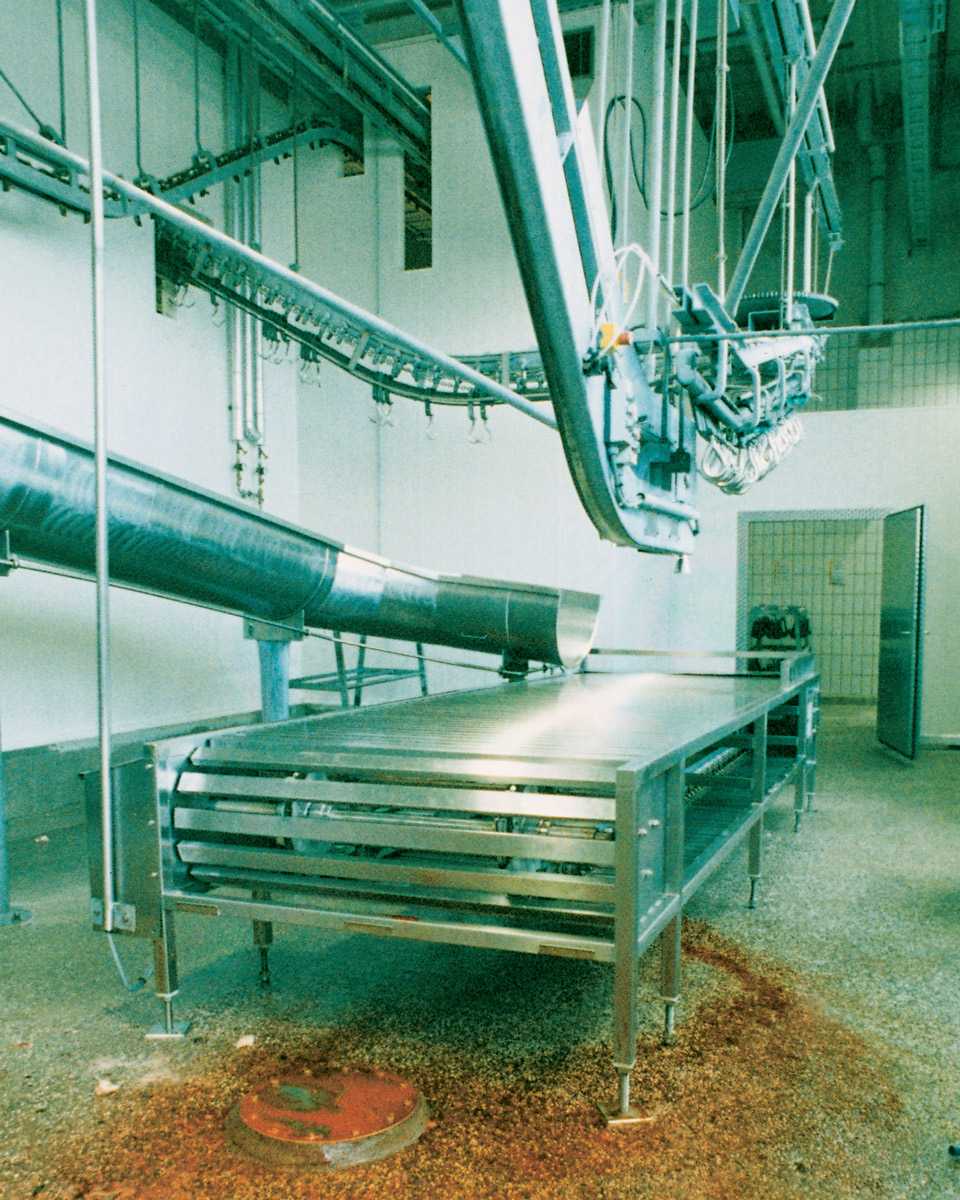
Although abattoirs radically altered the spatiality of slaughter, they did not immediately alter the practice of butchering. While butchers could no longer slaughter in their own shops, once they were at the public slaughterhouse, where each received a separate work chamber, they could perform their bloody craft in relative privacy and according to their own traditions. In the 1820s, animals were killed and flayed much as they had been 50 years earlier: “a young bull is thrown down and his head is tied to the ground with a rope; a strong blow breaks his skull, a large knife gives it a deep wound in the throat; steaming blood spills out in big bursts along with the life... Bloody arms plunge into its steaming innards, a blowpipe inflates the expired animal and gives it a hideous shape, its legs are chopped off with a cleaver and cut up into pieces and at once the animal is stamped and marketed.”[5] The entire act was performed by one or two specially trained men. In Paris and in Europe more generally, butchering retained its status as an artisan craft throughout the nineteenth and most of the twentieth century. Traditions remained strong, and butchers resisted the types of industrial automation that would typify the stockyards of Chicago.
The Parisian abattoirs, nevertheless, accomplished their two most important objectives. They removed slaughter from public view and placed it under state surveillance. It should be noted that the term “public” in public abattoirs did not refer to the people of Paris, but rather to the state and its welfare politics, which revolved around more abstract concepts of population growth and control. Especially in nineteenth-century cities, the provision of growing populations posed a major challenge to the process of urbanization. Public abattoirs were a first step towards the establishment of a mass-society liberated from famine. They helped to ensure the sufficient production of meat. They also served to protect the public and contain street pollution, while at the same time, they aided the state in its quest to gain control over its population, modes of production, and acts of killing.
The urbanization of animal slaughter was not just a matter of politics; it was also closely tied to the accumulation of knowledge and to evolving conceptions of urban space, especially the emergence of the public-hygiene movement that shaped the course of urban reforms. Advocating a peculiar mixture of morality, social welfare, and environmental control, public hygienists studied everything related to the health of humans and the cleanliness of urban environments. As a result, Paris’s five public abattoirs, too, came under increased supervision during the 1830s and 1840s. Alongside prostitution, hospitals, and sewers, abattoirs became a central battleground in the struggle to improve the physical and moral hygiene of Paris. Starting with the conduct of butchers and the physical appearance of livestock, hygienists investigated anything and everything related to the abattoir. Some even went as far as to conduct self-feeding experiments with rotten meat to determine its effects on human health.
Meat became a critical aspect in the discourse about and demands for better living conditions. The growing recognition of protein as a life sustaining nutrient enhanced the significance of meat consumption, not least because of its potential to extend the general life expectancy of populations, especially that of the lower classes. The tremendous population growth of the 1850s, which brought more than 600,000 new, mostly poor, inhabitants to the city, heightened the need for reforms, because it further intensified the already rampant problems with Paris’s urban space and its haphazard infrastructures of provision. With regard to meat production, the biggest problem was the continued geographical separation of the livestock market and the abattoirs. Since they were located in different parts of the city, livestock herds continued to be an all-too-visible sight in the streets of Paris. By 1850, close to a million animals traversed the city annually, adding considerably to traffic congestion and street pollution. And there was another incentive for reforms—the invention of rail transport. The emergence of railroads drastically altered existing infrastructures. Among other things, it enabled the expansion of agriculture, but also necessitated the greater concentration of markets, especially in the city.
It is hard to imagine that slaughterhouses could be the objects of pride, but for Baron Georges-Eugène Haussmann, probably the most famous and arguably the most controversial Prefect of Paris, they were “one of the most considerable works accomplished by [his] administration.”[6] This is all the more surprising since it was under Haussmann that Paris underwent the most dramatic transformation in its history. In 1858, following intensive studies of the existing conditions, Haussmann proposed the building of new slaughterhouses combined with markets and connected to railroads. Initially his plans were rejected by the city council, but following the annexation of numerous suburbs to the territory of Paris in 1859, Haussmann’s project was approved, in part, because suddenly the city housed nine separate slaughterhouses.
Despite disagreements among reformers, city officials, and butchers about the necessity for new slaughterhouses, their construction began in 1860. The chosen site was located in one of the newly annexed districts in the northeastern corner of Paris at La Villette. A rapidly growing industrial district, La Villette offered a premier site with plenty of water and a ready connection to Paris’s railways. The market was completed in 1862, and the slaughterhouses opened in 1867 during the World Exposition that was held in Paris that year. La Villette was instantly considered a monument to the new industrial design based on iron and glass. The fifty-six-hectare terrain housed three market halls for the trade of livestock, numerous stables for cattle, sheep, and pigs, and several administrative buildings, including a police station, post office, and stock market. The design of the grand halls followed that of the markets at Les Halles, both of which were built by the then prominent architect Victor Baltard. Much like Les Halles, La Villette combined elegant form with commercial function. Many of the adjacent buildings were built according to the neo-classical style of architecture. Attached to the market were the new slaughterhouses just on the other side of the Canal Ourcq, which served as the boundary not only between the two facilities, but also between the “living” and the “dead.”
The opening of Le Marché et Les Abattoirs de La Villette completed the centralization of slaughter. Trains delivered livestock right to the markets, where animals were traded and sent right to the slaughterhouse. Once animals entered the abattoirs, there was only one possible way out—as a carcass en route to a meat market. La Villette, at least for the animals, was a one-directional enterprise. The facility stood as an icon to the rationalization of space. By 1900, La Villette had grown into a “city within the city.” Hundreds of humans and close to two million animals passed through its gates every year. Apart from minor extensions and remodeling in 1904, 1920, and again in 1930, La Villette continued to operate unchanged throughout most of the twentieth century, until the facility became obsolete in the 1960s, when large urban markets no longer fit into the decentralizing postwar economy. La Villette closed its gates in 1974.
Many European cities took a similar course towards urbanization during the nineteeth century. As cities grew, new infrastructures were needed to provide for growing populations and to accommodate the emerging dynamic of mass society. The increasing concentration of people, goods, buildings, streets, and factories required a new spatial order that could support urban growth, foster mobility, heighten industrial production, and improve living standards. The necessity of transforming medieval towns into modern metropoles gave rise to urban planning as well as public hygiene and welfare politics. The responsibility to raise or at least maintain the population’s prosperity increasingly fell into the hands of the expanding European public welfare states. Centering on a troubled politics of population, governments oversaw the operation of numerous public facilities such as hospitals, bath houses, parks, and sewage systems, gas works, and schools. The emergence of public slaughterhouses in cities across Europe was part of this larger process of transformation.
Quite a different set of forces was at work across the Atlantic in Chicago. Just as La Villette was being built in Paris, Chicago also witnessed the emergence of large-scale slaughter yards. The developments on both continents were driven by similar ambitions towards the greater rationalization and increased efficiency of slaughter. But the particular circumstances in each city led to the adoption of different approaches. The most visible differences were the cities themselves. Paris had existed for centuries and its population had risen to close to two million by 1871. Chicago, in contrast, was a young city (growing up only in the 1830s), and in 1870 its population amounted to a mere 220,000. Hence, unlike in Paris, the building of the Chicago Union Stockyards was hardly about reforming existing structures, but rather about creating new urban forms. Chicago’s slaughterhouses were not an obstacle to urbanization. Quite to the contrary, they spurred Chicago’s growth into the city that the poet Carl Sandburg called “hog butcher to the world.”[7] By 1900, Chicago would be the second-largest city in the United States, in no small part due to the slaughterhouses.
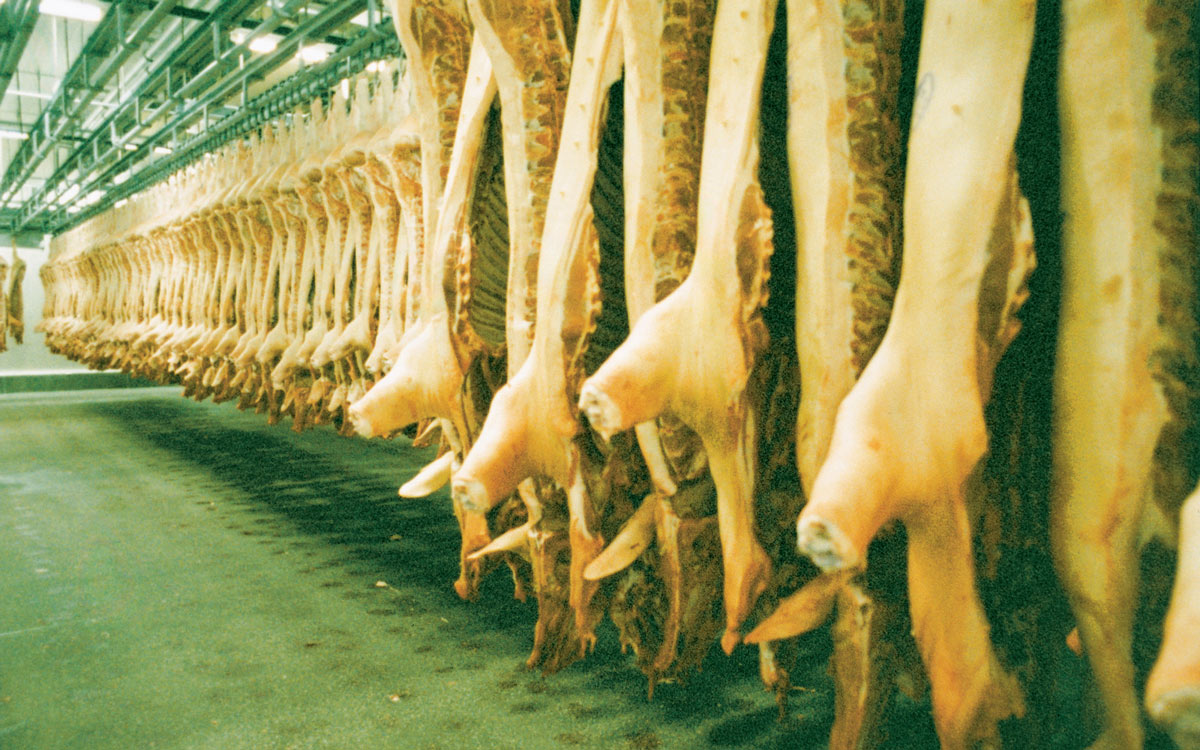
In the early 1860s, there were only a couple of small livestock dealers in Chicago, mainly to satisfy local demands. But with the arrival of railroads in the early 1860s, Chicago quickly developed into an important hub connecting the East and West. As in Europe, railroads offered a viable alternative to the treacherous shipment of goods over water. Yet, railroads required the centralization of markets. Thus, several of the existing hog companies decided to unite their operations in an effort to accommodate railroad technology and in the hope of creating a large profitable livestock market that would upstage Cincinnati. Consequently, on Christmas Day 1865, the Union Stockyards and Transit Company was founded on the South Side of Chicago. Within a few years, and especially after the arrival of Philip Armour and Gustavus Swift in 1875, Chicago devel-oped into a leading market for meatpacking. Whereas in the 1850s only about 20,000 hogs were slaughtered annually, by the mid-1870s, the number had climbed to more than three million. By the beginning of the twentieth century, an average of 13 million animals came through the stockyards each year. Undoubtedly, Chicago had turned into the largest producer of meat in the United States and possibly the world. La Villette fed Paris, but Chicago supplied the nation.
In nineteenth-century Europe, livestock, for the most part, was still painstakingly raised in small herds, while in the US large herds grew with minimum effort on the prairie. The stockyards were built for large herds that were kept in open-air cattle holding pens rather than stables. As slaughter facilities had to match this capacity, industrial efficiency became a key factor. New technologies of slaughter were constantly invented and old ones improved. One such invention was the refrigerated rail car, which enabled the transport of fresh meat. However, the most important of these inventions was the two-story disassembly line. Invented in Cincinnati but perfected in Chicago, the disassembly line gave Henry Ford his ideas for a prototype for car production. It consisted of an overhead rail system by which animals were hoisted and moved through compartmentalized workstations, where one man would slit the animal’s throat, another would tear off its hide, a third split the carcass, and on and on until the dressed carcass was hoisted into a rail car and sent on its way to consumers. With this process it took less than twenty-four hours from the moment an animal arrived until it was sold at the market, slaughtered, dressed, and shipped off as meat. This disassembly-style production enabled the stunning mechanization of slaughter, but it could not supplant manual labor completely. The individuality of animal bodies prevented the standardization of slaughter, which up to this day—despite technological sophistication—still often requires the human hand and its flexibility with a knife.
Such mechanization was possible because Chicago was less entrenched in the traditions of butchering. Reforms in Paris were constantly met with resistance by butchers intent on preserving their traditional habits. In Chicago there was little opposition; the stockyards were built not as a place for butchering but a factory of meatpacking. A different work structure guided production. Not individual butchers, but an easily replaceable manual work force arranged in a disassembly line turned animals into meat. By the late 1870s, the stockyards already employed approximately 2,000 workers. In the years to come this number would rise up to 45,000. Polish, Irish, and Lithuanian immigrant labor and African Americans from the South primarily sustained this growth. By the turn of the century, the stockyards were surrounded by ethnic neighborhoods that housed the workers and their families. They hardly shared in the prosperity that the stockyards were bringing to Chicago. Upton Sinclair powerfully captured their dire existence in his 1906 novel The Jungle. He described how the American Dream of the young Lithuanian immigrant Jurgis Rudkus turned into an American reality in the stockyards of Chicago. The slaughterhouses were not only deadly for livestock, but also horrific for workers, who had to endure bloody working and poverty-stricken living conditions.
The stockyards certainly were the American Dream for some, most notably for Philip Armour and Gustavus Swift, whose wealth was born amidst the blood, noise, and stench. One could get rich in Packingtown because it was based on private enterprise. In Europe most slaughterhouses belonged to the city, but in Chicago, they belonged to private entrepreneurs, whose motive was profit rather than public welfare. The developments in Chicago were less driven by a politics of population than by the economy of markets. The Union Stockyards illustrated how the pull of markets initiated an unprecedented mechanization and technological innovation. Nothing was wasted; every part of the animals was used. Packers prided themselves that they utilized “everything but the squeals.” The primacy of profit motives also manifested itself in the lack of concern for hygiene conditions and for the freshness of meat. Unlike in Europe, where inspections increasingly ruled operations in the slaughterhouse, in Chicago there were hardly any inspections or regulations because the state could not intervene as readily as in Europe. In Chicago, reforms were not instigated by the state but rather by scandal—a scandal brought on by literature. Upton Sinclair’s novel was fiction, but it shocked readers into demanding change. He had described the horrid conditions, poverty, and filth surrounding meatpacking. As he himself stated, “I aimed at the public’s heart, and by accident I hit it in the stomach.”
Like La Villette, the Union Stockyards existed well into the twentieth century. However, the postwar spread of automation increasingly rendered the once path-breaking multi-storey system inefficient and obsolete. Slowly the stockyards were replaced by new facilities further west in Iowa, Nebraska, and Colorado. Moreover, another transport innovation, the super-highway, took livestock traffic off the rails and onto the road. Once again market demands forced changes in the process of production. Whereas railroads had fostered centralization, now truck transport promoted decentralization and the search for cheaper locations in the countryside. And finally, urbanization itself was becoming an obstacle. The stockyards’ proximity to downtown was a growing nuisance, especially in terms of smell; thus the city showed little interest in retaining the slaughterhouses. Slowly the stockyards closed down. Swift left in 1958, Armour the following year, and most others followed suit. The final announcement, that after a hundred years of operation the stockyards would shut down completely, came in July 1971. Today there is nothing left of the former stockyards except one entrance gate and the small family-owned packinghouse of Chiapetti Lamb and Veal. The terrain is used as a multi-purpose industrial park for warehouses and low-rise office buildings. By the mid-1970s, neither Paris nor Chicago operated slaughterhouses anymore. Tucked away in the countryside, butchering has truly moved out of sight. The post-industrial age witnessed the demise of the modern mass-slaughterhouse because it did not fit into the image of the so-called postmodern city. All over the world, former slaughterhouses are being reclaimed by the living, who are appropriating them for other purposes. Just last year, Les Abattoirs, a museum for contemporary art, opened in Toulouse, France, on the premises of a nineteenth-century slaughterhouse. In Landau, Germany, a slaughterhouse has been put to “adaptive reuse” as a library. Cities from Buenos Aires to Frankfurt are partaking in the slaughterhouse revival by turning former spaces of death into clubs, restaurants, boutiques, and other hip places. Meat-market districts in New York and Chicago have been transformed into trendy hangout areas and loft neighborhoods, reinventing the slaughterhouse as an æstheticized space for consumption and entertainment.
Not long ago, I was at La Villette for an outdoor screening of The Night of the Hunter. La Villette is now a “polyvalent cultural complex” that houses a science museum, festival space, and la Cité de la Musique. In the words of one of its architects, Bernard Tschumi, La Villette has turned “architecture against itself.”[8] Watching the film projected onto the former cattle market, which is one of the few buildings that remain, was an eerie experience. The park of La Villette is not just architecture turned against itself. It is life turned on its head.
- Thomas More, Utopia [1516] (New York: Cambridge University Press, 1989), p. 57.
- Denis Hollier, Against Architecture: The Writings of Georges Bataille (Cambridge, MA: The MIT Press, 1989), p. xv.
- Louis-Sébastien Mercier, Tableau de Paris, vol. 5 (Paris: 1782), pp. 101–103.
- Ibid., p. 28.
- Louis-Sébastien Mercier, Tableau de Paris, vol. 5, pp. 123–124.
- Georges-Eugène Haussmann, Mémoirs du Baron Haussmann, vol. 3 (Paris: Victor-Havard, 1893), p. 560.
- Carl Sandburg, Chicago Poems (New York: Dover Publications, 1994), p. 1.
- Bernard Tschumi, Cinégram folie: Le parc de la Villette (New York: Princeton Architectural Press, 1987), p. vii.
Dorothee Brantz is writing a doctoral dissertation at the University of Chicago on the history of slaughterhouses in nineteenth-century Berlin and Paris.
Spotted an error? Email us at corrections at cabinetmagazine dot org.
If you’ve enjoyed the free articles that we offer on our site, please consider subscribing to our nonprofit magazine, which includes unlimited access to all our archives.