


Seashell Sound
Echoing ocean, vibrating air, brute blood
Stefan Helmreich
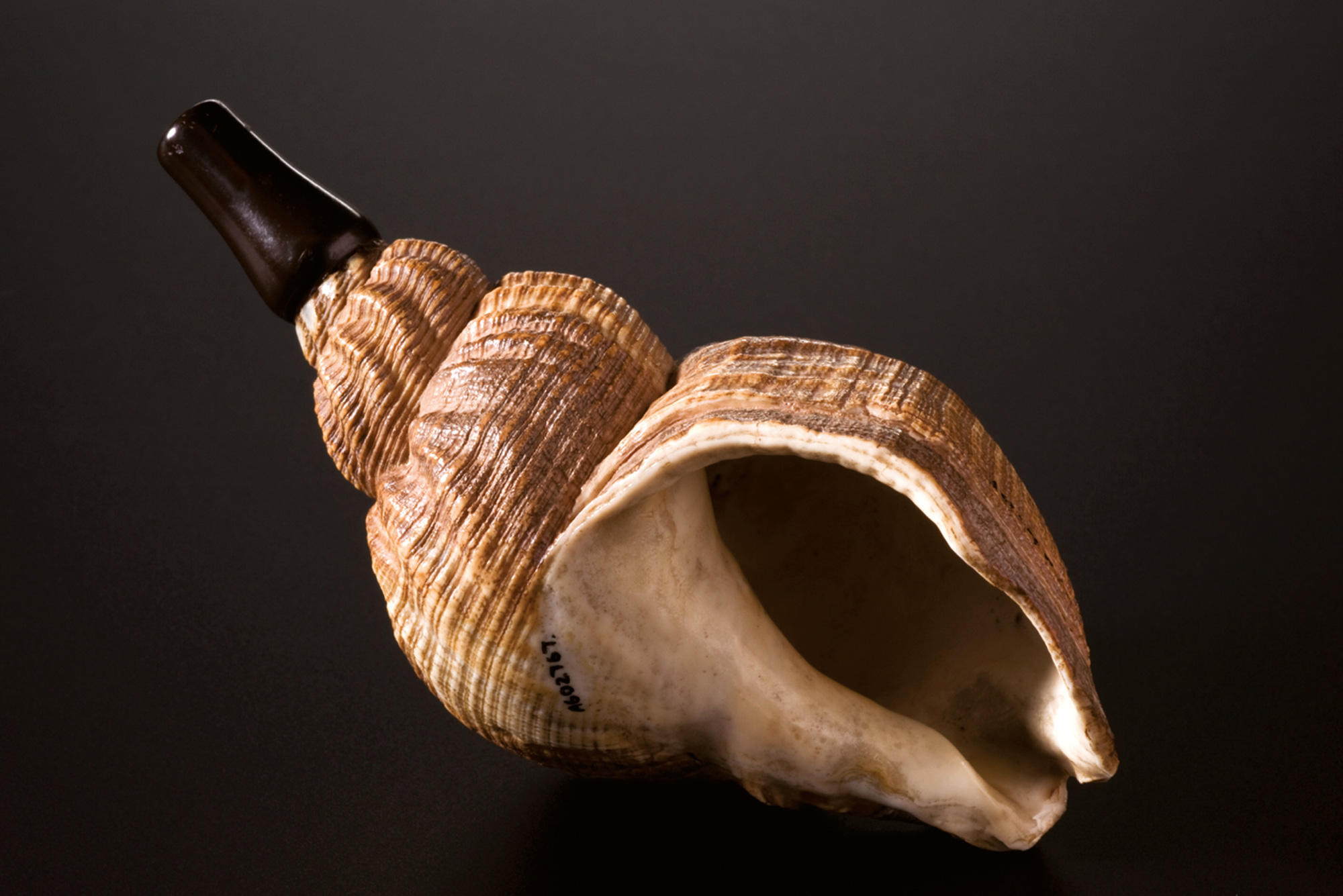
Shell of the bright sea-waves!
What is it, that we hear in thy sad moan?
Is this unceasing music all thine own?
Lute of the ocean-caves!
Or does some spirit dwell
In the deep windings of thy chambers dim,
Breathing forever, in its mournful hymn,
Of ocean’s anthem swell?
—Amelia Welby, “To a Sea-Shell,” 1845[1]
What sounds reside in spiral seashells? For generations, people who live by the sea have held that, when pressed to the ear, seashells resound with something like the roar of the ocean—a sensation whose explanation has offered a puzzle pleasurable and provocative to scientists and lay listeners alike.
In his 1915 Book of Wonders, popular science writer Rudolph Bodmer suggested that the association followed from the symbolic power of shells: “The sounds we hear when we hold a sea shell to the ear are not really the sound of the sea waves. We have come to imagine that they are because they sound like the waves of the sea, and knowledge that the shell originally came from the sea helps us to this conclusion very easily.”[2] But the likeness, he urged, had a technical explanation—though one in which similitude still figured. Both sea and seashell sounds were generated by waves: “The sounds we hear in the sea shell are really air waves”—waves, that is, of concentrated, resonant noise from the listener’s surroundings.
That explanation sought to supplant superstition with science, trading sublime enchantment for fascinating fact. The account in Bodmer’s book rested on a century of empirical and theoretical investigation in which sound had come to be understood as vibration, and not, as earlier, more numinously, on the model of music or voice, exampling what Jonathan Sterne names as a “shift from models of sound reproduction based on imitations of the mouth to models based on imitations of the ear.”[3]
Tune in a century later, however, and ear-centered explanations like Bodmer’s coil in on themselves; his explanation of seashell resonance (in agreement with scientific thinking then and now) loses out in most popular accounts to the erroneous claim that what we hear in seashells is the flow of our own blood. Jennifer Lawson’s 2001 Hands-on Science and Technology asserts, “Many students will tell you that they hear the ocean in the seashell. Actually, the dull roaring sound they hear is the echo of the blood moving inside their ear.”[4] OMGFACTS.com—“the #1 fact source on Twitter,” and a contemporary analog, perhaps, to the Book of Wonders—offers, “When you put a seashell next to your ear, it’s the sound of your blood surging in your veins, not the ocean.”[5] Oceanic other, sounded out, outs itself as inside noise.
Why this slide from the sound science of reverberating air to the sciency-sounding flow of blood? In 1889, Robert E. C. Stearns coined the term “ethno-conchology” to describe how shells have “been curiously interwoven with the affairs of men, both in civilized and barbarous communities.”[6] I suggest that the changing ratios of ocean, air, and blood in seashell sound accountings track a European-Atlantic-American ethno-conchology, one that unrolls from Romantic enthrallment toward a double-edged modernity that uses the language of science to disenchant at one moment and then re-enchant at another. This essay puts an ear to popular science and poetry, following a history that has, first, shells singing, speaking, sighing, and echoing distant oceanic and communal pasts, and next, shells reflecting back the personal and present moment, and, then, as we approach today, delivering sounds imagined deep inside, rather than outside, human bodies. At stake are changing models of the relation between hearing, the world, and the self, with the avowedly mystical and communal gradually replaced by the secular, scientific, and individual—though, with the arrival of the blood-in-the-ears interpretation, infused anew with an element of the mythical.
And heard that instant in an unknown tongue,
Which yet I understood, articulate sounds,
A loud prophetic blast of harmony;
An Ode, in passion uttered, which foretold
Destruction to the children of the earth
By deluge, now at hand.
—William Wordsworth, The Prelude or, Growth of a Poet’s Mind, Book Fifth, 1799–1805[7]
English and American poetry through the nineteenth century continued to hear speech in seashells, sometimes clear, sometimes ghostly.[8] Wordsworth’s ode came from the future (a “prophetic blast”), but most—and we need not distinguish between lesser and greater poets—heard sounds from a distant past:
Gather a shell from the strewn beach,
And listen at its lips; they sigh
The same desire and mystery,
The echo of the whole sea’s speech.
—Dante Gabriel Rossetti,
“The Sea-Limits,” 1849–1855[9]
I send thee a shell from the ocean beach;
But listen thou well, for my shell hath speech.
Hold to thine ear
And plain thou’lt hear
Tales of ships
—Charles Henry Webb, “With a Nantucket Shell,” 1888[10]
The concave, undulating, and perfectly polished surface of many sea shells, fit them to catch, to concentrate, and to return the pulses of all sounds that happen to be trembling about them, so as to produce that curious resonance from within, which resembles the distant murmur of the ocean.[11]
In 1836, John Ayrton Paris’s Sports and Amusements for the Juvenile Philosopher translated this accounting for a younger readership: “The interior of the shell merely concentrates and thus multiplies the sounds around us, so as to render them audible.”[12] The language of vibration became a steady feature in such explanations, as, for example, in 1857’s The Reason Why: A Careful Collection of Many Hundreds of Reasons for Things Which, Though Generally Believed, Are Imperfectly Understood:
Why do sea-shells give a murmuring noise when held to the ear?
Because what may be called expended vibrations always exist in air where various sounds are occurring. These tremblings of the air are received upon the thin covering of the shell, and thus being collected into a focus, are transmitted to the ear.”[13]
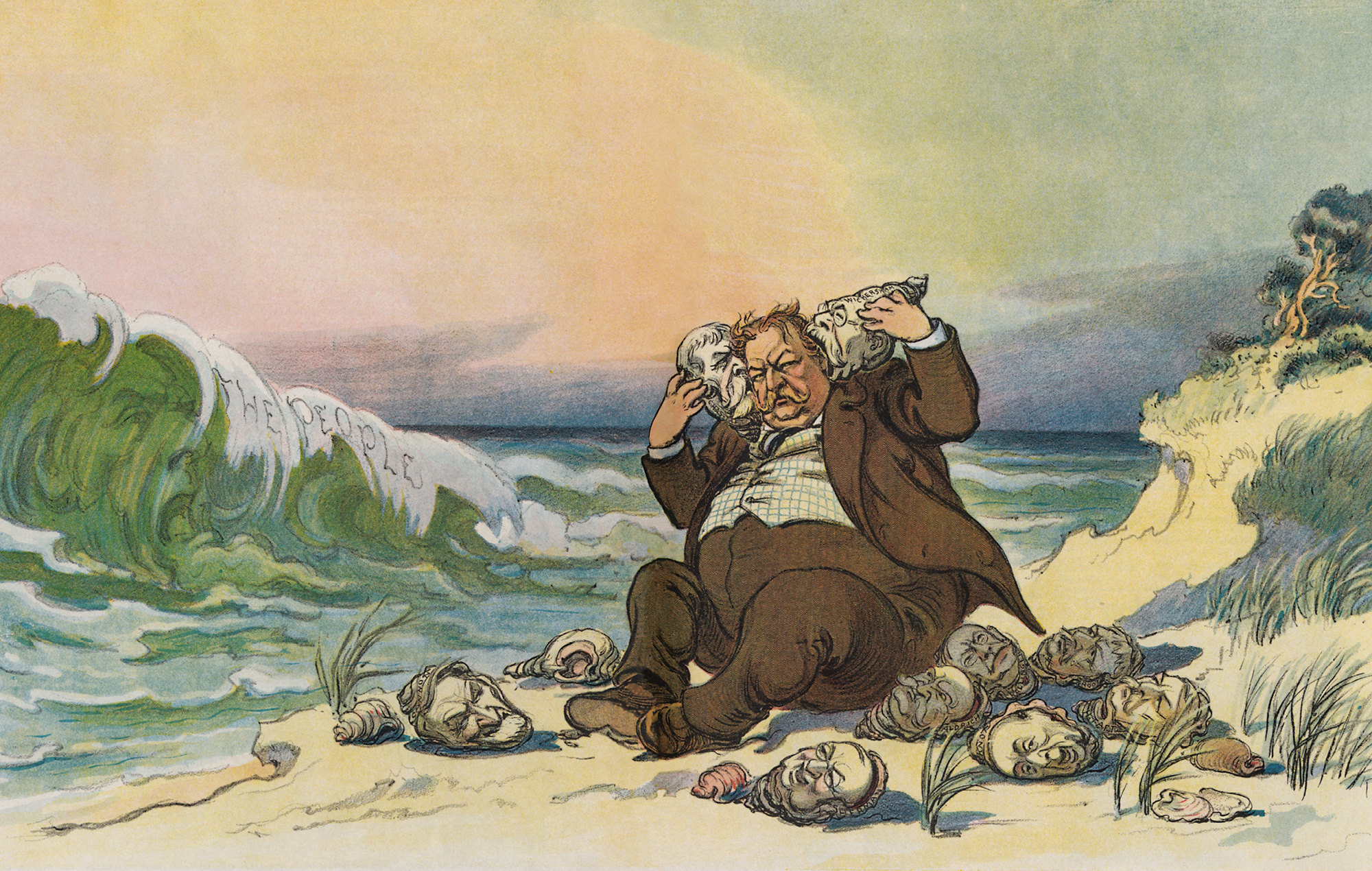
Such understandings of sound, which would be famously codified in 1862 by Hermann von Helmholtz in his On the Sensations of Tone, were not immune to fanciful appropriations, especially alongside spiritualisms that held that worldly vibrations might contain the voices of the dead.[14] In Florence McLandburgh’s 1873 story “The Automaton-Ear,” a scientist constructs an ear trumpet that can be tuned to the decaying sound waves of any moment in history.[15] Not dissimilarly, seashells sometimes harbor the diminishing, but never final, sounds of the dying:
I low mine ear incline:
Within your convolutions sway and swash
All voices of the brine;
I hear on barren reefs the surges dash.
The breakers roar;
The homeless billows fret and foam and wash.
And die far off upon an alien shore.
...
Though all things fade apace,
Do fade and fall, they pass not utterly;
Within your jasper vase
There lingers still a tone, a mystery.
A something hides
Of glory fled, of love that cannot die:
All Life that ever was somewhere abides.
—Benjamin Hathaway, “Sea-shells,” 1878[16]
As spirit mediums, shells were strangely active vessels. Like mediums, they were often female, with voices
Like the sigh of a maiden in lone despair,
...
Such, such are the sounds of the wild sea shell
...
Across my ear like the tones of woe,
It soundeth to me
Like the voice of the sea,
And sweet is its mournful melody.
...
Like a holy hymn
Of nymphs in deep devotion.
—William Quarmby, “The Song of the Sea-Shell,” 1867[17]
or like the sound
Of my mother’s voice—the ocean’s voice—
The murmur of the sea.
—E. W. Bäärnhielm, “The Song of the Sea-shell,” 1891[18]
As Susan Gubar suggests, “Associated iconographically with Venus and the Virgin, the shell is also said to represent the female genitals.”[19] Mother Ocean bodied forth messages from a mysterious past, with seashells the vibrating vessels of that murmurous history.
I saw the sea-shell’s lips burn like a flame
When the wave chased and caught it with a breath of laughter,
And whispered in its ear the ocean name
That it sings o’er and o’er forever after.
—Avanelle L. Holmes, “A Beautiful Life,” 1871[21]
Such ear-shell connections were in the making earlier (rendering this whole history, perhaps, more spiral than linear, with symbolisms washing to and fro, especially in the devious sounding devices that are poems). Paduan anatomist Gabriele Falloppio, describing the spiral cavity in the inner ear in 1561, called it the cochlea, Latin for “snail.”[22] Ear-seashell analogies remain saturated with the oceanic. Tara Rodgers explains that the ear has been construed as holding an ocean within: the “term ear ‘canal’ itself evokes a channel of water for navigation, an arm of the sea.”[23] She reports that physicist James Jeans in his 1937 Science & Music advanced a “vibrant analogy of sound and water waves that transposed this turbulent fluidity of the sounding world onto the interior of the subject.” Jeans wrote:
Sound reaches our ears in the form of waves which have travelled through the surrounding air, much as waves travel over the surface of a sea or river; some of these waves travel down the inch-long backwater formed by the auditory canal, and finally encounter the ear-drum, which forms a barrier at the far end.[24]
The shell operates at once as mouth, damp and resonant grotto, and doppelgänger ear—an eerie object becoming (never entirely) a disenchanted scientific thing.
Walter Benjamin played with the notion that shells contain worldly echoes, writing in the 1930s about his childhood around 1900: “Like a mollusk in its shell, I held my abode in the nineteenth century, which now lies hollow before me like an empty shell.” Imagining he could hold that century to his ear, he asked, “What do I hear?” answering,
the brief clatter of the anthracite as it falls from the coal shuttle into a cast-iron stove, the dull pop of the flame as it ignites in the gas mantle, and the clinking of the lampshade on its brass ring when a vehicle passes by on the street. And other sounds as well, like the jingling of the basket of keys, or the ringing of the two bells at the front and back steps.[25]
Robert Ryder suggests that, “what Benjamin hears in the conch are the primordial murmurings of the universe, but in the form of their smallest acoustical singularities.”[26] This, argues Ryder, is the acoustical unconscious (or “un-conch-ious”). But Benjamin’s is also a moment in Euro-conchology in which shells concentrate memory by gathering the history of the vibrating world around them. We have the meeting of two models for seashell sound: a mythic model that has seashells as channels for voices from a communal past, and a materialist model that has seashells as resonant chambers of individual, located experience.[27]
The hollow sea-shell, which for years hath stood
On dusty shelves, when held against the ear
Proclaims its stormy parent; and we hear
The faint far murmur of the breaking flood.
We hear the sea. The sea? It is the blood
In our own veins, impetuous and near,
And pulses keeping pace with hope and fear
And with our feelings’ every shifting mood.
—Eugene Lee-Hamilton, “Sea-Shell Murmurs,” 1882[28]
James Joyce’s Ulysses, 1922:
Bloom through the bardoor saw a shell held at their ears. He heard more faintly that that they heard, each for herself alone, then each for other, hearing the plash of waves, loudly, a silent roar.
...
The sea they think they hear. Singing. A roar. The blood is it.[29]
For this explanation to gather momentum, blood must first be imagined to have a sound. Such became newly possible with the stethoscope, invented in 1816 and fine-tuned through the nineteenth century. Interestingly, the sounds it delivered were sometimes compared to those from a seashell. An 1893 manual: “The principal pathological venous murmur is the venous hum or bruit de diable. It is compared to the sound heard on placing a sea shell of moderately large size against the ear.”[30] It would be important for doctors not to confuse the sound of blood with stethoscopic channels; an 1886 advertisement for a “binaural stethoscope” suggests that an imperfect device “reminds us of the child’s toy resonator, a sea-shell.”[31] But if seashells play tricks, stethoscopes enable people to imagine hearing their own blood.[32] In further lines of Lee-Hamilton’s “Sea-Shell Murmurs,” the heart itself becomes a shell:
Lo! in my heart I hear, as in a shell,
The murmur of a world beyond the grave,
Distinct, distinct, though faint and far it be.
Thou fool; this echo is a cheat as well,—
The hum of earthly instincts; and we crave
A world unreal as the shell-heard sea.
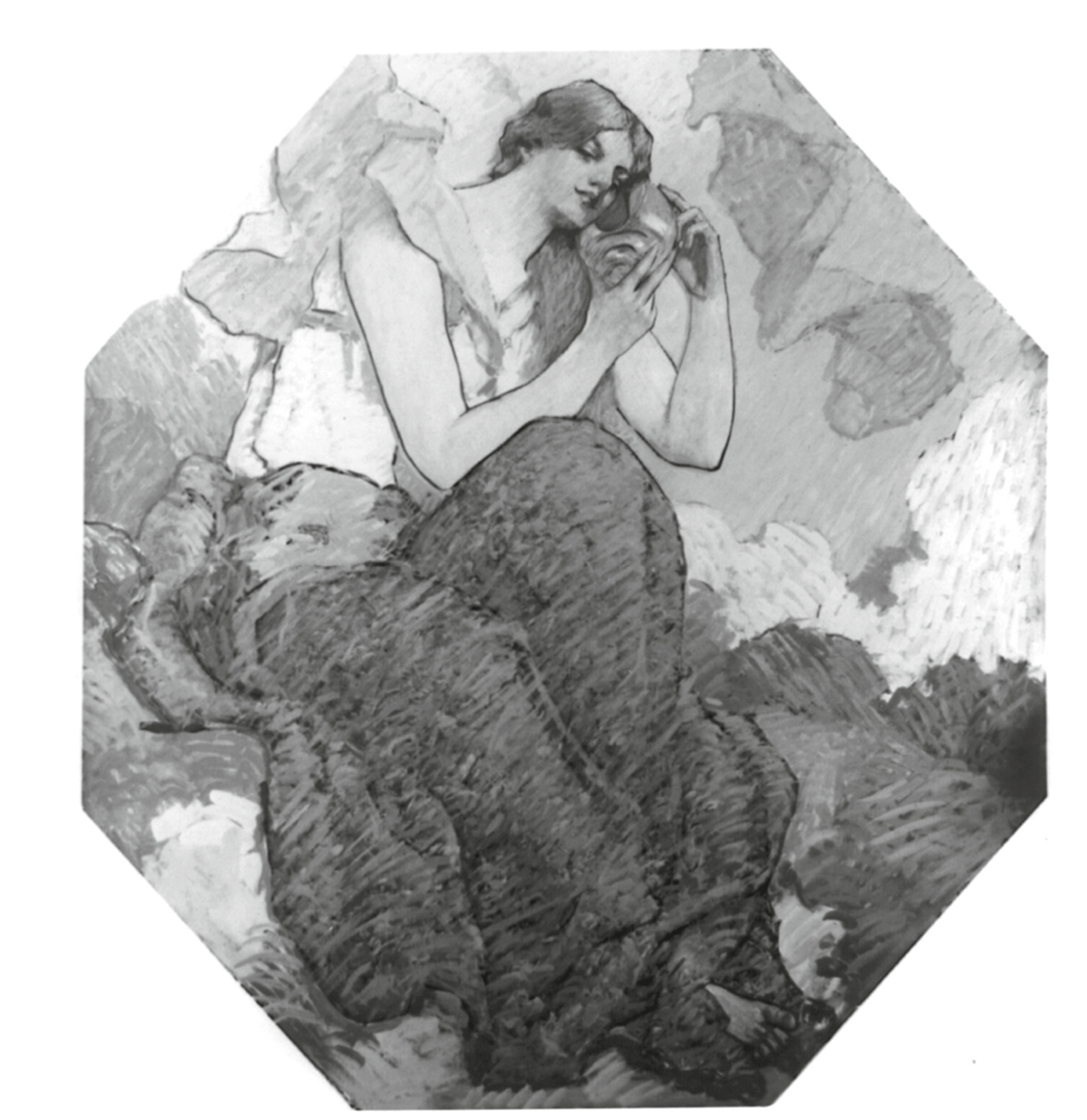
The move from hearing a communal mythical past to auditing an individual present continues, now reaching into physiology. Lee-Hamilton’s sly suggestion that even heart sound has no intrinsic meaning, however, indicates an emergent ambivalence here—something like the ambivalence of modernism, which oscillates between disenchantment and re-enchantment.[33]
One can find the blood-echo explanation these days in many venues, mostly—ironically—educational ones devoted to clearing up misconceptions of scientific facts. The 1993 textbook Science Interactions reports, “What you’re really hearing is the sound of your own blood rushing through the vessels inside your ear. You normally don’t hear this sound. The seashell makes it easier for you to hear it.”[34] Gifted and Talented, Questions and Answers: Super Edition for Ages 4–6 from 2000 suggests, “The seashell’s hard, smooth surface bounces, or echoes, the sound of the flowing blood back into your ears. This sound is very much like the sound of the ocean.”[35] Even rationalist skeptic Carl Sagan got behind this angle: “Everyone knows the ‘sound of the sea’ to be heard when putting a seashell to one’s ear. It is really the greatly amplified sound of our own blood rushing.”[36]
Sometimes such explanations bring waves back in; the cochlea contains fluid that carries traveling waves.[37] Deeper confusion arrives, courtesy of www.faqkids.com:
When you put a seashell up to your ear, what you hear is not the ocean. The sound comes from inside your own ear. The inner part of your ear, the part that is far back into your head, has both bone parts and soft tissue parts. In between these is your cochlea, which is a tiny organ that looks like a snail’s shell. Your cochlea is filled with fluid. This fluid helps you transmit sounds from your eardrum to your brain. And it sloshes around like waves. We don’t usually hear this sound because it is so quiet. But when you hold a seashell to your ear, this small sound echoes off the shell and back into your ear.[38]
This explanation recalls Jeans’s conception of the ear holding its own ocean. But how has the blood-(or other fluid)-in-the-ears account gained its popularity?
The shell, which in Wordsworth had a “tongue” and an “articulate sound,” came to have a voice whose “speech” (Rosetti, Webb) was always competing with the “moan” of “unceasing music” (Welby), a “sigh” (Rosetti, Quarmby), an “echo,” or a “murmur” (Rosetti, Bäärnhielm). The murmur became vibratory, a sign of present-day rather than long-ago worlds. It blurred boundaries between mouth and ear, and the shell became like a telephone—as in Holmes’s 1871 poem in which shell is “lips” and “ear,” a chamber of echoes conjoining listening and speaking, turning auditors back on themselves.
That transformation prepared the way for a model of subjectivity in which people could imagine themselves sensing themselves sensing. Fast forward to a key moment in the history of modernist sound. In the early 1950s, after visiting an anechoic chamber, a room designed to absorb all sound, composer John Cage wrote: “In that silent room, I heard two sounds, one high and one low. Afterward I asked the engineer in charge why, if the room was so silent, I had heard two sounds. He said, ‘Describe them.’ I did. He said, ‘The high one was your nervous system in operation. The low one was your blood in circulation.’”[39] As Douglas Kahn has observed, Cage, who in most settings refused to ask after the “source” of sounds (he wanted “sounds to be themselves”), here conjured a dematerialized, disembodied self: a listener inside the shell of the body.[40]
The blood-echo explanation winds the scientific back to the fantastic. The echoing ocean, once dethroned by vibrating air, has now been displaced by brute blood, something of a solipsistic surrogate for the salty sea. But what the ocean wave and blood pulse explanations have in common is the idea that human experience reaches into depths we cannot fathom—that what we feel in the moment arrives from far away or inside, from zones that evade direct apprehension.
I thank Noel Jackson, Douglas Kahn, Heather Paxson, John Picker, Sophia Roosth, Michael Rossi, and Hillel Schwartz for listening.
- Amelia B. Welby, Poems, by Amelia (Boston: A. Tompkins, Cornhill, 1845), p. 21.
- Rudolph John Bodmer, The Book of Wonders (New York: Presbrey Syndicate, 1915), p. 79. Bodmer’s book was described on its title page as giving “plain and simple answers to the thousands of everyday questions that are asked and which all should be able to, but cannot answer.”
- Jonathan Sterne, The Audible Past: Cultural Origins of Sound Reproduction (Durham, NC: Duke University Press, 2003), p. 33.
- Jennifer E. Lawson, Hands-on Science and Technology: Sound, Physical Science (Winnipeg: Portage & Main Press, 2001), p. 39.
- See www.omg-facts.com/view/Facts/13.
- Robert E. C. Stearns, “Ethno-Conchology: A Study of Primitive Money,” Annual Report of the Board of Regents of the Smithsonian Institution 1887, part 2, p. 297. I cannot follow all ethno-conchologies here, and sound created by blowing though shells is a major absence here. Take, too, Southern black American tradition, which uses shells to mark graves. A woman from St. Simons Island, Georgia: “The shells stand for the sea. The sea brought us, the sea shall take us back. So the shells upon our graves stand for water, the means of glory and the land of demise.” In William S. Pollitzer, The Gullah People and Their African Heritage (Athens: The University of Georgia Press, 1999), p. 184. In another context, audio designer Pietro Desiato in 2007 proposed a memory project for graves sited in Malmö, Sweden, that would use seashells outfitted with internal digital audio recorders as repositories for visitors’ words of remembrance. See Pietro Desiato, Memorie: Supporting the Practices of Memory in the Graveyard (Malmö, Sweden: School of Arts and Communication, Interaction Design Master Thesis, 2007). Available at dspace.mah.se/bitstream/handle/2043/6350/Memorie.pdf.
- William Wordsworth, The Prelude of Growth of a Poet’s Mind: An Autobiographical Poem (London: Edward Moxon, Dover Street, 1850). Wordsworth’s 1814 Excursion, ed. Sally Bushell, James A. Butler, et. al. (Ithaca: Cornell University Press, 2007), continues the theme:
I have seen
A curious child, who dwelt upon a tract
Of inland ground, applying to his ear
The convolutions of a smooth-lipped shell;
To which, in silence hushed, his very soul
Listened intensely; and his countenance soon
Brightened with joy; for from within were heard
Murmurings, whereby the monitor expressed
Mysterious union with its native sea.
- Spiral shells were new in Romantic poetry, displacing scalloped shells (which had been employed as sounding boards for lyres): “The seashell indicates the emergence of a new image of poetic voice as that which releases powers trapped in nature and in objects by breathing in (inspiring) voice as pneuma or spirit. … [But] … the voice or music which is projected from a seashell is not an original, external sound, but a series of echoes … the shell transforms these sounds by submitting them to the transforming acoustic of its resonating cavities, whether these belong to a seashell or to the Romantic poet.” Theresa M. Kelley, “Proteus and Romantic Allegory,” English Literary History, vol. 49, no. 3 (Autumn 1982), p. 636. Welby’s poem, with its shell moving from “lute” to “breathing,” may exemplify the shift from pre-Romantic to Romantic.
- Dante Gabriel Rossetti, Poems by Dante Gabriel Rossetti, ed. Elizabeth Luther Cary (New York and London: G. P. Putnam’s Sons, 1903), p. 123. More lips, this time from Oliver Wendell Holmes, Sr.:
From thy dead lips a clearer note is born
Than ever Triton blew from wreathèd horn!
While on mine ear it rings,
Through the deep caves of thought I hear a voice that sings:—
See his “The Chambered Nautilus,” in The Autocrat of the Breakfast-Table (Boston: Phillips, Sampson and Company, 1858), p. 111. The echo image appears in wider European worlds, for instance in J. H. van Lennep’s report on Dutch folklore, Notes and Queries, 2nd series, vol. 10 (July–December 1860), p. 184:
The shell, when put to child-like ears,
Yet murmurs of its bygone years,
In echoes of the sea;
- Charles Henry Webb, Vagrom Verse (Boston: Ticknor and Company, 1889), p. 27. Compare Stephen Crane’s “What says the sea, little shell?” in Souvenirs and a Medley (Aurora, NY: Roycroft Printing Shop, 1896).
- Dension Olmsted, An Introduction to Natural Philosophy: Designed as a Textbook for the Use of the Students in Yale College, vol. 2, second edition (New Haven: Hezekiah Howe & Company, 1835), p. 78.
- John Ayrton Paris, Sports and Amusements for the Juvenile Philosopher (Middletown, CT: E. Hunt and Company, 1836), p. 168.
- Robert Kemp Philp, The Reason Why: A Careful Collection of Many Hundreds of Reasons for Things Which, Though Generally Believed, Are Imperfectly Understood (London: Houlston and Wright, 1857), p. 133.
- Hermann Helmholtz, On the Sensations of Tone as a Physiological Basis for the Theory of Music (New York: Dover Publications, 1954). On vibrations as the persisting voices of the dead, see Jeffrey Sconce, Haunted Media: Electronic Presence from Telegraphy to Television (Durham: Duke University Press, 2000).
- For analysis of this story, see Shelley Trower, Senses of Vibration: A History of the Pleasure and Pain of Sound (London: Continuum, 2012).
- Benjamin Hathaway, Art-life, and Other Poems (Chicago: S. C. Griggs & Company, 1878), pp. 46, 49.
- William Quarmby, The Song of the Sea-shell, and Other Poems and Songs (London: Simpkin, Marshall & Co., 1867), pp. 8–9. 18 E. W. Bäärnhielm, The Icicle, and Other Poems (Portsmouth, NH: printed for the author, 1891), p. 24.
- Susan Gubar, “The Echoing Spell of H. D.’s Trilogy,” in Signets: Reading H. D., ed. Susan Stanford Friedman and Rachel Blau DuPlessis (Madison: University of Wisconsin Press, 1990), p. 301.
- In Lowell’s 1888 “With a Sea-shell,” a lover deputizes a seashell as his voice: “Shell, whose lips, than mine more cold, / Might with Dian’s ear make bold, / Seek my Lady’s.” The shell is masculine, though the beloved’s ear—an “archway, pearly-pink”—is a feminine double of the shell. James Russell Lowell, “With a Sea-shell,” in The Complete Poetical Works of James Russell Lowell, ed. Horace E. Scudder (Boston: Houghton, Mifflin and Company, 1896), p. 411.
- Avanelle W. Holmes, “A Beautiful Life,” in The Ladies’ Repository: A Monthly Periodical Devoted to Literature and Religion, ed. I. W. Wiley, vol. 31 (Cincinnati: Hitchcock and Walden / New York: Carlton and Lanahan, 1871), p. 279.
- Gabriele Falloppio, Observationes anatomicae (Venice: Marco Antonio Ulmo and Gratioso Perchachino, 1561).
- Tara Rodgers, “Toward a Feminist Epistemology of Sound: Refiguring Waves in Audio-Technical Discourse,” in Philosophy After Irigaray, ed. Mary Rawlinson, Danae Mcleod, and Sara McNamara (Albany, NY: SUNY Press, forthcoming).
- Quoted in Rodgers, Ibid.
- Walter Benjamin, Berlin Childhood around 1900, trans. Howard Eiland (Cambridge, MA: Harvard University Press, 2006), p. 98.
- Robert Ryder, “Walter Benjamin’s Shell-Shock: Sounding the Acoustical Unconscious,” New Review of Film and Television Studies, vol. 5, no. 2 (12 July 2007), pp. 135–155.
- Thanks to Hillel Schwartz for this parsing, as well as for reports from his research into the biographical details of many of poets I quote here, details that often point to lives filled with mourning and loss.
- Eugene Lee-Hamilton, The New Medusa, and Other Poems (London: Elliot Stock, 1882), p. 119.
- James Joyce, Ulysses (New York: Vintage Books, 1993), p. 231. Poet Winfield Townley Scott in 1937 fuses the blood-in-the-ears account with then contemporary radio imagery:
My changing blood that hoards
This constant sound of sea,
That raging in its course
Keeps fleshless breath in me,
Sings nothing till this shell
Wound for wave music—takes
The radiant miracle
Broadcast in ethered wakes
See Winfield Townley Scott, “Blood and Seashell,” Poetry, vol. 50, no. 4 (July 1937), p. 188. - James Tyson, Manual of Physical Diagnosis (Philadelphia: P. Blakiston, Son & Co., 1893), p. 134. Figurative swirls into literal in 1995 with a stethoscope head “constructed from a sea shell having a relatively broad, generally circular aperture defining a sound chamber opening, said chamber having a naturally polished, sound reflecting, interior surface” (D. B. Katz, US Patent 5,420,382, 30 May 1995). The phrases venous hum and bruit de diable were bold in the original advertisement. See Hillel Schwartz, Making Noise: From Babel to the Big Bang and Beyond (New York: Zone Books, 2011) for the definitive history of stethoscopy.
- Advertisement for “Dr. Spencer’s Improved Binaural Stethoscope,” The Practitioner: A Journal of Therapeutics and Public Health, vol. 36, no. 3 (March 1886).
- Medical professionals argue that one’s blood cannot be heard from within: “The ear filters out or minimizes these sounds. Thus, for instance, the auditory ossicles (the malleus, incus, and stapes) are separated by fluid-filled membranes that reduce bone-conducted vibration. Sounds from inside the body are screened out so as to make the outside world audible. Ackerman suggests that, were this not to occur, even the sound of a person’s own blood flow ‘would be as deafening as sitting in a lawn chair next to a waterfall.’” See Tim Rice, “Sounding Bodies: Medical Students and the Acquisition of Stethoscopic Perspectives,” in The Oxford Handbook of Sound Studies, ed. Trevor Pinch and Karin Bijsterveld (Oxford: Oxford University Press, 2011), p. 304.
- This can have modernist poet H. D. write, mythically, at one moment,
There is a spell, for instance,
In every sea-shell:
and, more acoustically, at another,
He heard, as it were, the echo
Of an echo in a shell,
See “The Walls Do Not Fall” and “The Flowering of the Rod,” in H. D., Trilogy (New York: New Directions, 1998), pp. 8 and 156, respectively. - Bill G. Aldridge, Science Interactions, vol. 1 (New York: Glencoe / Macmillan / McGraw-Hill, 1993), p. 109.
- Susan Amerikaner, Bailey Kennedy, and Kathie Sweeney, Gifted and Talented, Questions and Answers: Super Edition for Ages 4–6 (Chicago: Lowell House Juvenile, 2000), p. 126.
- Carl Sagan, The Cosmic Connection: An Extraterrestrial Perspective (Garden City, NY: Anchor Press/Doubleday, 1973), p. 224. Sagan gets weirder: “But is this really true? Has this been studied? Has anyone attempted to decode the message being sounded by the seashell? I do not intend this example as literally true, but rather as an allegory. Somewhere on earth there may be the equivalent of the seashell communications channel. The message from the stars may be here already.”
- Elizabeth S. Olson, “Direct Measurement of Intra-Cochlear Pressure Waves,” Nature, vol. 402, issue 6761 (2 December 1999), pp. 526–529.
- See www.faqkids.com/410-seashells-sound-ocean.html.
- John Cage, A Year from Monday (Middletown, CT: Wesleyan University Press, 1967), p. 134.
- Douglas Kahn, “The Art of Anechoic Perception in Postwar America.” Lecture presented at Amsterdam School of Cultural Analysis, 30 March 2005. A 2003 poem has the writer losing her hearing, listening to sounds generated by her wounded ear: “…ocean sounds / the sound a seashell makes when you put it / to your ear.” See Sheryl St. Germain, “Tinnitus,” Women’s Studies Quarterly, vol. 31, nos. 1 & 2 (Spring 2003), pp. 181–183.
Stefan Helmreich is a professor of anthropology at the Massachusetts Institute of Technology. He is the author of Alien Ocean: Anthropological Voyages in Microbial Seas (University of California Press, 2009). He has lately been writing on the semiotics of sound.
Spotted an error? Email us at corrections at cabinetmagazine dot org.
If you’ve enjoyed the free articles that we offer on our site, please consider subscribing to our nonprofit magazine. You get twelve online issues and unlimited access to all our archives.