


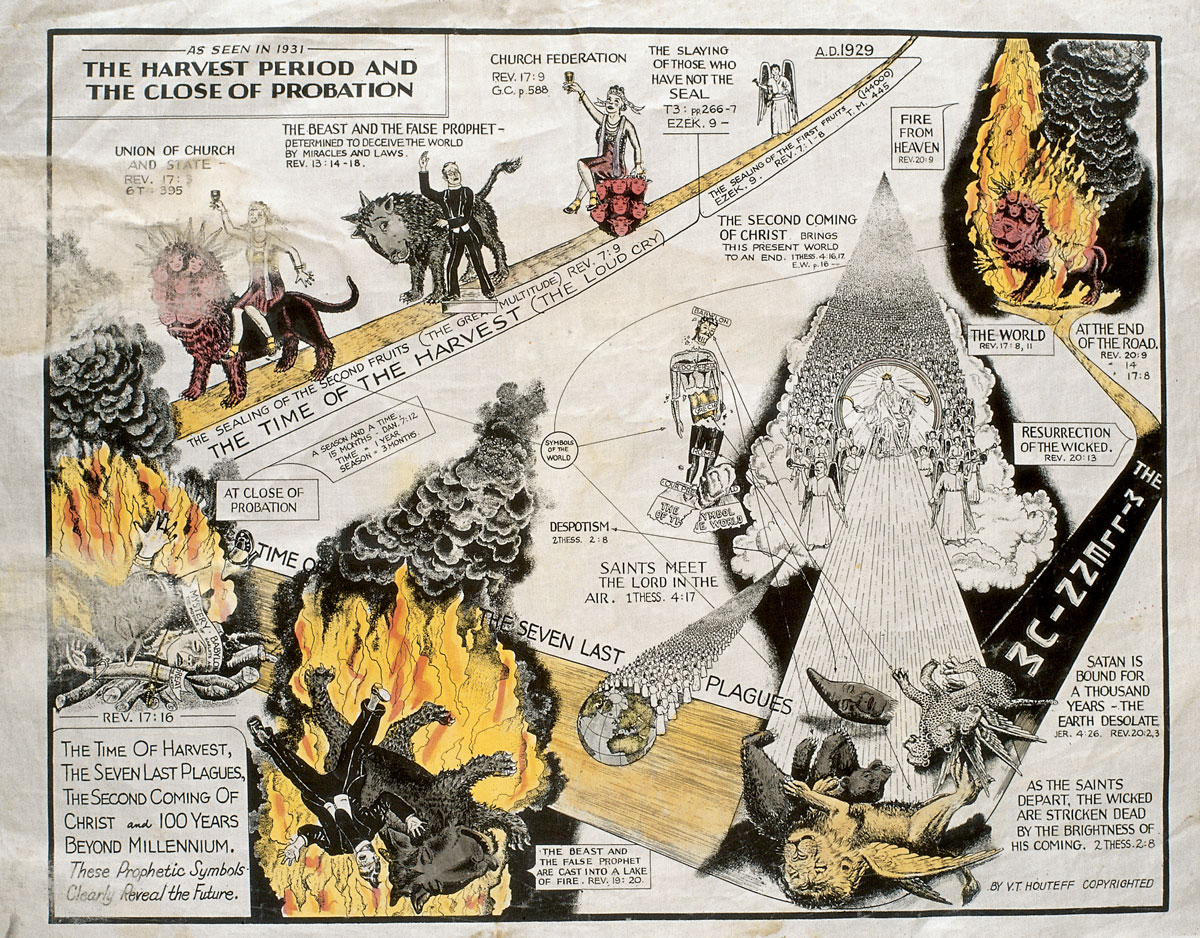
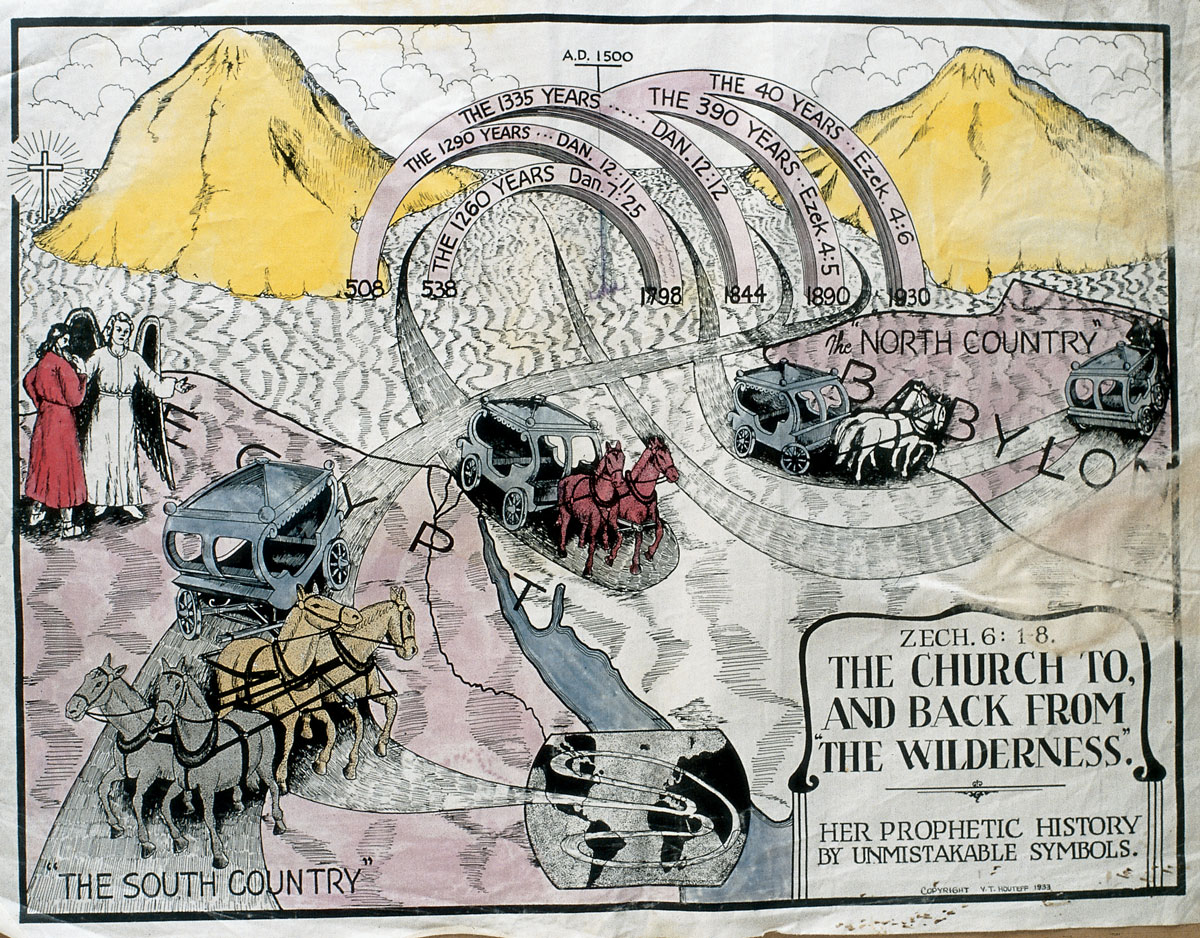
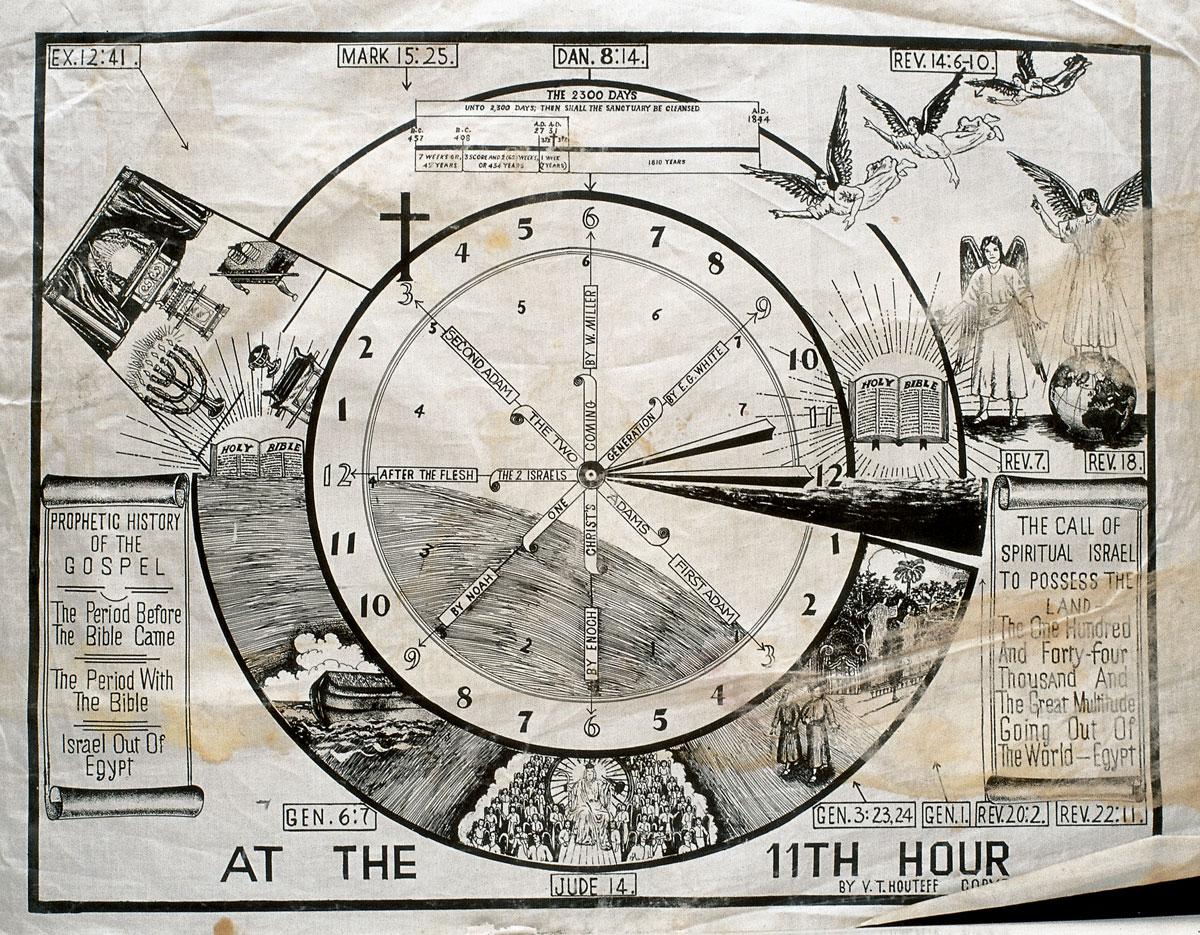
The three paintings by Victor Houteff on this page and the one offered as the postcard accompanying this issue are drawn from Jim Shaw’s collection of thrift store paintings. Shaw bought the four paintings in 1994 at a flea market in Pasadena.
A Bulgarian immigrant to the United States, Victor Houteff was running a hotel in the Southwest when, in 1918, he attended a tent meeting of a Seventh-Day Adventist group. Below is a chronology of the history of Adventist denominations in this country and Houteff’s involvement.
1782
William Miller born.
1843
Based on his studies of the Book of Daniel, Miller becomes convinced that Christ will return to earth. On 1 January, Miller commits himself to dates: “I am fully convinced that somewhere between March 21, 1843 and March 21, 1844, according to the Jewish mode of time computation, Christ will come.”
1844
In March, Miller states, “If this chronology is not correct, I shall despair of getting from the Bible and history a true account of the age of the world.” In May, Miller writes, “I confess my error and acknowledge my disappointment.” One of Miller’s Adventist followers revises Miller’s timetable and places Jesus’s second coming at 22 October 1844. Miller eventually accepts and promotes the revised date. When the October prophecy fails, the date becomes known as “The Great Disappointment.” Miller retires from active leadership, the movement falls into confusion, and numerous Adventist factions break off from the movement. After some recalculations, Miller declares that Christ had indeed come back, but had stopped halfway to earth in the heavenly sanctuary. One faction of Adventists also begins holding to the additional belief that the seventh-day Sabbath should be observed. Members of this group come to be known as “Seventh-Day” Adventists.
1849
Miller dies.
1918
Victor Houteff, a Bulgarian immigrant, joins the Seventh-Day Adventist church.
ca. 1929–1930
Houteff begins teaching doctrines that eventually get him expelled from the Los Angeles Seventh-Day Adventist church of which he is a member.
ca. 1930–1932
Houteff publishes his views in The Shepherd’s Rod, Vol. I and The Shepherd’s Rod, Vol. 2. He and his followers come to be known as the “Shepherd’s Rod Seventh-Day Adventists.”
1935
Houteff and his followers set up headquarters at Mt. Carmel, Texas, on the outskirts of Waco.
1942
Houteff’s group changes its name to the “Davidian Seventh-Day Adventists.”
1942–1954
The Davidians target their evangelistic efforts at the Seventh-Day Adventists denomination.
1955
Victor Houteff dies, leaving his wife, Florence, in charge. Almost immediately she gives a three-and-a-half year prophecy: God’s earthly kingdom will be established on 22 April 1959. One follower, Benjamin Roden, disagrees with Florence and asserts that the establishment of God’s kingdom will occur in 1960.
1955–1959
Roden claims he is the one who should succeed Victor Houteff as leader of the Davidians. He launches a letter-writing campaign to convince Seventh-Day Adventists and Davidians of his views.
Florence Houteff’s prophecy fails. Numerous factions break off from the once unified body of Davidians. The largest
faction is led by Benjamin Roden. He names his following “Branch Davidians.”
17 August 1959
Vernon Wayne Howell is born.
1960
Ben Roden starts backpedaling on his belief that the end will come in 1960. He changes his previously published chronological timelines, editing out what he predicted.
1962
Ben Roden legally obtains Houteff’s Mt. Carmel property.
1977
Ben’s wife, Lois Roden, has a vision in which she claims to have seen the Holy Spirit. Lois reveals she learned from the vision that the Holy Spirit is female.
1978
Ben Roden dies and Lois takes over as the head of the Branch Davidians.
1981
Howell joins the Branch Davidians.
1983
Howell gets his “message” and begins his live-in relationship with Lois Roden. His authority and influence start to grow.
1984
Twenty-four-year-old Howell weds fourteen-year-old Rachel Jones. After a heated conflict with Lois Roden’s son, George, Howell is forced out of Mt. Carmel with his wife. They move to Waco.
1985–1986
“Branches” (members of the group) begin to forsake Lois Roden and move away from Mt. Carmel to live under Howell’s leadership. Howell eventually acquires some property in Palestine, Texas, where he and his followers settle. Conflict between the Rodens and Howell continue.
March 1986
Howell takes thirteen-year-old Karen Doyle as his second “wife.”
August 1986
Howell secretly takes twelve-year-old Michelle Jones (Rachel’s sister) as his third “wife.”
Late 1986
Howell teaches that he is entitled to have at least 140 wives.
Early 1987
Seventeen-year-old Robyn Bunds becomes Howell’s fourth “wife.” He will continue to take more wives.
November 1987
Howell and eight of his male followers are arrested for attempted murder after being involved in a shoot-out with George Roden at Mt. Carmel.
April 1988
Howell and the eight others tried for attempted murder are set free. Within a few months, all the Branch Davidians move back to Mt. Carmel with Howell as their leader.
5 August 1989
Howell teaches the “new light” doctrine while staying in the Pomona, California, home of Donald and Jeanine Bunds. The “new light” makes Howell the rightful husband of all the women in the group, including those who are married. Husbands and wives are separated and the wives become part of Howell’s army.
Spring 1990
Howell changes his name to David Koresh.
Harry Steinberg received his Ph.D. at the Noll Institute in Copenburg. His forthcoming book is titled Journalistic Ethics and False Identity.