


Campus Prairie
A community assesses its landscape
Benjamin Goluboff
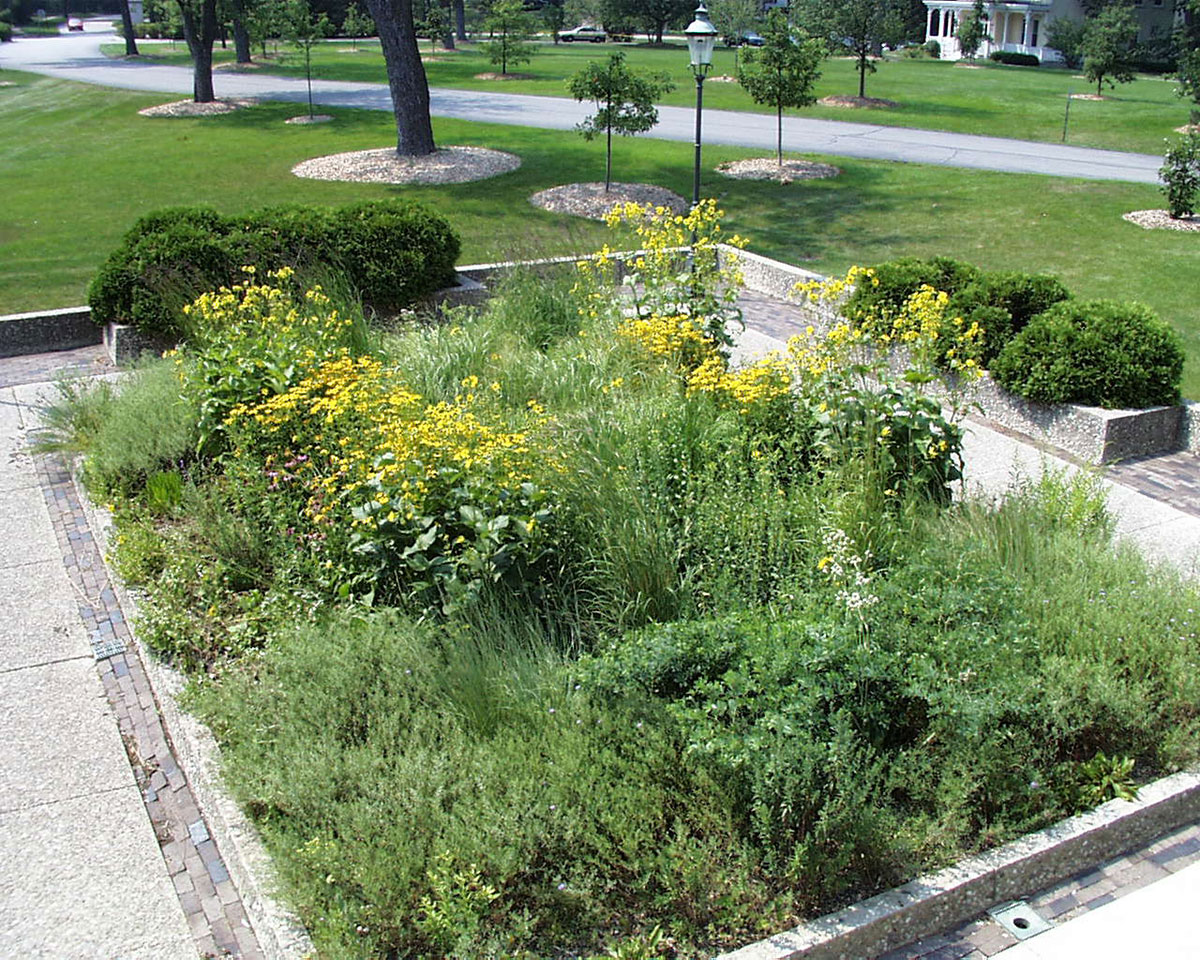
Campus legend has it that at the last homecoming weekend—an event on which our administration and development people focus a year’s worth of fundraising anxiety—an alumnus and presumptive donor walked into the Dean’s office and announced that if Lake Forest College couldn’t find a better way to manage its landscaping, it would never get another dime out of him. What had offended the alumnus were a pair of large in-ground planters outside one of our main academic buildings that are filled with native prairie plants. These planters have been the most conspicuous feature of a program of landscape renewal taking place on our campus, and as such have been the focal point of a community’s reassessment of its landscape.
Lake Forest College is a small liberal arts school located in a northern suburb of Chicago. Most Lake Foresters are not aware that Illinois is the site of one of North America’s largest lost ecosystems. Since the retreat of the Wisconsin glacier up till just three human generations ago, a very great deal of what is now Illinois was covered with tallgrass mesic prairie. A self-renewing and fire-dependent system comprised of dozens of grass and wildflower species, their pollinators and other associates, the tallgrass prairie occupied millions of acres, exciting reverence and fear in 19th-century travelers through the American interior. One Englishman, afoot for days upon Iowa’s prairies, found that their “very beauty and fertility were so monotonous as to be tiresome” (Dunlop 60).
1837 is often cited as the year when prairie began to vanish from the midwest. John Deere of Grand Detour, Illinois, invented the steel moldboard plow in that year, making possible the “breaking” of the prairie and the appropriation of its rich soil by the agriculture that would very quickly occupy most of the prairie’s former range (Sullivan 14). By the 1970s, when the state undertook its first major natural history survey, only some 2,000 acres of Illinois—less than 0.01% of the state’s landmass— remained original prairie (Robertson).
Illinois has also been the site of one of the 20th century’s best-coordinated and most successful habitat restoration movements. Working under the influence of Aldo Leopold who undertook the nation’s first prairie restoration at the University of Wisconsin, Illinois environmentalists have restored thousands of acres of prairie, marsh, and woodland to something like their pre-settlement ecological balance. Perhaps the flagship project for this movement has occurred on the grounds of the Fermi National Accelerator Laboratory near Batavia, Illinois, where more than 1,100 acres of prairie have been restored since 1974 (Wiggers).
It was in this context of loss and restoration that in April of 1997 a number of students, staff, and teaching faculty at the college gathered to fill the planters with some 500 specimens from 30 species native to the Illinois tallgrass prairie. The selection of plant materials and the design for their placement were overseen by P. Clifford Miller, a naturalist and landscape architect who has developed a thriving practice on Chicago’s North Shore. While the planters’ detractors speak of the randomness with which the prairie plants are arranged, Miller’s design, while minimal, is a design nevertheless. Each of the planters is a rectangle of 7 by 12 feet elevated 6 inches above ground level. Within each rectangular frame, the tallest plants are at the center. The seven-foot prairie grasses, Big bluestem (Andropogon gerardii), and Indian grass (Sorghastrum nutans), along with several very tall wildflowers are surrounded by species that are progressively shorter as the composition moves toward the perimeter of the planters. The observer’s impression is of a hump or mound of foliage peaking in the center with the backbone prairie grasses.
The purpose of this design, of course, is so that none of the species will be obscured from view by a taller one, and it is in observing the individual species that the interest and beauty of the prairie planters lie. Most prairie flora bloom late summer into mid-fall, and Miller’s design emphasizes these late bloomers so that the planters are at the height of their bloom as students come back to campus around Labor Day. However, several early-flowering species draw attention to the planters during the final weeks of spring term. One of these is Prairie Smoke ( Geum triflorum) a low-growing member of the rose family that sends up odd rust-colored flowers before the last of the frost is out of the ground. Another is Wild Columbine (Aquilegia canadensis), a broadly distributed member of the buttercup family. More properly a plant of woodland edges than of prairie, Wild Columbine has a place in the design because of its association with the Ruby-throated hummingbird which seeks out its nectar during spring migration.
As with the Northern Illinois prairies which they sample, the planters reach their peak in the middle of August when the many members of the Aster family come into bloom. Asteraceae in our group include two true asters, three species of goldenrod, Saw-toothed sunflower (Helianthus giganteus), and three members of the genus Silphium. One of these, Cup plant, or Silphium perfoliatum, we’ve discovered to be a plant with a very strong personality. Named for its perfoliate leaves that form cups where rainwater collects, this Silphium is superbly attractive to pollinators. In high summer it is not unusual to see goldfinches drinking from the cups, and clouds of Monarch butterflies coming to its yellow daisy-shaped flowers. Cup plant seed is extremely viable and the finches have distributed it widely across the campus. Young silphium are coming up in chipped areas and flower beds across the campus, creating an extra management task for the volunteers who look after the planters.
When they were first built in the 1970s, the planters were the site of a formal rose garden that was removed after a few Illinois winters did a number on it. The roses were replaced by turf. Concrete planters of lawn looked absurd to me, especially after several of us, early in the 90s, began burning lawn off the north edge of the campus and seeding in prairie there. But the lawn planters had utilitarian value for the many students who lounged there, and over the years must have acquired a quality of inevitability. Perhaps it was for this reason that when in 1997 we revised the planters once more, controversy began almost immediately.
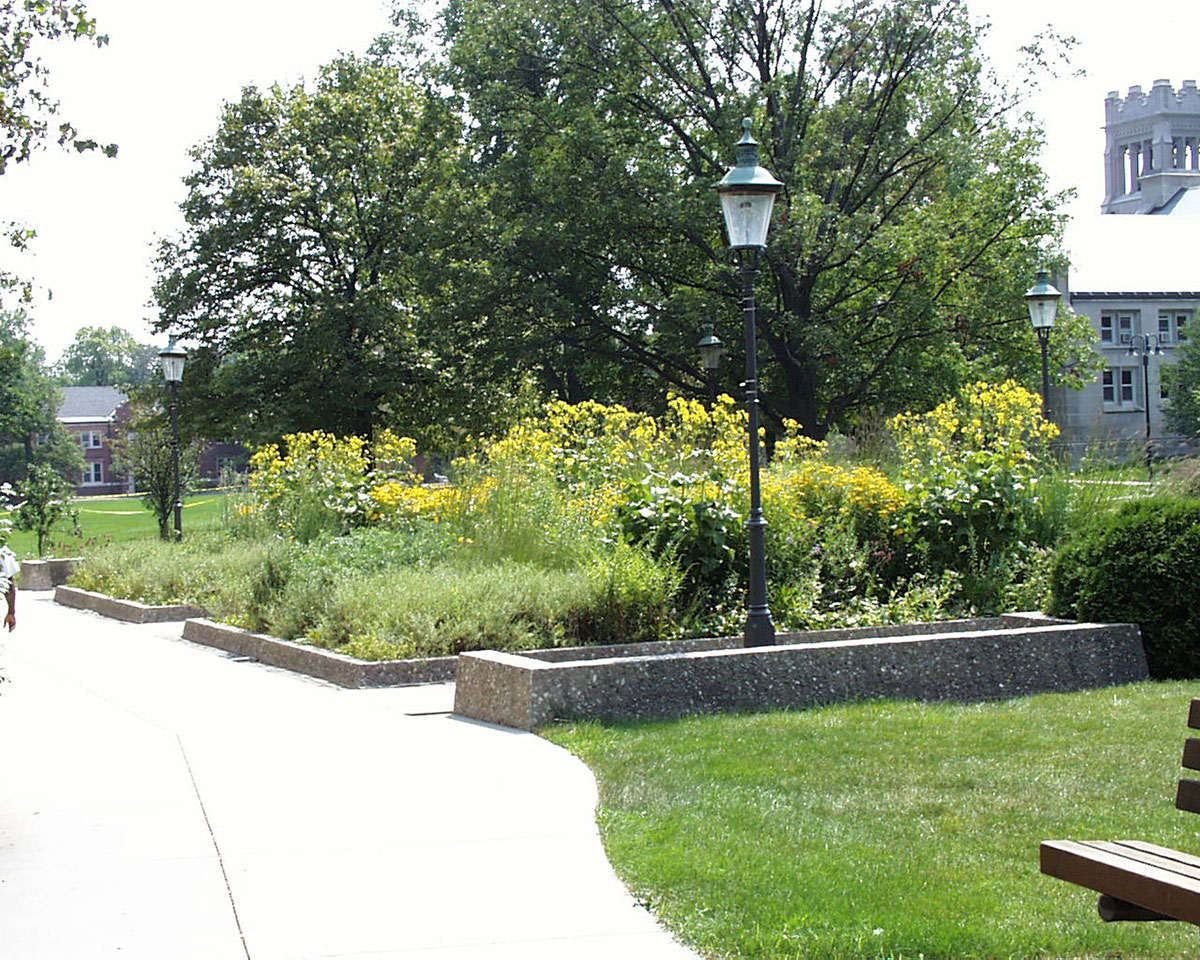
In general, critics of the planters complain that they do not look enough like a garden. Typical criticisms include the absence of symmetry, of color variety (in high summer most prairie flowers bloom yellow), and of conspicuous horticultural design: “It’s just one big mass of stuff,” say many detractors. Several members of the teaching faculty have offered more analytic justifications for their distaste for the planters; these typically consider what are thought to be inconsistencies between the wildness of the plants and the formality of their setting.
One colleague, a scholar of 18th-century British literature, writes “Young Hall is a formal building, with, I think, a formal setting in the landscape pattern of beds and lighting that faces it. The ’natural’ plantings, which are quite tall, appear straggling and unkempt in such defined beds. I am not looking for a 17th-century bow-knot treatment, but something that does not look to me like an overgrown, neglected collection of blowsy ’weeds’” (Cowler). Another, an economic historian, finds the planters “incompatible with the rest of the college campus, and in full bloom they constitute an eye-sore. To me, the idea of a ’prairie‘ is synonymous with open space. These plants are artificially confined” (Moskoff).
Students here have been largely non-committal about the planters—the student environmental group has quite sensibly reserved its energies for campus recycling and for picketing the local Home Depot, but a number of non-teaching staff have taken up the quarrel. At its annual meeting with the college president, the advocacy group for hourly-wage employees—secretaries, custodians, clerical personnel—introduced a question about the planters into the agenda. They wanted to know if the president shared their opinion that the planters made a bad first impression on prospective students and their parents. The president took their question under advisement (Fox).
The planters have survived these five years because they have influential allies. One of these is Dennis Nyren, a Chicago real estate investor, and an alumnus and trustee of the college. A passionate advocate of native plants, Nyren both funded and did much of the shovel-work for an ambitious tree-planting program on the campus. It was Nyren who commissioned Miller’s design for the planters and bought the plant materials for them. It’s not unusual to find Nyren on his knees in the planters, digging up Silphium seedlings, or watering new plantings. Another ally is Jeffrey Sundberg, a professor in the Economics department and member of the Environmental Studies program, who has been an active steward of the planters and of several other habitat restoration projects on campus. Sundberg defends the planters on educational grounds: “The plants are important because they represent everything that the local ecosystem lost because we moved here. … Placing them in the center of the most trafficked area on campus confronts people with all that has been lost, and I think there is real value in doing that” (Sundberg).
At its core, the dispute centers on what can and cannot be considered a garden, and with how closely the college should cleave to the cultural and etymological equation that “campus” equals “lawn.” Janet Marinelli of the Brooklyn Botanic Garden offers a paradigm for the modern garden that, while it may not resolve the controversy over our planters, provides a valid framework for understanding them. In a study of what she calls “gardening in the age of extinction,” Marinelli theorizes a garden that recapitulates a region’s natural history and mirrors some of the ecological dynamics of that region. Marinelli’s “wild gardens” are “designed to enhance the sense of place, to meld easily with the surrounding vegetation, and to restore what once flourished but has since been lost. Culturally, the wild garden alludes to the native landscapes that greeted the pioneers and that have for centuries imbued America with its sense of limitless possibility; biologically, it provides a sanctuary for beleaguered native species” (135). Marinelli draws on the work of philosopher Frederick Turner to make the claim that the new ecological or wild garden rejects the mimetic impulse that animates the chief traditions of western horticulture: “The ecological garden won’t try to imitate, like classical gardens, what nature is, or, like romantic gardens, what nature looks like. ... The new garden instead must act like nature, must do what nature does. And what nature does is reproduce itself, copy itself into the future, gradually improving on the copies by means of the evolutionary forces of sexual reproduction, mutation, and selection” (76).
Perhaps the prairie planters have been hard for the community to accept exactly because they are less the imitation than the embodiment of a natural community. While it would be incorrect to say that the planters are prairie—they lack the soil bacteria, the large herbivores, and the terrifying scale, to name just three features—it is certain that, as Marinelli puts it, they act as prairie. The planters are a seedbank or genetic repository for many of the prairie species that have been crowded out by development and agriculture. They recapitulate the characteristic associations those species maintained on the now vanished mesic prairie. And they do a lot of the things that prairies do: rise sluggish and late in spring through ash and burned earth; draw Monarchs and Goldfinch to a chaos of daisy-head flowers in high summer; stand tall and dead all winter. I have been happy to watch them act this way for five years now, and hope to keep watching for years to come.
Rosemary Cowler, letter to the author, 10 December. 2001
M. H. Dunlop, Sixty Miles from Contentment: Traveling the Nineteenth-Century American Interior (New York: Basic Books, 1995).
Joyce Fox, personal interview, 17 December 2001.
Janet Marinelli, Stalking the Wild Amaranth: Gardening in the Age of Extinction (New York: Henry Holt, 1998).
Kenneth Robertson, “The Tallgrass Prairie in Illinois,” 19 December 1999. Illinois Natural History Survey, 10 December 2001. See more at www.inhs.uiuc.edu
Jerry Sullivan, Chicago Wilderness: An Atlas of Biodiversity (Chicago: Chicago Region Biodiversity Council, 1998).
Jeffrey Sundberg, letter to the author, 20 December 2001.
Raymond Wiggers, “Classic Prairie Restorations,” 20 December 2000. Chicago Wilderness Magazine, 10 December 2001.
See more at chicagowildernessmag.org [link defunct—Eds.]
Benjamin Goluboff teaches in the English department and Environmental Studies program at Lake Forest College. His work, short fiction, nonfiction prose, and scholarly articles have appeared in American Studies, New England Quarterly, Northwest Review, and elsewhere.
Spotted an error? Email us at corrections at cabinetmagazine dot org.
If you’ve enjoyed the free articles that we offer on our site, please consider subscribing to our nonprofit magazine, which includes unlimited access to all our archives.