


Subdivided Memory
Sinti and Roma in German Erinnerungskultur
Sanders Isaac Bernstein
Raise yourself around us, dear forest,
sing to them a song where our people walk,
in front and at the back let your song sound out, laugh.
Forest, forest, thick with trees!
Mighty forest, covered with leaves!
—Papusza, Tears of Blood
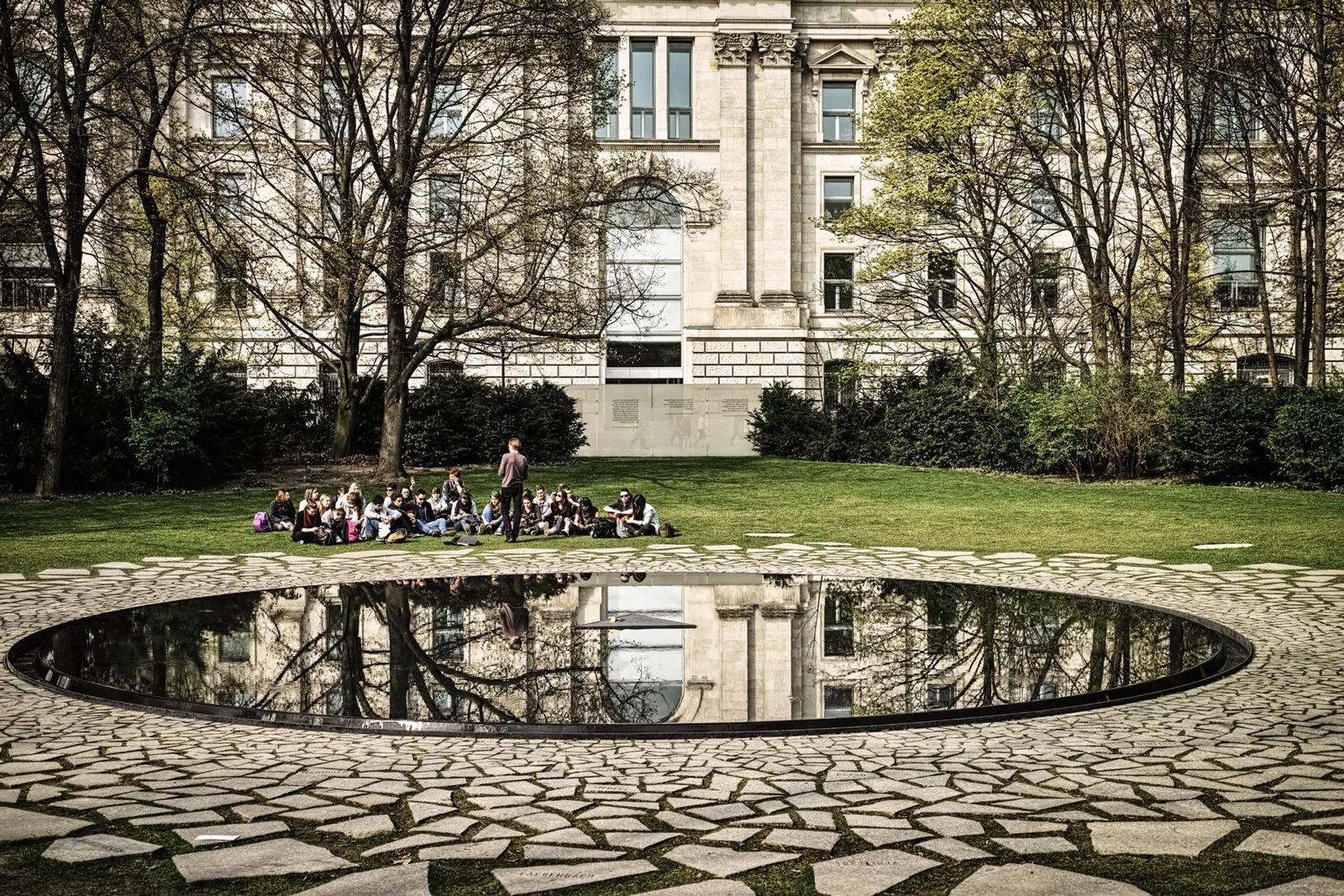
In the glade that is the Memorial to the Sinti and Roma of Europe Murdered under National Socialism, history seeks to enter memory. At the center of a grove of trees is a dark pool, reflecting the open sky as well as the looming face of the Reichstag. Surrounded by shattered stones inscribed with the names of sixty-nine sites where National Socialist Germany incarcerated and killed Sinti and Roma, the pool itself in turn surrounds a triangular island, the memorial’s center, on which rests a flower or two, unwilting.
Situated in the middle of Berlin, steps away from the Brandenburg Gate and across the street from the Reichstag, the memorial, sheltered by tall trees, feels a place apart. Its sounds and rhythms are distinct from the babbling frenzy of the city, seemingly distant. From the trees comes birdsong, and from invisible speakers a plaintive violin composition—“Mare Manuschenge” (Our people), composed for this site by Sinto violinist and politician Romeo Franz. Visitors who enter the memorial drift around its landscape. They read the historical material on the wall. One Frenchwoman points to a stone that carries the name Neuengamme, the camp where at least 113 Sinti and Roma were held, and spiritedly says to her companion, “Neuengamme—comme ’new game,’ nouveau jeu.” Groups take photos of the pool and its flowers. They walk around and try to spot the speakers that transmit the violin. They stop at Santino Spinelli’s haunting poem “Auschwitz,” engraved in four languages on a stone pillar in the southeast corner of the memorial. Pallid face / Dead eyes / Cold lips / Silence / A broken heart / Without breath / Without words / No tears. They murmur among themselves.
Every day, just before 1 pm, the day-old blooms on the triangular island at the center of the pond descend, lowered by hydraulics, and new flowers rise, appearing to emerge out of the water. Dani Karavan, the Israeli artist who designed the memorial, deemed this daily ritual “an incessant, admonishing prayer that recalls what happened time and again and demands that we never forget anyone.”
I visit this place as a kind of outsider—the memorial for “my people” killed by the Nazis is on the other side of Ebertstraße. But where that memorial seeks to disorient with its modernist tombstones and uneven ground, this one offers a centering ritual. The triangle carrying the small, entangled bouquet of purple, yellow, and pink blossoms will descend beyond sight, returning to the light refreshed with flora once more in full bloom. As the flowers begin their downward journey, I hear not only the pump of the hydraulics but also the appeal, the responsibility, to hold onto the history and find a way into it—not only to remember, but to turn it into memory. As the monument’s core descends, I am conscious of the memorial braiding time together, its movement turning the past tense of history into a present act, an event. It is a theater that insists on its significance to each visitor, addressing each person who steps through the iron frame of its entrance.

And yet, as I wait to watch the daily exchange of flowers, I must admit that I am not contemplating the persecution carried out by the German state between 1933 and 1945—detailed on the frosted panels of the memorial’s front wall. I am not thinking of the personal narratives I’ve read—of Hermann Herzberg, trader of horses and father to eleven, killed at the Bialystok Ghetto in 1941, or his ten murdered children, or his wife Luise, who contracted tuberculosis at Ravensbrück and died from the disease in 1953, leaving her son, Otto, wholly without a family. I am not thinking about Waldemar Winter, who survived Auschwitz, medical experiments at Natzweiler, and forced labor at Dachau and Neuengamme, before dying just after the war’s end due to the abuse he had suffered at the hands of the Nazis. I am not thinking about Gretel, a quiet, happy, and beloved child whose mother called her Mutti, and who at four years and three months was marched into the gas chamber with her grandparents. Instead, as I watch the blossoms slowly lower, I find myself thinking not of the past but of the future. I contemplate the dark hollow of the triangle at the center of the pool’s dark waters, its core lost to an invisible underworld, and I can only think of the regional rail extension that the Berlin Senate recently approved, which threatens to turn this memorial into a construction site.
That the memorial exists at all is a testament to the long struggle by Sinti and Roma for public recognition of what was done to them by the German state. Even the name by which they are known, Sinti and Roma, is the result of organizing against racist designations and insisting on their own terms of address. Roma was the designation adopted in 1971 at the first World Romani Congress for the entirety of the Romani communities in Europe, diverse groups of people who came to Europe from South Asia starting in the Middle Ages, speaking varieties of the Romani language. “Sinti” usually refers to Roma who settled in northern Europe before the nineteenth century, which differentiates this group from the Roma who were just then arriving in the German Empire. Today, there are both Sinti and Roma who live in Germany, with Sinti the larger and longer-established group, and the conjunction of “Sinti and Roma” has become the standard appellation in German-speaking countries to refer to Romani peoples in general. Some academics prefer the term “Romanies” to emphasize the great diversity of peoples who fall under the banner of the Roma. Still, along with achieving public awareness for this chosen name, the campaign of the Sinti and Roma has succeeded in some significant ways in overcoming the centuries of marginalization and discrimination that they have faced in what is today Germany. However, much as Sinti and Roma still face prejudice and discrimination in their daily lives, they also continue to confront ongoing marginalization and displacement in Germany’s much lauded memory culture.
The nature of the persecution of Sinti and Roma during World War II bears repeating, for it is still too little known and discussed—how Sinti and Roma, along with other groups of traveling people (such as the non-Romani Yenish), were, under the pejorative designation of the German equivalent of “Gypsy,” sent to concentration camps, sterilized, made into the subjects of eugenic studies, medically experimented on, and murdered.


The Nazi persecution began when the new regime simply extended Weimar Germany’s laws, which included such statutes as the 1926 Law on Gypsies and the Work-Shy that identified “Gypsies” as “asocial” from birth and required them to be incarcerated in workhouses. From 1936 onward, concentration camps were established for “Gypsies,” who were classified as “people of foreign blood.” In 1938, Heinrich Himmler issued his decree on the “Resolution of the Gypsy Question” (Regelung der Zigeunerfrage aus dem Wesen dieser Rasse heraus), which “promised to attack the essence of this race.” On 30 January 1940, the decision was made to deport 30,000 “Gypsies” from Germany to Poland. At this time, government doctors began increasing the number of sterilizations they performed; 2,500 Sinti and Roma were sterilized before the regime’s collapse halted the practice. Meanwhile, during the 1941 invasion of the Soviet Union, Einsatzgruppen killed thousands of eastern European Roma—deaths that have left to history little record. From November 1941 to January 1942, 5,000 Roma were deported to Lodz and then killed in Chelmno. It was also in this year that Joseph Goebbels put forward the idea that “the asocial life of Jews and Gypsies simply … be exterminated.” By year’s end, on 16 December 1942, Himmler gave the order that all “Gypsies” in Europe were to be deported to Auschwitz-Birkenau. In the coming year, 23,000 Sinti and Roma from eleven countries were sent to Auschwitz. By 1945, half a million Sinti and Roma had been killed in the Romani Holocaust, which is known as the Porajmos, “the devouring,” or Samudaripen, “the murder of all.” As early as 1951, Ralph Lemkin, who had earlier developed the concept of genocide with reference to the Turkish persecution of Armenians, used his novel term to describe Germany’s mass murder of Jews, Slavs, and Sinti and Roma.
After the war, the West German state repeatedly denied Sinti and Roma compensation for their persecution, forced labor, medical experimentation, sterilizations, and familial deaths. A 1956 ruling declared that the National Socialist deportations, internment, and murders prior to 1943 were, rather than racial persecution, part of a “legitimate struggle against criminals.” It thus attempted to invalidate any future Sinti and Roma claims for compensation for persecution under National Socialism that took place before Himmler’s order of deportation in December 1942. With sweeping generalizations, the legal framework underpinning this ruling argued that it was “the Gypsies’ character” that had merited their treatment under National Socialism prior to 1943—and indeed during the Wilhelmine and Weimar eras: “Since the beginning of time, the Gypsies have been regarded by Western civilized nations as a state plague.” With such racist logic and dubious rhetoric, the commentary exculpated the state for its actions against Sinti and Roma, suggesting instead it was their innate criminality that had justified the brutal treatment up until 1943 when they were deported to Auschwitz. Only in 1963 did West Germany’s Federal Court of Justice reverse the 1956 verdict, recognizing the racial motivations of Nazi Germany’s 1940 deportations of Sinti and Roma to Poland. They set an expiration date for applications for compensation: 31 December 1969.
The situation in East Germany, where only a few hundred Sinti and Roma continued to live after 1945, was hardly better. While Sinti and Roma were recognized as victims of Nazism beginning in 1946, when the German Democratic Republic was simply the Soviet Occupation Zone, the preconditions for compensation served to disqualify many Sinti and Roma from claiming “victim of fascism” status and the corresponding state-administered support. They were not only required to have a past unblemished by brushes with the law—a circumstance that disqualified many Sinti and Roma, already the object of unjust police attention prior to the Nazis—but also, in special conditions for Sinti and Roma, prove a permanent residence and “regular job.” As one might imagine, many survivors of the camps were in no condition, physically or mentally, to perform the labor demanded of them. Although records are limited, it seems that many Sinti and Roma ended up emigrating to West Germany.
West Germany continued to harass its Sinti and Roma citizens and residents through the 1970s. German police returned to many of the repressive measures they had used between 1871 and 1933, employing Nazi-era registries to continue to track and persecute “Gypsies,” now called “vagrants.” In some cases, they even used Auschwitz tattoos to identify Sinti and Roma. Robert Ritter and Eva Justin, eugenicists who had helped to design the National Socialist policy against Sinti and Roma—including genealogies that had determined who would live, who would be sterilized, and who would die—were acquitted of abetting the genocide and, through the 1970s, were called upon to testify in courts as expert witnesses on Sinti and Roma.


Sinti and Roma took to the streets for the first time in Germany in 1973, after police shot and killed Anton Lehmann in Heidelberg. One hundred protestors from across West Germany paraded through the city center carrying banners that read “Second-Class Citizens.” In 1974, Sinti and Roma erected, on the land of the former “Gypsy Camp” at Auschwitz-Birkenau, their first memorial to the dead; the Sinto activist Anton Kutscher called it “the first memorial in the history of the gypsies.” Five years later, the German Association of Sinti—the precursor organization to the Central Council of Sinti and Roma—collaborated with the Society for Threatened Peoples to organize at Bergen-Belsen the first large international commemoration of the Nazi genocide. They titled it, “Gassed in Auschwitz, Persecuted until Today.” In 1980, eleven Sinti and Roma, including five Holocaust survivors, went on hunger strike at Dachau. Two years later, West Germany finally extended official recognition that National Socialist Germany had committed genocide against the Sinti and Roma. While the courts had recognized in 1963 the racial nature of the National Socialist persecution, it was only in 1982 that the German government admitted that it had not simply deprived Sinti and Roma of rights and deported them but had also pursued a racial policy tantamount to genocide.
Perhaps it had something to with the encroaching awareness of the so-called “forgotten victims” of National Socialism that, in 1988, German television journalist Lea Rosh and historian Eberhard Jäckel, an ardent defender of the singularity of the Holocaust, first proposed the idea of a German memorial to the Holocaust’s Jewish victims in Berlin. Believing in the entwined fates of Jews and Sinti and Roma, the head of the Central Council, Romani Rose, argued that this memorial should also represent the Nazis’ Romani victims. As he would write in many variations, “The Holocaust also means the annihilation of 500,000 Sinti and Roma.” Placing petitions in newspapers and engaging in public debate against the historian Yehuda Bauer, who insisted on ontological differences between the National Socialists’ persecution of Jews and Roma, Rose attempted to convince the public that there should be a single “memorial for all victims” of the National Socialist regime. Rosh protested that if Sinti and Roma were to be included, “we would then also be expected to commemorate the soldiers or the German housewife who was killed by bombs.” When the Jewish Central Council, led by Ignatz Bubis, insisted on the need for a distinct memorial to the dead Jews, and received the support of Chancellor Helmut Kohl, the argument was lost. Ultimately, Rose’s campaign brought forth a commitment from Germany for the current Sinti and Roma memorial, which was to be funded by the government and sited at a prime location near the Reichstag.


Yet, while Rose received this promise in 1994, it took almost twenty years for it to be realized. Rose certainly did not waste time. With the promise in hand, he chose the Jewish Israeli artist Dani Karavan, who had just designed the cityscape memorial Way of Human Rights in Nuremberg and the land art Passages, Homage to Walter Benjamin in Portbou. But work would take a while to begin. Not five years later, the Berlin Senate attempted to contravene the federal government’s promise of a memorial near the one for Jewish victims and place the memorial on the city’s outskirts. The Berlin Senate wanted to place the memorial at the site of the Nazis’ 1936 internment camp for so-called “Gypsies” in Marzahn, a far-flung district known for its gray prefab housing. Berlin’s mayor at the time, the CDU politician Eberhard Diepgen—who had been opposed to any Holocaust memorial in the center of Berlin, decrying the possibility of memorial proliferation, which he called Denkmaleritis (memorialitis)—argued that Berlin was under no legal obligation to provide the land in the Tiergarten to the Memorial to the Sinti and Roma. With the help of the federal government, led by the SPD’s Gerhard Schröder, Sinti and Roma activists were able to defend the original agreement. Finally, in 2007, the federal government passed a formal resolution on the construction of the memorial. As late as 2010, however, Karavan threatened to walk away from the project, arguing that the Berlin Senate’s uncooperativeness was making it untenable for him to complete the memorial. He pointed out how the municipality wouldn’t even countenance the relocation of a bus stop to allow him to implement his planned access to the site.
On 24 October 2012, after more than twenty years of campaigning by Sinti and Roma activists, the German state finally opened the Memorial to the Sinti and Roma of Europe Murdered under National Socialism. It was the first national memorial of the Romani Holocaust. Before the 1,200 people in attendance, culture minister Bernd Neumann promised that the memorial was a sign that “we do not repress or forget the crimes against Sinti and Roma.” The mayor of Berlin, Klaus Wowereit, offered a spatial metaphor, stating that on this day “the last gap in the remembrance of the victims of Nazi dictatorship and genocide closes.” Chancellor Angela Merkel declared that, with the inauguration of this memorial, Sinti and Roma would finally receive their due, not only recognition of their genocide but also a renewed commitment from the state to deal with ongoing discrimination. “Ladies and gentlemen,” she began, “this memorial commemorates a group of victims who, for far too long, have received far too little public recognition.” Emphasizing the state’s active engagement in empowering Sinti and Roma, she situated the monument—using terms highly reminiscent of the language of multidirectional memory—within “the diverse memory culture that Germany cultivates, memory that isn’t backward-looking.”


When Rose spoke, he insisted that the memorial marked a new chapter of German history—one that stretched beyond his dreams when he took part in the hunger strike at Dachau. For Rose, the placement of the memorial was a sign of Germany’s recognition of the importance of protecting its minorities. Echoing Merkel, who had insisted that “this monument in the heart of Berlin commemorates the unspeakable injustice that befell them all,” Rose proclaimed, “This monument near the Reichstag, in the immediate vicinity of the Brandenburg Gate and the Memorial to the Murdered Jews of Europe, is the expression of the commitment to proscribe antigypsyism as well as antisemitism.”
At the dedication, there was a single voice of disquiet. When Merkel noted that “Sinti and Roma also have to fight for their rights today,” before insisting that this was a responsibility that Germany actively shouldered, the voice of Hamze Bytyçi, Romani actor and activist, broke through the applause. He shouted that recent Romani deportees also “should be allowed to stay here.”
Sinti and Roma, especially recent immigrants, have continued to face ongoing discrimination in Germany—recent reports from the Bundestag, Germany’s parliament, note how Sinti and Roma suffer structural, institutional, and interpersonal discrimination and racism. In 2023, there were over 1,200 cases of documented anti-Roma crimes, including ten cases of extreme violence. Bytyçi’s actions at the memorial insisted, as he continues to insist: “A memorial alone isn’t enough.”
Bytyçi’s protest has proven prescient. The promises of the inauguration began to ring hollow when, in 2020, only eight years after the dedication, it became public that Deutsche Bahn was planning to extend Berlin-Brandenburg’s regional train service, the S-Bahn, underneath the memorial—requiring its temporary closure. At first, the Central Council publicly declared its outrage. Rose proclaimed it “unimaginable” that there could be plans affecting the memorial without consulting the Sinti and Roma community. However, after discussions with the Berlin Senate and Deutsche Bahn, he announced the Central Council’s begrudging approval of the extension, stating he feared opposition to a public works project beneficial to millions of Berliners would only result in increased anti-Romani racism. He had also received, he stated, promises from the Berlin Senate that the memorial could stay open as construction plans had been altered to spare the central reflecting pool.
The new S-Bahn 21 line, long a dream of Berlin city planners, would indeed increase the capacity of the Berlin-Brandenburg regional train system within the city. Strangely enough, the idea for a new north-south S-Bahn line is one that the Deutsche Bahn website traces back through the “megalomaniacal plans of Adolf Hitler (and Albert Speer).” The current project, it states, will unite the pieces of the route that date from that time but are currently disconnected, what in German they call “a torso”—that is, track without an originating station or terminus.
Even as the Central Council acknowledged the new line as unavoidable, many Sinti and Roma warned that the entire scheme disrespected the memory of the remains of their ancestors, whom German trains had, in many instances, ferried to their fates. They insisted that the memorial site was “a tomb for the people whose ash is still scattered in Auschwitz.” Or as survivor Zoni Weisz wrote, “I considered this memorial to be my family’s grave.” And the memorial is where Sinti and Roma gather for moments of silence on various days of memory throughout the year: on April 8 for International Romani Day; on May 16 for Romani Resistance Day, which remembers the successful Sinti and Roma resistance when the SS attempted to liquidate Auschwitz’s “Gypsy Camp”; and on August 2 for the International Memorial Day of the Roma Genocide, which commemorates all the victims of the Romani Holocaust on the grim anniversary of the day in 1944 when the SS finally did murder all the Sinti and Roma remaining in Auschwitz—2,900 people, mostly children and the elderly.

An open letter that Bytyçi organized in October 2023 argued that even though the proposed construction would no longer directly affect the built elements of the memorial, it would still forever alter the land that was part of it. It noted how the construction would require the felling of “ancient trees” that insulate the glade. And it cited the opposition of the memorial’s creator, Dani Karavan, who until his death insisted that his work included these natural elements. Denouncing the project as an act of symbolic violence against the memorial, the letter states that it “dishonors the victims, the survivors, and their descendants.” The letter asks, “Are we allowing the interests of Deutsche Bahn, legal successor to the Deutsche Reichsbahn, which transported the victims to the concentration and extermination camps, to destroy the memory of the dead?”
On 14 December 2023, the Bundestag passed a motion recognizing the “injustice” that Sinti and Roma have experienced in Germany since 1945 and recommended that an independent and permanent commission address these ongoing problems. Five days later, the Berlin Senate formally voted to build the tunnel under the monument and turn its surroundings into a construction site.
In the year and a half since, there have been more protests—and another open letter, from July 2024, which responds in concrete terms to the planned construction. It notes how the excavation would not only uproot the memorial’s sheltering trees but also how the tunnel’s presence would interfere with the replacement trees’ root structures, all but ensuring the memorial’s glade would never recover its full presence. It expresses concern about train vibrations interrupting the memorial’s tranquility. And again, it decries the violation of the memorial’s “integrity and dignity.”

There is an inescapable and grim irony to this whole enterprise—and not only that the trains that once destroyed families are now disturbing their remembrance. The construction project also repeats, on a symbolic level, the experience of marginalization that Sinti and Roma have suffered in Germany and Europe at large. The symbol of the “forgotten holocaust,” as the Romani Holocaust has long been known, was, seemingly, forgotten by the city and rail planners. And this is not even to mention how this decision by the city and state crudely literalizes a question broached by Holocaust scholar Michael Rothberg: “Does collective memory really work like real-estate development?”
Rothberg, that is, asks if collective memory is a zero-sum calculus, where there are definite borders between groups and experiences and only finite space. Germany’s insistence on quarantining National Socialism’s victims to separate monuments seems to suggest that this is indeed how the state perceives collective memory to function. Categories of victims, each forever separated, never to meet: the Memorial to Homosexuals Persecuted under Nazism, the Memorial to the Sinti and Roma of Europe Murdered under National Socialism, the Memorial to the Murdered Jews of Europe, and the Memorial and Information Site for the Victims of the National Socialist “Euthanasia” Murders. And, of course, even if the place and space allotted to each memorial didn’t already betray the state’s judgment, we know that separate but equal is always a fallacy, with distinct too easily conflated with distinction. This sense of things is only compounded when one learns that one proposed plan for the new S-Bahn line would have required the temporary removal of 3 of the 2,711 stelae of the Memorial to the Murdered Jews of Europe. While the accepted construction plan will permanently damage the environment of the Sinti and Roma memorial, the fact that the earlier variant would have affected this other Holocaust remembrance site meant that it was quickly disqualified. In real estate terms, while the landmark protections for the Memorial to the Murdered Jews of Europe were inviolable, those for the Memorial to the Murdered Sinti and Roma of Europe were negotiable. In terms of remembrance, this suggests that the place of Sinti and Roma in Germany’s vaunted memory culture is still highly provisional.
Morally, the German state should be as responsible to Sinti and Roma as to Jews—if not more so, due to how little the German state has attended to this history and attempted to make amends for it. Indeed, it has often worked to frustrate Sinti and Roma bids for justice. It is tempting to discount the entire project of German memory culture in light of the state’s treatment of the memorial—not to mention its crackdown on pro-Palestinian demonstrations and organizations, its persecution of citizens and residents with Arab backgrounds, or its cold-blooded support of Israel’s genocidal campaign in Gaza. But such discounting can become a justification for not engaging with German discourse on a level where the nation is clearly deeply invested. Germany’s relationship to the Nazi genocide is unquestionably at the center of its modern identity. It’s perhaps hard to understand the more recent actions of the German government regarding the state’s commitment to Vergangenheitsaufarbeitung as anything other than a cloak for realpolitik, but as James Young has written, “the motives of memory are never pure.” Thirty years ago, the Israeli historian Amos Elon pointed out how Germany’s “politics of memory” hardly operated according to moral values. “You see it in the nature of reparation payments over the years,” he said in a talk he delivered in Berlin. “Jews benefited more than other victims of Nazism because there was a political interest in placating Jews rather than gypsies (who for decades had no political voice at all).”

Perhaps Elon had not considered the real work that Sinti and Roma had been doing in Germany and beyond since the 1970s. They have organized nationally and, since the World Romani Congress in 1971, increasingly transnationally. In addition to the Central Council, Germany alone is home to two other powerful political organizations: the Sinti Alliance and the Federal Association of Sinti and Roma. However, at this moment in time, Europe’s largest ethnic minority has not one representative in the European parliament. There is clear ongoing inequity.
And the Anglosphere has not helped matters either. For the last decade, when English-language writers were extolling Germany’s “coming to terms” with its past, they have rarely, if ever, mentioned the Sinti and Roma. Susan Neiman’s Learning from the Germans mentions them glancingly among other groups victimized by the Holocaust and subsequently represented on Stolpersteine, the “stumbling stones” in various German cities that commemorate individual victims of National Socialism. And it is only, too, in the context of Stolpersteine that Clint Smith invokes them in his long article for The Atlantic, “Monuments to the Unthinkable.” John Kampfner’s celebratory Why the Germans Do It Better: Notes from a Grown-Up Country does not discuss the Sinti and Roma a single time. So it goes with Pankaj Mishra, whose critical re-examination of Germany’s memory culture in the wake of the ongoing genocide in Gaza also fails to consider the long struggle of Sinti and Roma for recognition. To attend to the place of Sinti and Roma in Germany’s memory politics would have only strengthened Mishra’s argument about Germany’s “self-righteous hypocrisy.”
The Anglosphere, perhaps due to its intense focus on Israel-Palestine and its orientation toward the racial problematics of the United States, continues to ignore the Sinti and Roma. But if we turn to history, we can see that Nazi persecution was aimed at the very people to whom no one was paying attention, for whom no nation was advocating. As Hannah Arendt has written about the path to the Holocaust, it began by symbolically and legally expelling groups from the polis—creating undesirables:
This was done, on the one hand, by putting certain categories of people outside the protection of the law and forcing at the same time, through the instrument of denationalization, the nontotalitarian world into recognition of lawlessness; it was done, on the other, by placing the concentration camp outside the normal penal system, and by selecting its inmates outside the normal judicial procedure in which a definite crime entails a predictable penalty.
Through this maneuver, Nazi Germany not only silenced the minorities that it persecuted—there was no law, no higher power, to which they could appeal—but it also made them invisible to the rest of the world. Today, modern, multicultural Germany threatens to repeat the symbolic expulsion carried out by its disavowed forebearer. Always carrying on about the lessons it learned from the crimes of National Socialism, it should have learned by now that an ethical bearing is not a question of how one treats another nation, but how one treats minorities who have no army to defend their interests, no state with which to make weapons deals. The morality of its memory should inhere in the state’s treatment of the marginalized.

Perhaps a single, inclusive memorial would have affirmed that Sinti and Roma belong to Germany’s imagined community. After all, such a memorial—honoring all of the victims at a central site—was what Romani Rose originally wanted. The Bundestag did in fact consider this matter of a universal memorial on 25 June 1999. Bundestag president Wolfgang Thierse opened the day’s deliberations, insisting that the memorial was not being built for “the Jews” but “for ourselves, as our very own commitment to a political identity.” He declared it to be a day of destiny: “Today we must decide: do we want to dedicate this memorial not only to the murdered Jews of Europe but also to the other victims persecuted, tormented, and murdered by the National Socialists?” Acknowledging the difficulty of making this decision, he cited Reinhart Kossellek’s plea: “We, as perpetrators, have no right to sanction a hierarchy of victims.” Thierse suggested that a single memorial would avoid reproducing eugenic categories that the SS had used. Despite these eloquent words, the Bundestag voted against the motion, 325 to 218, determining once and for all that the victims of the National Socialist regime would each have their own sites of remembrance.
A single, collective memorial would not have necessarily changed the way Sinti and Roma are treated in Germany today. But the current uncertainty surrounding the memorial reveals how the dominant culture continues to conceive of the Romani as marginal to its image of Germany. Just as Sinti and Roma often find themselves at risk of housing instability, here the state has brought instability to the dwelling place of memory. The injustices of daily life are played out on a symbolic level of collective memory. To wish for a single memorial is also to wish that white Christian Germany might conceive of itself differently, recognizing the diversity that constitutes a Germany beyond its narrow vision. For memory alone is not enough to change politics. All too often, especially today, political conditions shape the reception of memory. The past becomes merely the raw material for a weapon with which to brutalize political foes. To remember is not enough to fill the void that exists in the present, where the state still refuses to recognize a shared humanity beyond any national, racial, or ethnic designations, still considers entire peoples expendable, still denies its own denial, and the violence, fast or slow, perpetrated beneath it.
I can hear the hydraulics again over the music. The journey to the underworld, the brief pause when the center of the island reaches its nadir and the memorial’s caretaker replaces the old blooms is over. The shale plate is rising to the surface again, today, like every day since 24 October 2012, carrying its flower.
I exhale. I have been worried about writing this essay—concerned about the responsibility entailed in speaking about Sinti and Roma experience in Germany, as well as the position from which I do so. I wrote part of this essay at a residency with other Jewish writers. At one point, I mentioned to one of them my concern. He laughed at me. “You’re a Jew. Of course you can write this.” When I protested, he added, with a smile. “Or, at least, you’re halfway there.”
I don’t mean to publicly flog the man who said this to me. He was well-intentioned. He was half-joking. But as I’ve worked on this subject for the past year, I’ve come across so many instances where Sinti and Roma have bristled at how they are represented by people outside of their community. I remember watching RomaniPhen’s Alfreda Noncia Markowska, a Heroine of Resistance, a play that proposed Markowska, the Polish woman who saved fifty Romani and Jewish children during the genocide, as the first Romani Marvel superhero. I remember the characters speaking of how it rankled them that Romanies are so often thought of as simply a subset of Jews. (It didn’t help that in the Marvel comics, Magneto, for example, who is Jewish, takes on a Romani cover story.)
And yet, at least when it comes to death as engineered by National Socialism, Romani and Jewish experiences are undeniably intertwined. There are real differences, but in many cases, they were the only witnesses to each other’s tragedies. As the Jewish Holocaust survivor and one-time president of the European Parliament Simone Veil declared before a gathering of Sinti and Roma at the 1979 memorial at Bergen-Belsen, “This monument here contains the last remains—some bone fragments, some ash— of all our parents.”
The emergence of the flower from the water returns me to the present. In its motion, the memorial insists on the presence of the present, bringing me back from my concerns about this essay, drawing me away from my memories of the history of this city and the history of the Sinti and Roma. With its moving daily ritual, this memorial creates memory, imbuing history with immediacy. This memory, I know, is not enough on its own to guarantee anything about the politics of the present or the future. But as I watch the memorial, I feel it also braiding together experiences. When Dani Karavan took part in the dedication, he spoke of how he saw “my own family before me, whom I so loved, and who were sent into the gas chambers—perhaps the same gas chambers as the Sinti and Roma.”
Indeed, the Memorial to the Sinti and Roma of Europe Murdered under National Socialism, for whose architect recalls Jews as well as Sinti and Roma, is also a hybrid memorial capable of housing the memory of multiple categories of victims. And so are the Memorial to the Murdered Jews of Europe, the Memorial to Homosexuals Persecuted under Nazism, and the Information Centre for the Victims of the Nazi Euthanasia Program. They are all part of the same terrible moment, each, unfortunately, prefiguring the other. They take place within physical spaces that exist steps away from each other. They are even overseen by the same foundation. They deserve the same respect, the same inviolability. All of these monuments are entangled with each other. If only the German state could see that.
The flower emerges from the depths, as if rising out of the water. It is a prayer, a command that it continue to emerge day in and day out into this space. It is an obligation placed upon us, in the form of a deep red rose, not to forget anyone.
Sanders Isaac Bernstein is a writer living in Berlin.
Spotted an error? Email us at corrections at cabinetmagazine dot org.
If you’ve enjoyed the free articles that we offer on our site, please consider subscribing to our nonprofit magazine. You get twelve online issues and unlimited access to all our archives.