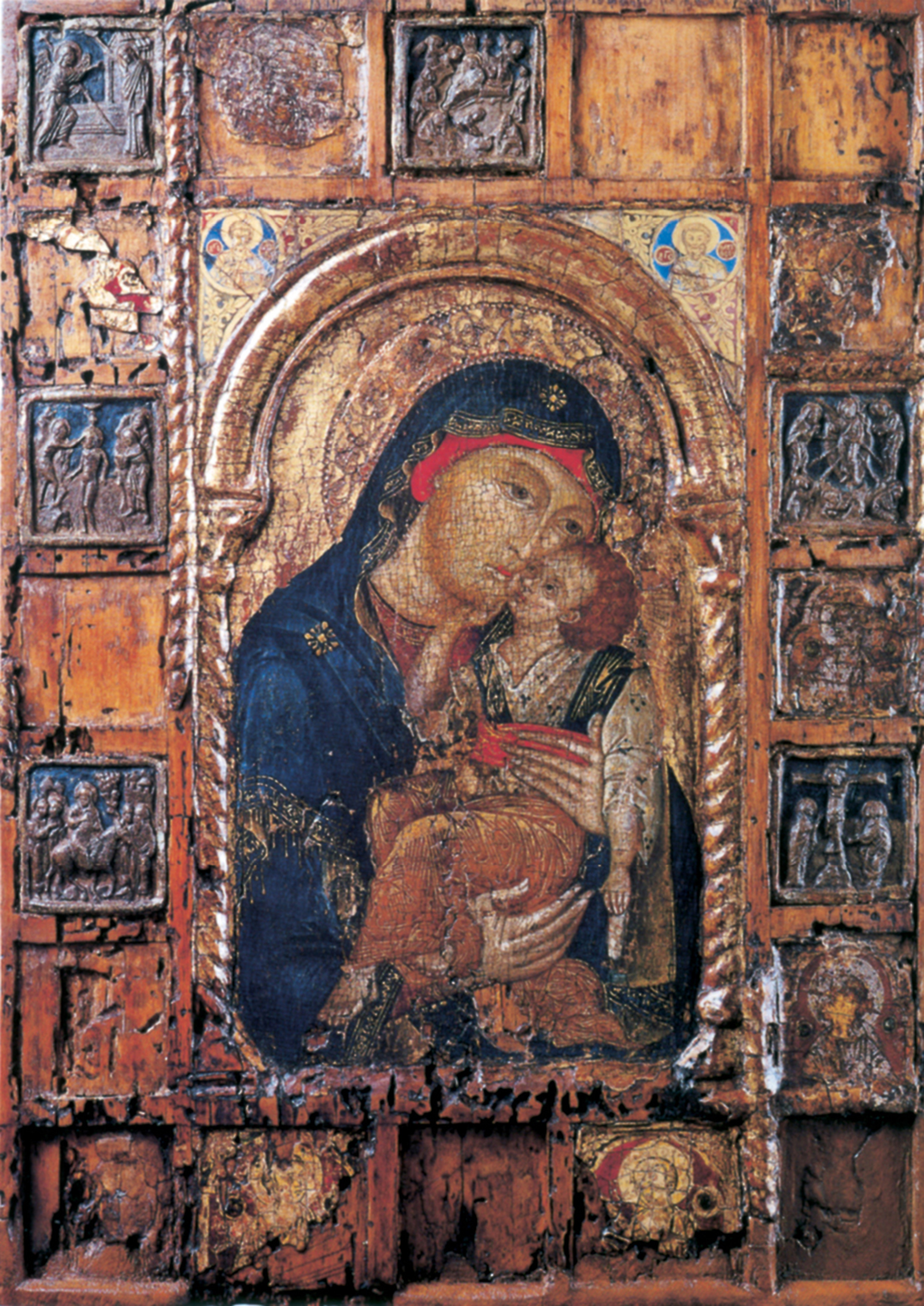
Icon of the Virgin Eleousa, Venice, mid-14th century.
1.
You would expect that the crime of art forgery has been around as long as people have been making artifacts. But
in fact it is very difficult to find an art forgery in the West before the 15th century—in contrast to China, where, as with paper and spaghetti, they were doing it already a millennium earlier. There have been cases of textual forgery ever since documents carried legal authority, and forged coins appear pretty much as soon as coinage was invented, in the early 7th century BCE. But art forgeries appeared only with the advent of the idea that works of art are to be appreciated
primarily as singularities, as unrepeatable performances
by an author.
2.
Works of art were not always authored performances. The work of art as we see it enshrined in modern museums is
the historical aberration. Some of the more interesting experiments in 20th-century art have made it easier to see this. Media like photography or film that involve mechanical
replication suspend the notion of the authentic and unique work of art, as Walter Benjamin saw: it makes no sense to ask for the authentic print from a photographic negative. And then there is the factory-produced readymade, the media-saturated images of Pop Art, the serial applications of Minimalism and Conceptual Art. The digital universe has, finally, introduced the idea of images with no physical existence at all, where each virtual instantiation presents exactly the same information and there is no degradation from one reproduction to the next.
3.
Before the advent of the cult of art—before the museum, the picture gallery, the connoisseur, the art dealer, and the art forgery—images naturally took the form of copies. The 16th-century Neoplatonist, alchemist, and mnemnotechnician Giulio Camillo once described images as just one of the “phases” that a body can take: there is the form of the physical body, which could then be translated into subtler form in
a painting (Camillo mentions the portrait made of him by
Titian), and to still subtler form in the reflection of a mirror. The idea was an old one, and it fundamentally affected the way images were understood. Images were not merely
representations but were understood as translations of the physical form of a person into another medium. By transferring the lineaments of form they actually transmitted something of the essence of the person they depicted. Further translations of forms from image to image were simply an extension of the process.

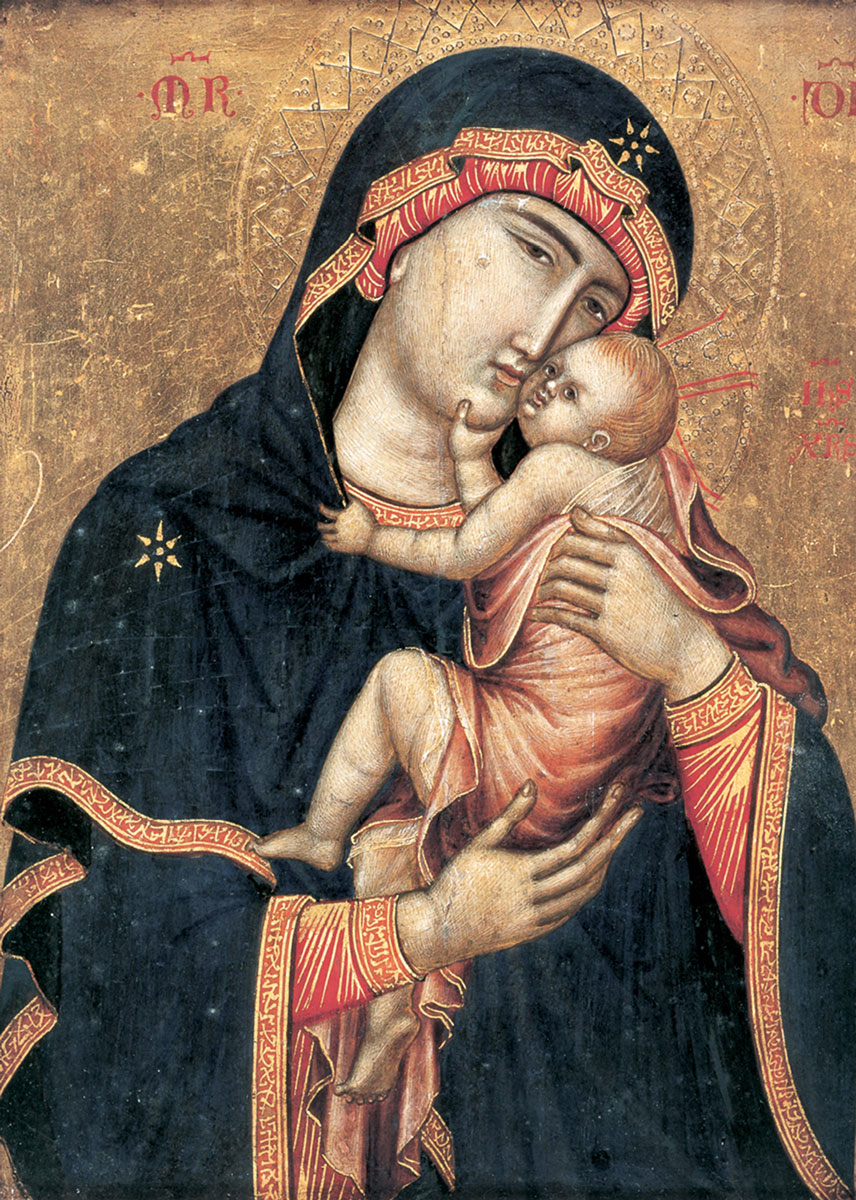
The Cambrai Madonna (Notre-Dame du Grâce), Italo-Byzantine, ca. 1340. Believed at the time to be painted by St. Luke himself.
4.
The entire tradition of the Byzantine icon was based on the idea
that a copy of an image, if done accurately, was another translation of
the prototype-form. Portrait icons were thought to have their basis in
a miraculous moment of truth when, say, St. Luke painted the portrait
of the Virgin Mary from life. Later images were presented as copies of
that original portrait, and so were translations of the essential form
of the Virgin. This meant that images led a strange and unstable
chronological life. An icon made yesterday, if it legitimately
transmitted the original image, was treated as an antiquity. The
Byzantine prelate Nikephorus, in the 9th century, said this about an
icon produced in his own day: “This image of Christ is not a new
invention. The picture has the authority of time: it is coeval with the
proclamation of the Gospels.”
5.
The philosopher Nelson Goodman once made a distinction between
autographic works, like paintings, that exist as unique products, and
“allographic” works, like musical compositions, that exist in multiple
applications. Two different performances of Beethoven’s Fifth Symphony
are both equally instances of Beethoven’s Fifth Symphony. Texts are
also allographic in a basic sense: a Penguin edition of Jane Austen’s Sense and Sensibility offers the same
novel as a luxury edition, as long as it follows the same
philologically established text. We point at the paperback edition and
say, “This novel was written around 1810.” If we put Goodman’s
distinction through some historical adaptations, we find that in
premodern times images functioned quasi-allographically. They were
iterations of a prototype image, and so belonged as much to the time of
the content they depicted as to the time of their making.
6.
In Roman antiquity, famous Greek statues existed in innumerable
replicas, which were regarded as legitimate substitutes for the
original. The 2nd-century Roman writer Lucian regularly described
copies as “Myron’s work” or “Polycleitus’s work.” The work was
understood to reside in the basic form and conception, and these could
be copied by an able craftsman. Sometimes the copyist would sign his
own name on the sculpture, but there is no need to call this fraud; he
was simply claiming credit for the technical execution of this work. In
his treatise On the Sublime,
the 3rd-century writer Longinus was careful to distinguish between
literary imitation and plagiarism, and to characterize “good” imitation
he compared it to taking casts from beautiful statues, “as it is
acceptable to do.” Whereas exact copying of texts was stealing, making
an exact replica of a statue was good cultural transmission. Literary
authorship and artistic authorship were not equivalent cultural values.

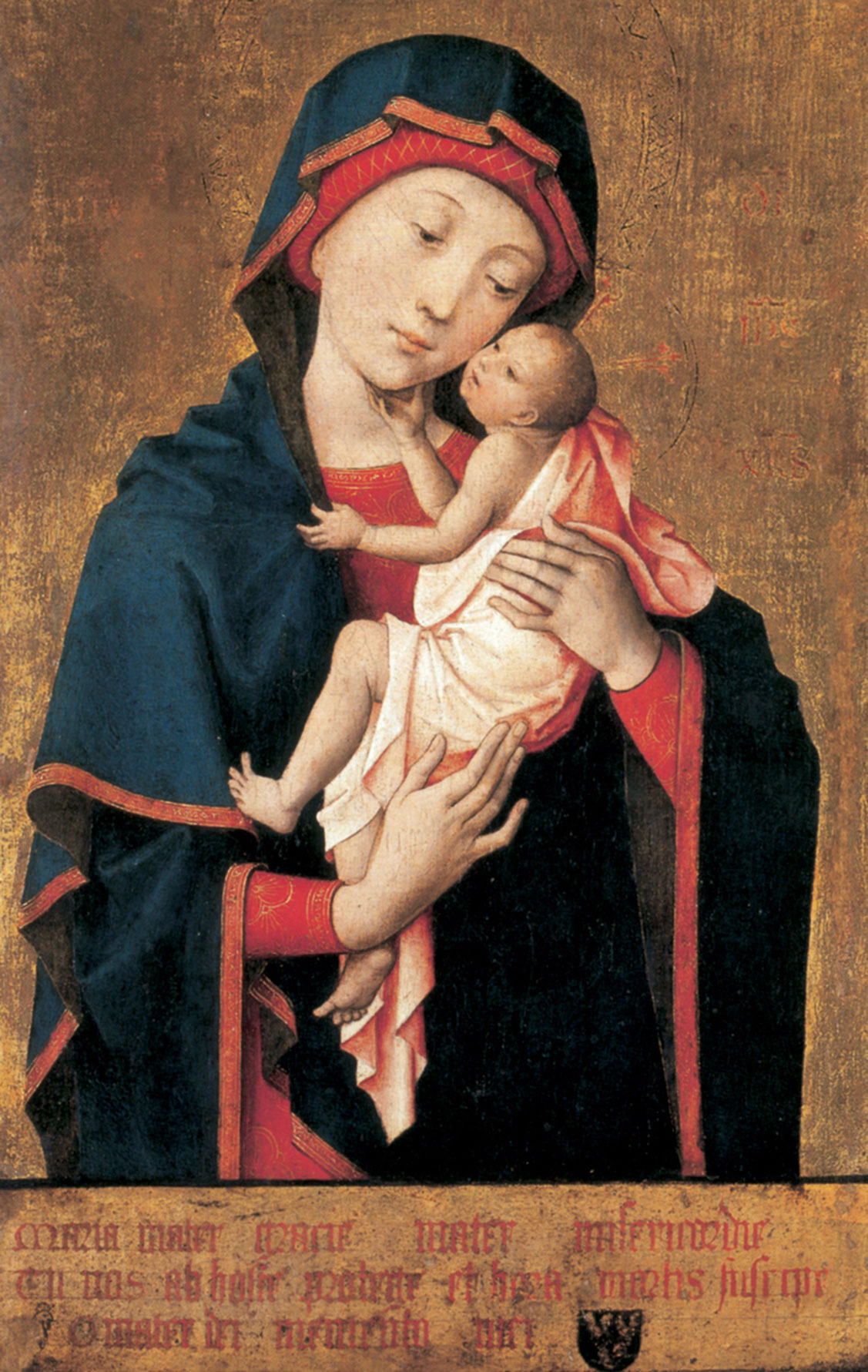
Virgin and Child by Hayne of Brussels, ca. 1455. Flemish interpretation/copy of Cambrai Madonna.
7.
When images inhabit a copy culture, there is no room for
forgery. Without a cult of the originally produced work, appreciated as
a singular and unrepeatable performance—without a conception of the
work as an event—forgery
has no function. This is why it is so difficult to find documented
cases of art forgery in Antiquity, and why the few cases that have been
brought forward are inconclusive: in each case what is alleged a
forgery can reasonably be explained as a copy. But ultimately we are
not talking about this or that case; the question is a systemic one.
Either forgery is widespread or it isn’t, either it is a structural
feature of a world of art or it isn’t, and in Antiquity and the Middle
Ages it was not. The Romans were the great lawmakers: they had laws
about the forgery of documents and about the forgery of currency, but
they had no laws about the forgery of works of art.
8.
In 1440, a Flemish prelate returned from Rome to Cambrai with a
small painting of the Virgin and Child on gold ground. The exotic panel
was installed in Cambrai cathedral and soon became famous in its new
setting: touted as a portrait of the Virgin painted by St. Luke, it
quickly began attracting thousands of pilgrims. In fact, it was painted
only about 100 years earlier in a Byzantine manner by an Italian,
probably Sienese, painter. It is itself a copy, an adaptation of a type
long held to be an invention of St. Luke, the Virgin of Tenderness, or
Virgin Eleousa. And it in turn generated copies: fifteen copies by
Petrus Christus and Hayne of Brussels were ordered in the 1450s alone.
Like the Cambrai Madonna itself, these copies are not exact: there is
no effort to avoid a normal 15th-century painting style in the bodies
and facial features, and there are even significant changes, such as in
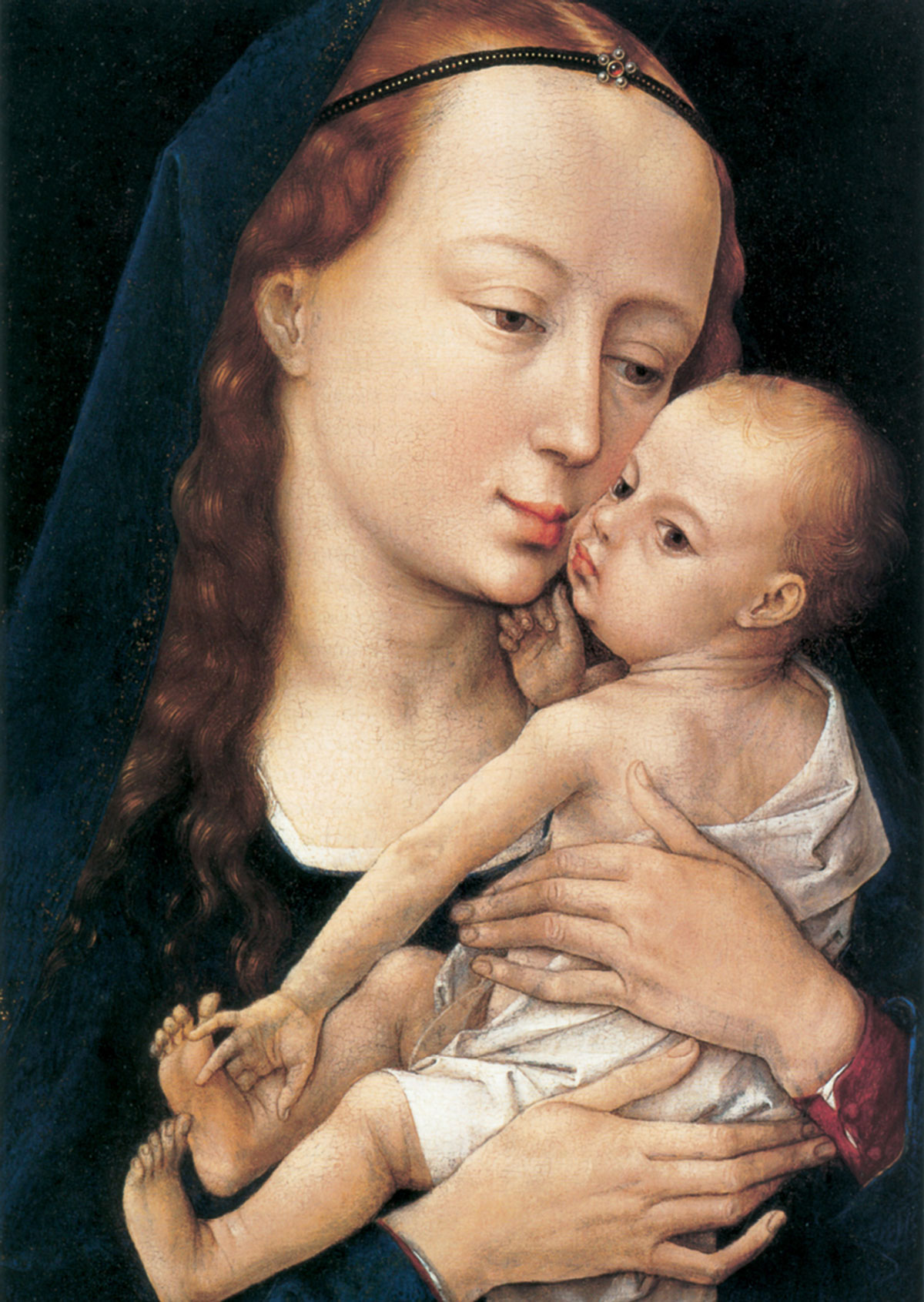
the gaze of the Virgin. Other paintings, such as one by Rogier van der
Weyden, show even freer adaptations of the model.
9.
In the copying of a text, a misspelled word, or a skipped word,
is an alarm signal that the scribe-copyist has made a mistake. In
“continuous” media like painting or sculpture there is no way to tell
that the hand-made copy has veered away from the model. For this
reason, the protocols that governed image-substitution were generally
tolerant of a certain amount of drift between model and copy. What
mattered above all was the transmission of programmatic, essential
content. That is why premodern copies are so often far from exact. Only
a general typological resemblance links the various copies of
Praxiteles’ Aphrodite of Cnidos. It is
one of the most famous statues of Antiquity, and yet the copies vary so widely that we can only guess at what the
lost original looked like.
10.
Around 1500, the art world begins to bristle with stories of
frauds, scandals, and reprisals involving fakes. But this is not to say
that forgeries displaced traditional modes of copying overnight.
Forgeries came into being fitfully, in certain places and at certain
times. A work made as a copy might be passed off as a forgery in
another context. The conspiring conditions included newly assertive
artist-authors, a new breed of collector and connoisseur, an emerging
art market, and a new class of intermediaries later known as dealers.
In 1496, Michelangelo makes a Sleeping Cupid
in the antique manner. He is told by a proto-dealer to “distress” it so
as to sell it as an antique at a higher price. The rich Cardinal who
buys it—for about the price of a house!—is incensed when the work is
exposed and gets rid of it. It is almost immediately snapped up by one
of the great art collectors of the day, Isabella d’Este, and now
displayed as a famous Michelangelo forgery. In fact, she sets it
alongside a (copy of a) famous Sleeping Cupid by the ancient
Greek sculptor Praxiteles, and so stages a mini-exhibition on the
subject of copies and forgeries, modernity, and antiquity.

Virgin and Child by Rogier Van der Weyden, ca. 1455-60. Thought to be another copy of the Cambrai Madonna.
11.
Traditional conceptions of the copy don’t just go away. When
Reginald Pole, a friend of Michelangelo’s, is asked for his copy of a
drawing of a Pietà by the master, he replies that he would be
happy to give it away, as he can get another copy from a friend. To
this day, scholars debate the attribution of several highly finished
Michelangelo drawings that exist in copies. When Isabella d’Este is
asked by an aristocratic friend for her painting of Mary Magdalene, she
replies that she would be happy to send it, but only asks for time to
have a good copy made. Even today, companies dealing in “genuine
fakes”—expertly painted copies of famous paintings, sold as copies—do
an enormous business. A well-executed copy evidently still carries
something of the magic and force of the original. Recently a copy of a
Van Gogh was sold as a copy for $200,000. If forgeries are the form copies take in the era of art, this is the form copies take in the era of forgery.
12.
The emergence of art forgery presupposes a culture in which what
matters above all is not the content a work of art transmits but the
irreducible qualities that make this work an unrepeatable
event. Eventually this conception of art would form the basis of a
discipline called the History of Art, which devoted its energies to
putting each artistic performance on a timeline, and to studying it as
the product of an author and a historical moment. When the 19th-century
priest and art collector Alexander Schnütgen was on his deathbed, one
of his crucifixes was brought to him to kiss. He opened his eyes,
looked up at it for a moment, and said: “Thirteenth century.” When it
came to art, the connoisseur had eclipsed the priest. Always the mimic,
forgery conforms to the new criteria of value. No longer content to
reproduce only schematic features, it now aims to render the kinds of
details that would satisfy a connoisseur. A 17th-century copy of the
Cambrai Madonna shows the new criteria at work. It is a copy in the era
of forgery: exact enough to confuse the critics as to its date until
scientific tests were done on it in recent times.
13.
The pairing forgery/copy may be more interesting than the
pairing copy/original. Forgery is not merely the criminalized version
of what had been in earlier times a legitimate replica. A collateral
effect of a system in which performativity is all, the forgery is the
copy in metastasized form. It crawls over the surface of art, imitating
with obsessive care the appearance of the original. Ultimately, of
course, in serving the cult of the authored artifact the forgery aims
to subvert it: it is out to prove that an artifact can escape its historical moment, and its author. It claims that the singular can
be repeated. The threat of forgery intensifies the pleasurable rituals
of art—close looking, the making of fine distinctions—to the point
where they turn into paranoid surveillance. Forgery is the harassing
bad conscience of the cult of art, shadowing our obsession with
originals and mocking our fetishism of the art object.
Alexander Nagel teaches and writes about Renaissance and contemporary
art and divides his time between Toronto, New York, and Rome. From 2004 to
2006 he will be Mellon Professor at the National Gallery in Washington, where
his aim is to become a student again.
Cabinet is a non-profit organization. Please consider supporting us by
subscribing to the magazine, buying a
limited edition artwork, or making a tax-deductible
donation.