


The Business of Pleasure
Ilf and Petrov’s adventures in Americana
Lisa A. Kirschenbaum
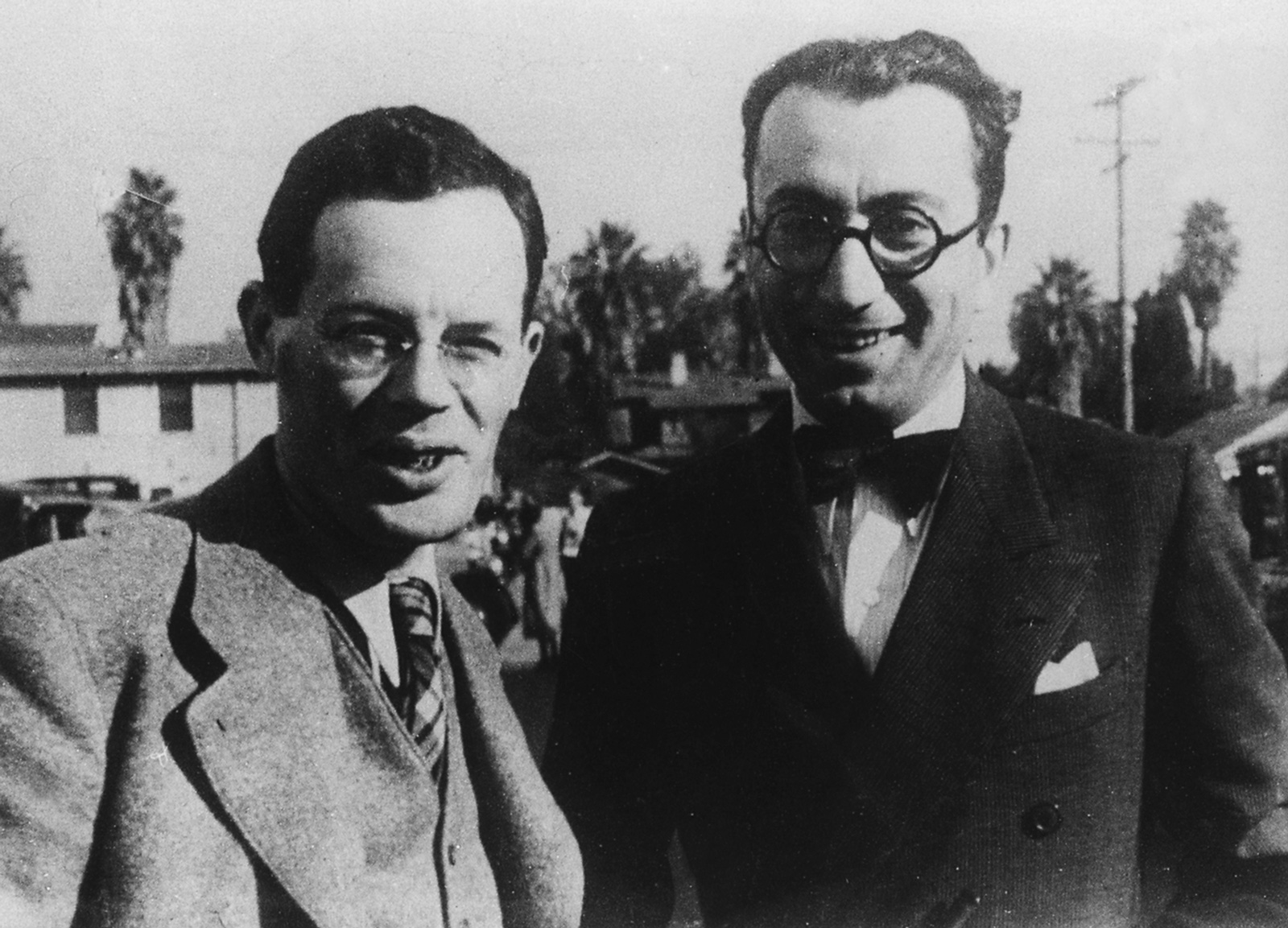
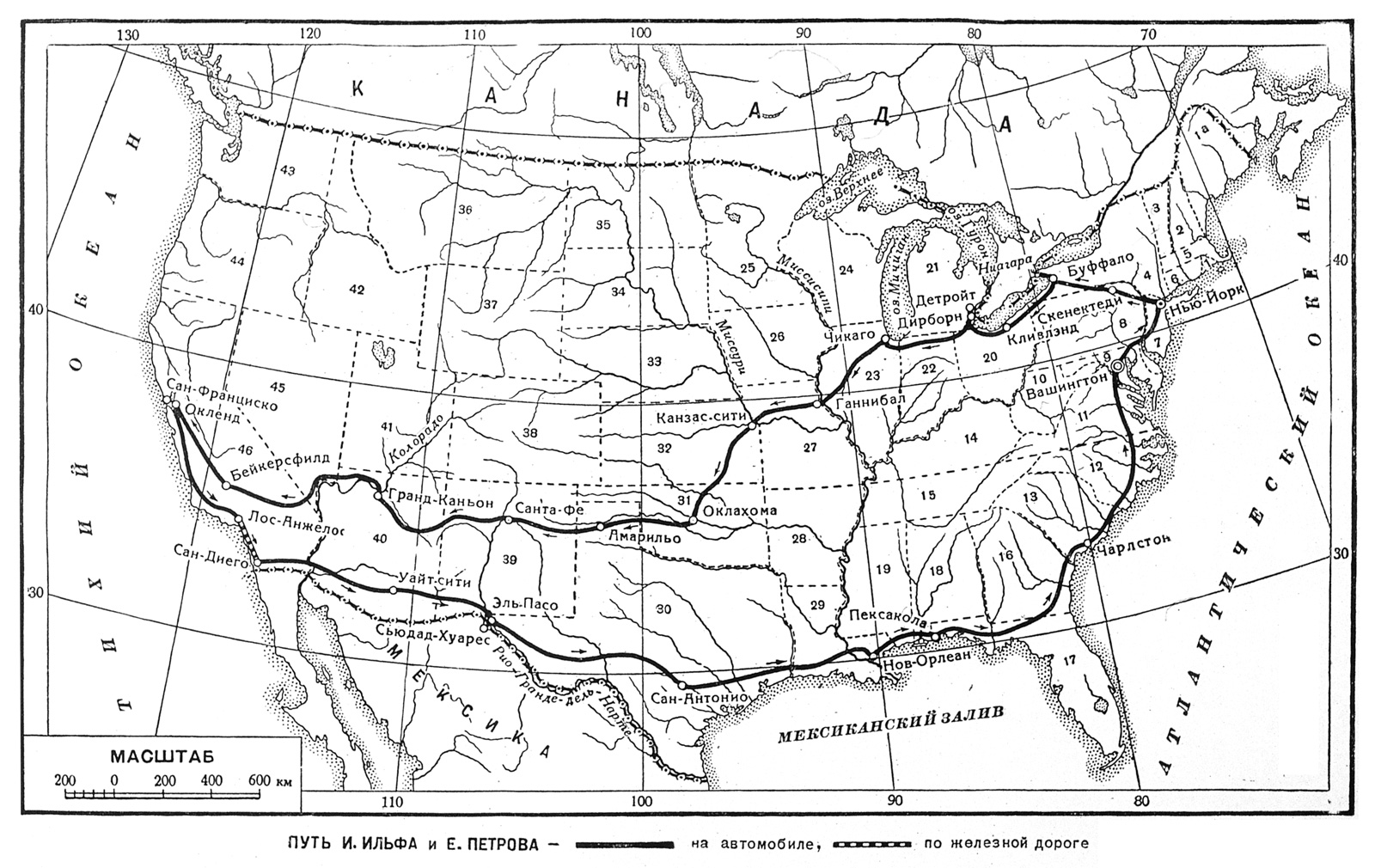
In October 1935, the Odessa-born satirists Ilya Ilf (1897–1937) and Evgeny Petrov (1903–1942) set off on a road trip from New York to California and back. They were serving as special correspondents for Pravda, the official newspaper of the Central Committee of the Communist Party of the Soviet Union. During their two-month journey, they assembled material for literary sketches on everything from the American love of popcorn to the country’s conspicuous racial discrimination, while Ilf captured landscapes and portraits with his Leica. Not long after their return to the Soviet Union, they published a photo-essay in eleven installments in the popular Soviet magazine Ogonek titled “Amerikanskie fotografii” (American photographs), which Cabinet Books republished in 2007. In 1937, Ilf and Petrov released a book titled Odnoetazhnaia Amerika (“Low-Rise” or “One-Storied” America), a travel narrative that was translated into English as Little Golden America that same year. For decades after, Odnoetazhnaia Amerika served as one of the primary sources for Soviet readers to learn about the United States. In what follows, Lisa A. Kirschenbaum examines the first leg of Ilf and Petrov’s trip: their adventures in risqué New York nightlife, disillusionment with auto races, and reservations about “the American dreamworld of leisure and consumption.”
The Zulu ceremony continued for several hours. This is pornography mechanized to such an extent that it acquires a kind of industrial-factory character. There is as little eroticism in this spectacle as in the mass production of vacuum cleaners or adding machines.
—Ilya Ilf and Evgeny Petrov, “Low-Rise America”
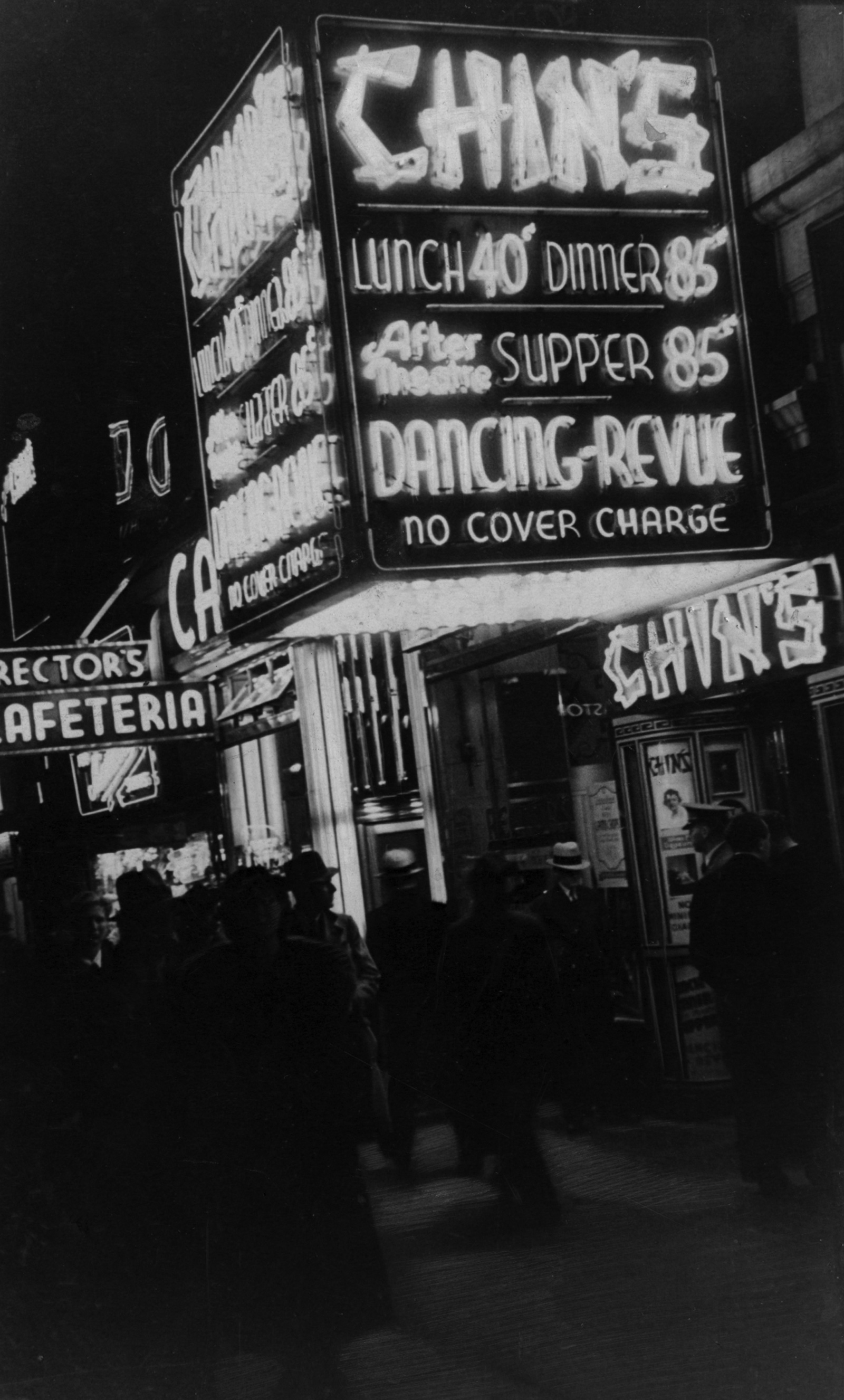
The Hollywood Restaurant was the place to go in Times Square for glamour on the cheap. A huge venue accommodating a thousand patrons for dining, dancing, and socializing, the nightclub, founded before the end of Prohibition, pioneered a business model that revived New York nightlife during the Depression. There was no cover charge, and diners brought their own alcohol. They paid as little as $1.50 for dinner and a show in the early evening or $2.00 after the theaters let out.[1]
John Dos Passos, Ilf, and Petrov caught the early show, at seven o’clock. It is not clear whether they indulged in the extras—a table in front of the stage ($3.00) or ice and glasses for brown-bag booze ($1.00). The club’s four nightly performances featured low-budget “novelties” such as roller skaters and contortionists, which Ilf and Petrov’s account ignored. They focused on the main attraction: the nearly nude chorus girls in their late teens, chosen more for their looks than their talent.[2] Ilf and Petrov recorded that the “average New Yorker” found complete pleasure dancing to jazz, “eating a cutlet,” and admiring the chorines. In their capacity as careful observers, they saw the show and ate the dinner. But they separated themselves from the natives’ pleasure. “We were saddened,” they concluded, “by New York’s happiness.”[3]
Dos Passos was not the only acquaintance to guide Ilf and Petrov through the American dreamworld of leisure and consumption. The “several thousand” new friends acquired at endless cocktail parties eagerly suggested what the Soviet visitors “must see” in order to really “know America.” The writers’ “amusements” became “most businesslike,” as they visited nightclubs, an auto race, the “Zulu ceremony” of a burlesque show, penny arcades, boxing and wrestling matches, a rodeo, and the New York auto show.[4]
As Ilf and Petrov investigated American amusements, back home in the USSR leisure and consumption were becoming serious matters. The completion of the First Five-Year Plan and the lifting of bread rationing coincided with a propaganda campaign celebrating the arrival of socialist abundance. In 1935, Stalin famously declared, “Life has become better, comrades. Life has become happier.”[5] Soviet leaders promised consumers that they would soon find not only necessities but luxuries such as caviar, champagne, and cosmetics in Soviet shops. For the moment, only elites—party cadres, Stakhanovites (workers who overfilled their production quotas), and favored members of the intelligentsia—had regular access to such goods. Nonetheless, in the Soviet media tempting visions of “cultured” consumption displaced revolutionary appeals to asceticism and toughness. The upwardly mobile communist man of the 1930s traded his leather jacket and Nagant revolver for a suit and tie. His wife, “with her permanent wave, fur-collared coat, and stylish cloche,” likewise rejected the militarized and masculinized appearance associated with earlier cohorts of Bolshevik women.[6] But in this transitional moment, understandings of what made Soviet consumers “cultured”—and how “cultured” consumption could be distinguished from capitalist excess—remained fluid.[7]
The new emphasis on consumerism, increasingly understood as the domain of women, interacted with a rethinking of the state’s commitment to women’s emancipation.[8] Before their American adventures, Ilf and Petrov had participated in the campaign to promote the sanctity of marriage and the sentimentalization of motherhood. This was an area in which the Soviet authorities tolerated something that passed as “satire.” In a piece published in Pravda, they pointed out that Soviet “divorce laws were not written so that a person could use marriage like a tramway, paying ten kopecks’ fare, enjoying the ride, and then chasing after another car.”[9] In 1936, Soviet legislation that recriminalized abortion and made divorce more difficult and expensive to obtain marked the official enshrinement of motherhood as a woman’s most important role and greatest joy. But even after legislating compulsory motherhood, the Stalinist state continued to employ the rhetoric of women’s emancipation and to uphold the new woman, whether a young tractor driver or daring aviatrix, as a revolutionary icon.[10] Thus, Stalinist visions of appropriate gender roles—and of appropriately gendered consumption—were ambiguous. Could a good communist mother wear lipstick and the latest fashions without succumbing to petty-bourgeois materialism? What made consumption tasteful, socialist, and cultured? Ilf and Petrov’s exploration of American consumption and leisure provided them with a series of case studies that probed the line between wholesome, enriching consumption and capitalist vulgarity. They usually avoided explicit comparisons with Soviet practices, counting on readers to supply the contrast for themselves. Instead, their reports of encounters with the amusements of the “common people” highlighted what Dos Passos called the “dream” of the New York shop clerk or the crass materialism of American wives. Doing so, they had leeway to mock and criticize and, in one telling case, to make fun of themselves.
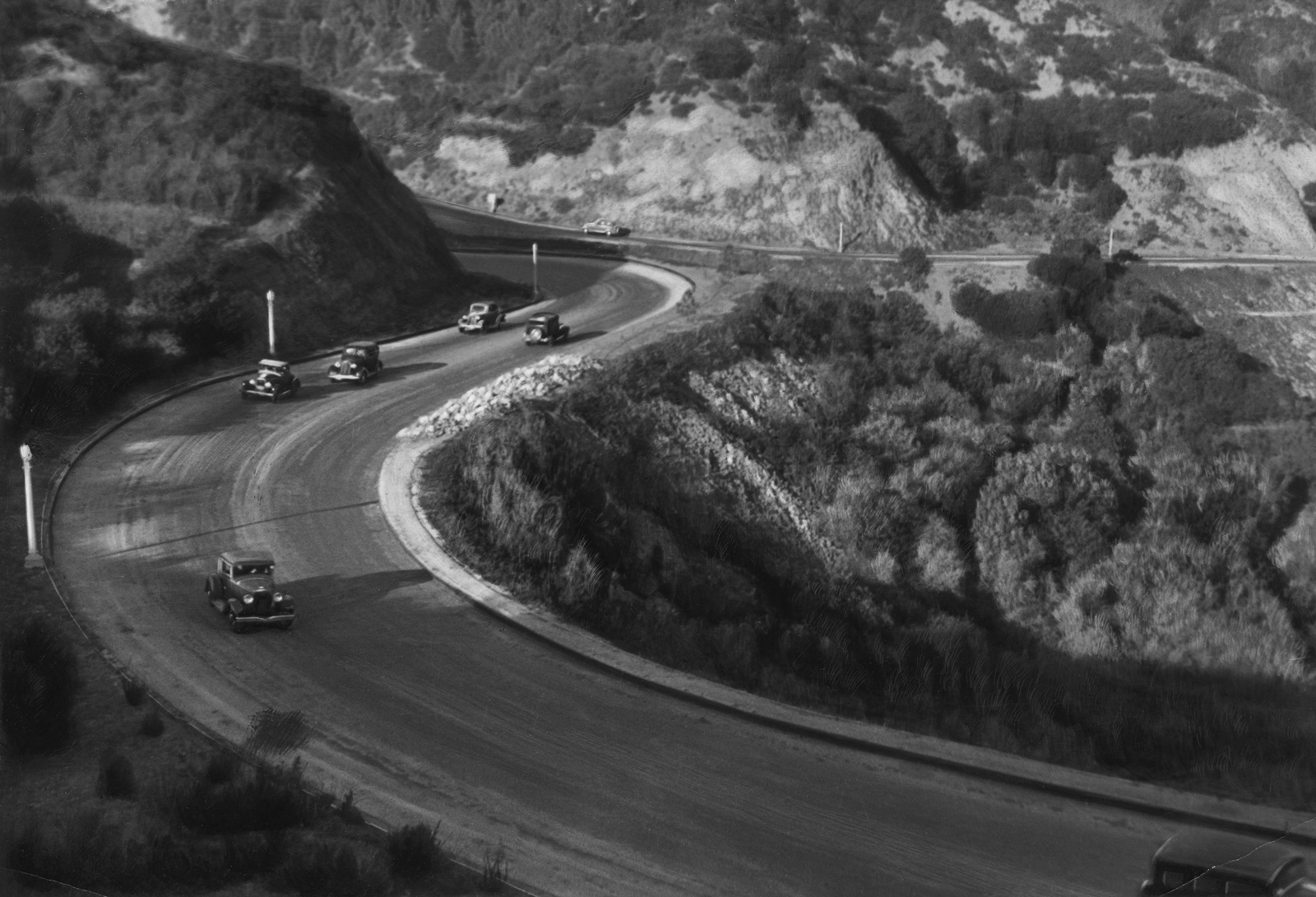
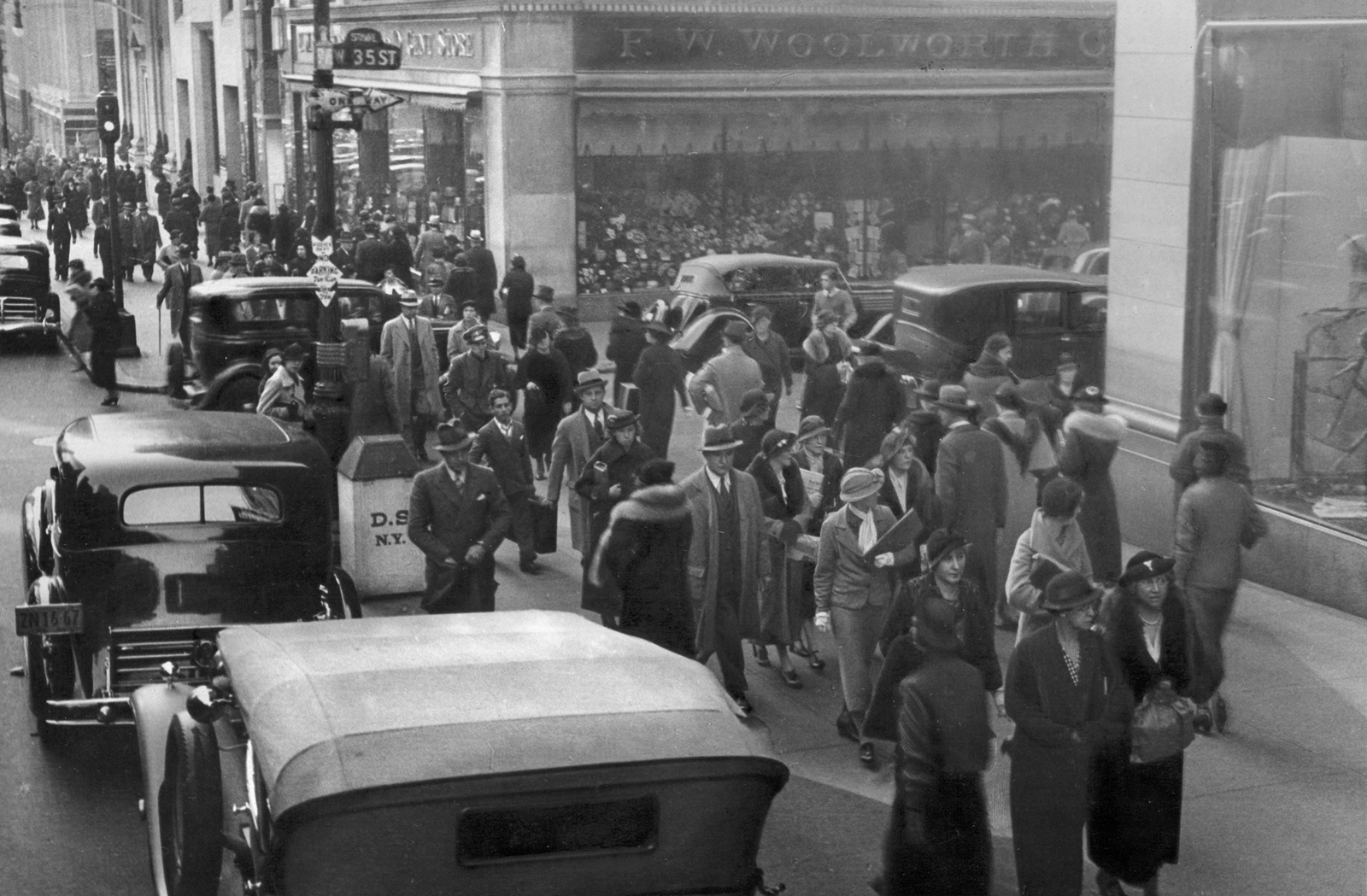
From the moment they arrived in New York City in early October 1935, Ilf and Petrov avidly sampled America’s cultural offerings from high—rarely discussed in the published work—to low. Less than a week into their stay, they left the city with the Soviet consul in New York, Jean Lvovich Arens, to see the auto races at the Danbury Fair in Connecticut. The lengthy account of the fair in “Low-Rise America” illustrates the typical features and the complexity of their responses to American popular culture. The three-hour drive itself was an unmitigated pleasure. This first encounter with American roads made of “concrete slabs separated by expansion joints” elicited raptures. In his notebook, Ilf gushed: “Cars roll along with merry-go-round smoothness; the road is so beautiful that I looked only at it, not paying attention to the wonderful red autumn landscape.”[11] Petrov agreed, writing, “The roads in America are mindboggling. You want to dance on them.”[12] In the published chapter, they paid more attention to the foliage, asserting that the roads deserved a “special chapter” all to themselves, which they supplied and in which they recounted their initial wonder.[13]
After driving through the “Indian sylvan festival” of southern New England, Ilf and Petrov found themselves at a “drab provincial fair” of the sort they had read about in O. Henry’s stories.[14] They surveyed agricultural exhibitions, souvenir vendors, and a carnival midway, which reminded them of home. The “openhearted, hysterical female squeal” let out as a carnival ride turned the occupants of a boat-shaped swing upside down high in the air “immediately carried us from the state of Connecticut to the state of Moscow, to the Park of Culture and Rest,” better known in the West as Gorky Park.[15] Opened in 1928, the Moscow park, its pompous name notwithstanding, had become by the mid-1930s “a sort of Moscow Coney Island,” a place that materialized promises of a happier life.[16] Ilf and Petrov suggested that the carnival ride united modern urban cultures across the socialist-capitalist divide. So, too, did a good clown act, which they thoroughly appreciated.
By contrast, the writers represented the auto races that brought them to the fair as a wholly alien concoction, a potent distillation of the dangers and depravities of capitalism. Not that their account of the races lacked excitement. They described red, white, and yellow cars with numbers painted on their sides “rocketing” around the track, kicking up gravel and hot sand. The audience roared. But Ilf and Petrov denied that watching five, six, even ten cars “flying” past had any appeal for them. They pronounced the whole thing “frightfully boring.” Only the horror of an accident broke the tedium. Catching a glimpse of the injured driver, they imagined him “angry” because he had “lost the prize for which he had risked his life.” Unlike the carnival rides or the clown act, the races were an “empty, gloomy, soul-draining” spectacle.[17]
Positioning themselves as cultured representatives of the Soviet intelligentsia, Ilf and Petrov characterized the penny arcades they found around Times Square and on the Lower East Side as similarly soul draining. They marveled that people spent hours in the “solitary entertainment” of feeding coins, “without anger or delight,” into pinball machines, slowly accumulating the points to claim one of the “lovely prizes” on display: a glass vase or an aluminum cocktail shaker, a table clock or a cheap fountain pen or razor. They had even less patience for the mechanized fortune tellers tempting passersby to part with their nickels. All of these “idiotic wonders,” they concluded, were “disgusting” even amid the city center’s “glitz and noise”; in the dark, dirty, impoverished streets of downtown, they became “unbearably depressing.”[18]
In “Low-Rise America,” Ilf and Petrov underscored the parallels between these mind-numbing mechanical games and the auto races by compressing the timeline and narrowing the focus. Ilf’s notebook lists the episode’s key words—“mech. fortuneteller. Entertainment. Stroll around the East Side. Dirt. Resourceful young people. Café Royal”—in an entry dated October 21, nine days after their visit to the fair. But in the book, they narrate the encounter with pinball machines and the mechanized fortuneteller as the adventure that immediately followed, and was in part inspired by, the auto races.
Tellingly, they omitted in the published travelogue what was likely the most engaging, if the least “American,” piece of the East Side adventure, Café Royal, a “kibitzers’ hangout” on the southeast corner of Second Avenue and Twelfth Street. Renowned for its chicken paprikash, Café Royal was, according to a 1937 New Yorker profile, “the forum of the Jewish intelligentsia.” Actors, writers, and impresarios—“everybody who is anybody in the creative Jewish world”—came to see and be seen and argue in English, Yiddish, and Yiddish-English about “the sacred cause of Art.”[19] Ilf perhaps understood the conversation in Yiddish.[20] But Jewish intellectuals from the Russian empire likely spoke Russian, a marker of cultural prestige even among those who wrote in Yiddish.[21] Interactions with the Jewish Russian-American intelligentsia constituted an essential linchpin of Ilf and Petrov’s sojourn in the city.[22] However, vibrant, cultured, immigrant New York had no place in their efforts to parse and judge the American business of pleasure.
Ilf and Petrov placed the climax of their sampling of “soul-draining” entertainments—their encounter with “industrial-factory” striptease—on the same eventful day or couple of days as the fair and their visit to penny arcades. In this case, too, they condensed the timeline. A letter from Ilf indicates that they saw an “absolutely vulgar” and “therefore interesting” burlesque show on October 16, several days before their encounter with the mechanized fortune teller.[23] Long a part of the New York scene, burlesque was at least a notch less respectable than the leg show to which Dos Passos took the authors. It offered a variety show mix of “baggy-pants comics, slapstick, double entendres and strip tease.”[24] As the Depression decimated legitimate (and more expensive) theater, producer Billy Minsky moved burlesque from the immigrant enclaves of the Lower East Side to Broadway, leasing the venerable Republic Theater on Forty-Second Street.[25] More burlesque theaters and other downscale entertainments soon followed: dance halls, peep shows, penny arcades, and no-frills cafeterias. By the mid-1930s, the area around Times Square, a five-minute walk from Ilf and Petrov’s hotel, offered a “bargain-basement sexual smorgasbord.”[26] Captivated, if also somewhat appalled, by the gaudy lights, Ilf and Petrov depicted Broadway as more showy than seedy.[27]
The authors selected a very cheap entrée from the cultural buffet. Tickets for legitimate Broadway theater went as high as $8.80, while opening night tickets to the more popular musicals might set theatergoers back $75 or $100 dollars.[28] Ilf, who kept careful accounts, reported in his letter home that the pair paid thirty-five cents each for a burlesque review on Broadway. “Low-Rise America” cites the same low figure, the cost of a movie ticket.[29] This was cut-rate, even for burlesque. “High-class” venues, such as Minksy’s Republic Theater, which featured luxurious movie palace–style interiors and ushers in fancy uniforms, charged $1.50; the most successful spot in the mid-1930s, the Irving Place Theater, charged $1.10. Even more modest theaters on Forty-Second Street or downtown charged fifty cents.[30] Perhaps Ilf misquoted the price. Or perhaps they really did find the bargain basement of the bargain basement.
Unsurprisingly, Ilf and Petrov judged burlesque uncultured. Their account omitted the comedians and the performers’ cynicism and raunchy humor. The language barrier may have rendered the dirty jokes indecipherable. But did observers as sharp-witted as Ilf and Petrov really fail entirely to understand that the show was both a sexual display and a sendup of sex? Whatever the case, they steered clear of depicting the laughter that, as the historian Rachel Shteir argues, afforded “women more agency than other forms of popular entertainment by acknowledging their sexuality and allowing them to connect directly with the audience.”[31] Instead, Ilf and Petrov portrayed the show as a disturbing parody of high culture. The performers could neither sing nor dance. The audience, the writers astutely concluded, had come “for something else.” What that “something else” was became clear when the first performer began to take off her clothes and then, “with a bedroom squeal, ran into the wings.” The master of ceremonies’ proposition, “If you applaud harder, she’ll take off something else,” produced an “explosion of applause” the likes of which the most accomplished performers would never in their whole lives enjoy.[32] This sounds very much like a description of the show at the Irving Place Theater where, according to a contemporary article in Billboard, “the customers expect the limit and get it by applauding.”[33] Of course, the ploy may have been widespread. In Ilf and Petrov’s telling, the talentless stripper reappeared and “sacrificed what little was left of her garments.” Ten more strippers did exactly the same, becoming graceless cogs in a pornographic machine.
Having established that striptease was not “culture” in the sense of opera or ballet, Ilf and Petrov approached it as culture in the anthropological sense, calling the show a “Zulu ceremony.”[34] The racialized metaphor can be understood as highlighting the exotic, even uncivilized, nature of the spectacle. Variety’s Sime Silverman made a similar point with a different exoticized culture, comparing a stripper to a Polynesian icon.[35] But in Ilf and Petrov’s account, the evocation of a primitive ritual sat uneasily with the depiction of striptease as modern mechanized pornography. Their quasi-ethnographic description functioned less as an explanation of burlesque than as an explanation—or rationalization—of their own decision to spend “several hours” watching a show they found offensive and, even worse, dull. Like the English travel writer and anthropologist Geoffrey Gorer, who published a study of New York burlesque in 1937, they distanced themselves from the “men who go to burlesque theaters week after week, year after year.” Emphasizing, like Ilf and Petrov, the show’s “extra-ordinary monotony,” Gorer, more forthrightly than the Soviet writers, asserted that the spectators desired not “simple entertainment” but “sexual stimulation.”[36] Declaring themselves repelled and bored by the spectacle, Ilf and Petrov, like the anthropologist, positioned themselves as outsiders, who watched the show and the audience as systematic observers, not as pleasure-seekers. As in their account of the leg show, the writers emphasized that they suffered through the vulgarity in the service of scientific thoroughness.
Ilf and Petrov’s reactions to the striptease and the leg show resembled those of leftist Western critics, who likewise reached for industrial metaphors when condemning modern capitalism’s commodification of the female body.[37] But they expressed less sympathy for the strippers than the chorines. In both cases, they highlighted the entertainment’s machine-like qualities. However, while they depicted the strippers as gears in a pornographic apparatus, they portrayed the chorus girls as exploited assembly line workers—albeit workers whose jobs required that they appear “half naked, three-quarters naked, and nine-tenths naked.” Noticing that the nightclub’s proprietor, with a “passion for service,” would not let the dancers “be idle,” Ilf and Petrov described the young performers at the Hollywood Restaurant as disempowered women workers: “The girls ran out” again and again—“in the interval between the first and second course, before coffee, and during coffee”—with the result that they sometimes “dipped their feathers into bowls of soup or jars of mustard.” In fact, the dancers may have worked seventy to eighty hours per week. Ilf and Petrov saw the results of this overwork on their faces, some of which were “blank, others pitiful, and still others hard, but all equally tired.”[38] However, they failed to register that the strippers, too, were overworked; only a month before their visit, the burlesque workers’ union had staged a four-day strike in hopes of improving performers’ wages and working conditions.[39]
As “chaste Soviets abroad,” Ilf and Petrov appeared unable or unwilling to grant the legitimacy of women expressing (if also commodifying) their sexual agency.[40] They narrated their burlesque adventure as a moral tale in which Stalinist virtue was virtually indistinguishable from bourgeois puritanism. Representing the strippers as mass-produced and interchangeable objects of erotic consumption—the only way to tell them apart was by their hair color—Ilf and Petrov focused on the unseemly display’s dangerous effects on men.[41] Their concerns about the allegedly unnatural spectacle of women articulating or embodying sexual desire sounded very much like those of the American moral reformers, who managed to get most of New York’s burlesque theaters shut down in 1937. American middle-class opponents of burlesque bluntly characterized the audience as “sex-crazed perverts.”[42] From the Soviet perspective, the frantically applauding burlesque spectators embodied the male American consumer’s irrational and sexualized desires.[43]
Applying emerging Soviet understandings of consumption and leisure to the United States, Ilf and Petrov represented American men as often succumbing to the coarse charms of popular commercial spectacles: auto races, strip shows, professional wrestling, boxing matches. At the same time, Ilf and Petrov saw elements of American vulgarity on the Soviet side of the divide. In a letter home, Ilf expressed the same criticisms of American culture as in the published work: the line about the half-, three-quarters, and nine-tenths naked dancers appears verbatim. He also noted that the show reminded him of the “artistic conceptions” of the director Grigory Aleksandrov, with whom the writers were embroiled in a dispute about changes to their screenplay for the film Circus. Ilf and Petrov objected to the director’s decision to add “large-scale dance numbers with showgirls in skimpy costumes” to their comedy. Ultimately, the funnymen had their names removed from the musical’s credits.[44]
While Ilf and Petrov satirized the (American) male taste for vulgar and sexualized spectacles, they associated women with the obsessive consumption of vulgar things. This linkage of women and “rampant consumerism” was not “unique to the Soviet Union.”[45] It was both deeply embedded in Soviet conceptions of gender and rife among American radicals. Deploring women’s commodification under capitalism did not prevent men on the left, in the Soviet Union no less than the United States, from representing women, and especially spendthrift housewives, as “materialist viragoes.”[46]
On the American side, what literary historian Seth Moglen calls “left misogyny” shows up with particular clarity in Dos Passos’s fiction. In his sketch of the socialist Eugene Debs, the first biography in the U.S.A. trilogy, Dos Passos asked: Where were “Debs’ brothers in nineteen eighteen when Woodrow Wilson had him locked up in Atlanta for speaking against the war”? His answer shifted the blame for political docility from “the big men fond of whisky and fond of each other” to women, who subdued their husbands by playing on their desires for “a house with a porch to putter around and a fat wife to cook for them.” In Dos Passos, women like the fictional Maisie, who nags Mac to give up his activism in the International Workers of the World in order to get married and settle down, appear as small-minded consumers: “Maisie read a lot of magazines and always wanted new things for the house, a pianola, or a new icebox, or a fireless cooker.”[47]
Dos Passos’s assumption that women lacked “revolutionary” virtues chimed with Soviet images of “real” revolutionaries as male. While Bolshevik ideology promised gender equality, Bolshevik culture often associated women with the domestic sphere and intractable political “backwardness.”[48] The mid-1930s campaign for “culturedness” (kulturnost) featured both men and women as enlightened “new consumers.” Soviet leaders themselves modeled the new image of the communist man in a tailored suit; they sponsored a “wife-activist” movement that encouraged factory managers’ spouses to use their homemaking skills to beautify their husbands’ workplaces. Still, the fear that “backward” women would “corrupt” men with demands for frivolous goods died hard. The Soviet media simultaneously urged women to pay attention to their clothes and hairstyles and worried that women were more liable than men to cross the thin line that divided “culturedness” from “petty bourgeois vulgarity” (meshchanstvo).[49]
In Ilf and Petrov’s telling, American women enslaved by their desire for the latest thing crossed this line. The writers depicted working-class women, whether exhausted chorines or heavily rouged secretaries having breakfast at a drugstore, as trapped by their longing to fulfill the American dream on the installment plan. Less charitably, the writers described American housewives as shrewish angels with the “blue eyes of a vestal virgin” and the insatiable greed of the fisherman’s wife in the tale of the golden fish. The pair may well have seen thin, pretty women “moaning” over the 1936 models on show at the New York auto show. To overcome a Depression-era slump in car sales, manufacturers included features expressly designed to appeal to women: automatic controls, deeper and more luxuriously upholstered seats, and roomier luggage compartments that made it “possible for women to carry apparel on long trips without wrinkling or crushing it.” But Ilf and Petrov clearly invented the conversation that occurred the “night after” the auto show: She will not listen to the sensible husband who wants to get a few more years out of the Plymouth with only 20,000 miles. She wants a “golden Chrysler!”[50]
Freely admitting their own enthusiasm for automotive marvels, Ilf and Petrov assayed a world of difference between their rational—if also comically eager—consumerism and the grasping materialism of the American wife. They “knew beforehand that we would buy the cheapest automobile to be found anywhere in the United States.” And so, at the auto show, the writers enjoyed the opportunity to sit a while in a Rolls Royce they deemed “too luxurious for us.” They gleefully pushed the button to reveal the Cord 810’s popup headlamps. Moving among the Plymouths, Oldsmobiles, Studebakers, Hudsons, Nashes, Chevrolets, Buicks, and Cadillacs, they turned steering wheels, honked horns, and examined engines without being tempted to buy something beyond their means. As they surveyed the business of pleasure in New York, Ilf and Petrov carefully marked the differences between coarse American and cultured Soviet consumption, even as they admitted that a lack of funds held them in check.
In late October 1935, as they were preparing to leave New York, Ilf and Petrov themselves took center stage at a very businesslike amusement, a meeting of the Dutch Treat Club. Their publisher John Farrar, who was a member, likely arranged the invitation to the New York club, which was frequented by editors, writers, illustrators, lyricists, and other literary types. The members gathered every Tuesday for a lunch usually lasting no more than hour. After all, as Ilf and Petrov noted, these were “businesspeople,” who needed to be back in their offices “advancing culture or simply making money.”[51] As the club’s name suggested, members paid for their own lunch; guest speakers got their meals covered in exchange for a humorous, or at least brief, speech.
The theme of Ilf and Petrov’s speech—delivered by Ilf in Russian and Petrov in almost incomprehensible English—was the pair’s quest to find “real” America.[52] They related that everywhere they went—New York City, Washington, DC, Hartford—Americans gestured vaguely into the distance and told them that “real America” was elsewhere. They concluded with an appeal to the gathered gentlemen “to show us where America really is located, because we have come here in order to learn as much as we can about it.”[53]
After their speeches, the guests received a “medal” featuring the club’s emblem, which Ilf and Petrov described as portraying a “reveler in a crushed top-hat, slumbering under the club’s initials.”[54] The logo was somewhat more louche than they allowed. The reveler, with top hat, monocle, and cigarette holder, reclined at the bottom of a martini glass. The image was in line with an organization whose all-male membership produced an elaborate annual dinner show featuring songs and skits filled with political satire, unsubtle double entendre, and casual misogyny. (The club began admitting women in 1991, but it retains the emblem.) One wonders what Ilf and Petrov would have thought of the yearbook distributed at the club’s April 1935 show, overflowing with images of women in various stages of undress. It included a drawing of a topless woman, her back toward the viewer, shaking her hips with the caption, “The most popular revolutionary movement of all time.”[55]
In their account of the Dutch Treat Club, as in their account of the American business of pleasure more generally, Ilf and Petrov identified themselves as thorough and eager participant-observers. They bravely explored all manner of entertainments and asked the natives to point them in the direction of “real” America. But the Soviet distinction between cultured and uncultured consumption remained the guiding star of “Low-Rise America.” To make the Dutch Treat Club more “businesslike,” Ilf and Petrov removed the martini glass from its emblem. To emphasize the soul-draining crassness of popular amusements, they deemed cars “rocketing” around a track monotonous and drained the laughter from the burlesque stage. Thus, Ilf and Petrov tried to make Soviet sense of what they saw. But their account is not wholly persuasive. The reader is left wondering whether they, too, thrilled to speeding race cars or enjoyed the nightlife more than they let on.
Excerpted and adapted from Lisa A. Kirschenbaum, Soviet Adventures in the Land of the Capitalists: Ilf and Petrov’s American Road Trip (Cambridge University Press, 2024). Reprinted with permission. All rights reserved.
- Burton W. Peretti, Nightclub City: Politics and Amusement in Manhattan (Philadelphia: University of Pennsylvania Press, 2011), pp. 113–114.
- Ilya Ilf and Evgeny Petrov, Odnoetazhnaia Amerika: Pis’ma iz Ameriki, ed. Aleksandra I. Ilf (Moscow: Tekst, 2003), p. 440. This and all other translations from Russian sources are my own. When I cite the 2003 edition of Odnoetazhnaia Amerika, it is in reference to Ilf and Petrov’s letters home, which are collected in this edition. Quotations from the travelogue are taken from the 1937 edition of Odnoetazhnaia Amerika. In citations that feature both Odnoetazhnaia Amerika and Charles Malamuth’s English translation, Little Golden America, I have used all or part of the latter edition. For more on New York nightlife in this period, see: Rachel Shteir, Striptease: The Untold Story of the Girlie Show (Oxford: Oxford University Press, 2004), p. 163; Lewis Erenberg, Inventing Times Square: Commerce and Culture at the Crossroads of the World (New York: Russell Sage Foundation, 1991), p. 171.
- Ilya Ilf and Evgeny Petrov, Odnoetazhnaia Amerika (Moscow: Khudozhestvennaia literatura, 1937), p. 58.
- Ilya Ilf and Evgeny Petrov, Little Golden America: Two Famous Soviet Humorists Survey the United States, trans. Charles Malamuth (New York: Farrar and Rinehart, 1937), p. 30; Ilf and Petrov, Odnoetazhnaia Amerika (1937), pp. 35, 40.
- Joseph Stalin, “Speech at the First All-Union Conference of Stakhanovites” (17 November 1935). Available at
; Julie Hessler, A Social History of Soviet Trade: Trade Policy, Retail Practices, and Consumption, 1917–1953 (Princeton, NJ: Princeton University Press, 2004), pp. 201–222. - The quotation is from Rebecca Balmas Neary, “Mothering Socialist Society: The Wife-Activists’ Movement and the Soviet Culture of Daily Life, 1934–41,” The Russian Review, vol. 58, no. 3 (July 1999), p. 410. See also Randi Cox, “All This Can Be Yours! Soviet Commercial Advertising and the Social Construction of Space, 1928–1956,” in The Landscape of Stalinism: The Art and Ideology of Soviet Space, ed. Evgeny Dobrenko and Eric Naiman (Seattle: University of Washington Press, 2003), p. 144.
- Philippa Hetherington, “Dressing the Shop Window of Socialism: Gender and Consumption in the Soviet Union in the Era of ‘Cultured Trade,’ 1934–53,” Gender & History, vol. 27, no. 2 (August 2015), pp. 419–422.
- Randi Cox, “All This,” p. 147.
- Ilya Ilf and Evgeny Petrov, “Mat’,” Pravda (Moscow), 7 June 1935; “Topics of the Times,” The New York Times, 10 June 1935.
- Victoria E. Bonnell, Iconography of Power: Soviet Political Posters under Lenin and Stalin (Berkeley: University of California Press, 1997), p. 10; Susan E. Reid, “All Stalin’s Women: Gender and Power in Soviet Art in the 1930s,” Slavic Review, vol. 57, no. 1 (Spring 1998), p. 136; Melanie Ilič, “Traktoristka: Representations and Realities,” in Women in the Stalin Era, ed. Melanie Ilič (Basingstoke, UK: Palgrave, 2001), pp. 110–112; Choi Chatterjee, “Soviet Heroines and the Language of Modernity, 1930–39,” in Women in the Stalin Era, pp. 54–59.
- Ilya Ilf, Zapisnye knizhki, 1925–1937: Pervoe polnoe izdanie, ed. A. I. Ilf (Moscow: Tekst, 2000), pp. 430, 433. Ilf and Evgeny Petrov, Odnoetazhnaia Amerika (2003), pp. 430–431.
- Ilya Ilf and Evgeny Petrov, Odnoetazhnaia Amerika (2003), p. 435.
- Ilya Ilf and Evgeny Petrov, Odnoetazhnaia Amerika (1937), p. 35.
- Ibid., p. 36; Ilya Ilf and Evgeny Petrov, Little Golden America, p. 30.
- Ilya Ilf and Evgeny Petrov, Odnoetazhnaia Amerika (1937), p. 36; “The Danbury Fair, 1869–1981,” ConnecticutHistory.org, Connecticut Humanities, 1 October 2020. Available at
. - Walter Duranty, “The Capitals of Two Opposite Worlds,” The New York Times, 28 August 1932.
- Ilya Ilf and Evgeny Petrov, Odnoetazhnaia Amerika (1937), pp. 37–38.
- Ibid., p. 39; Ilya Ilf, Zapisnye knizhki, p. 439.
- Leonard Q. Ross [Leo Rosten], “Café Royal,” The New Yorker, 10 April 1937, p. 45; Sachar M. Pinsker, A Rich Brew: How Cafés Created Modern Jewish Culture (New York: New York University Press, 2018), pp. 226–233.
- Alice Nakhimovsky, “How the Soviets Solved the Jewish Question: The Ilf-Petrov Novels and Ilf’s Jewish Stories,” Symposium: A Quarterly Journal in Modern Literatures, vol. 53, no. 2 (1999), pp. 101–102.
- Steven Cassedy, To the Other Shore: The Russian Jewish Intellectuals Who Came to America (Princeton, NJ: Princeton University Press, 1997), pp. 3–14.
- Ilya Ilf, Zapisnye knizhki, pp. 426–430, 433–434, 440.
- Ilya Ilf and Evgeny Petrov, Odnoetazhnaia Amerika (1937), p. 40; Ilf and Petrov, Odnoetazhnaia Amerika (2003), p. 434; Ilf, Zapisnye knizhki, p. 436.
- Robert C. Allen, “‘The Leg Business’: Transgression and Containment in American Burlesque,” Camera Obscura, vol. 8, no. 2 (May 1990), p. 45; Rachel Shteir, Striptease, pp. 166–167.
- Ibid., pp. 134–139; Burton W. Perretti, Nightclub City, pp. 116–118; Alva Johnston, “A Tour of Minskyville,” The New Yorker, 28 May 1932.
- Burton W. Peretti, Nightclub City, pp. 102–116.
- Ilya Ilf and Evgeny Petrov, Little Golden America, p. 33.
- Brock Pemberton, “In Re the Year 1935,” The New York Times, 29 December 1935.
- Ilya Ilf and Evgeny Petrov, Odnoetazhnaia Amerika (2003), p. 434; Ilf, Zapisnye knizhki, p. 436.
- Rachel Shteir, Striptease, pp. 133, 136, 164; Russel Maloney, “Burlesk,” The New Yorker, 8 June 1935, p. 15.
- Rachel Shteir, Striptease, p. 141; Kathleen Spies, “‘Girls and Gags’: Sexual Display and Humor in Reginald Marsh’s Burlesque Images,” American Art, vol. 18, no. 2 (Summer 2004).
- Ilya Ilf and Evgeny Petrov, Odnoetazhnaia Amerika (1937), p. 40.
- As quoted in Rachel Shteir, Striptease, p. 164.
- Ilya Ilf and Evgeny Petrov, Odnoetazhnaia Amerika (1937), p. 40;
- Rachel Shteir, Striptease, p. 139.
- Geoffrey Gorer, Hot Strip Tease and Other Notes on American Culture (London: Cresset Press, 1937); Kathleen Spies, “‘Girls and Gags,’” pp. 53–54.
- Christina Kiaer, “African Americans in Soviet Socialist Realism: The Case of Aleksandr Deineka,” Russian Review, vol. 75, no. 3 (July 2016), pp. 419–420; Alix Beeston, “A ‘Leg Show Dance’ in a Skyscraper: The Sequenced Mechanics of John Dos Passos’s Manhattan Transfer,” PMLA, vol. 131, no. 3 (2016), p. 646.
- Ilya Ilf and Evgeny Petrov, Odnoetazhnaia Amerika (1937), pp. 58–59; Ilf and Petrov, Little Golden America, p. 47; Rachel Shteir, Striptease, p. 158.
- Ibid., pp. 6, 158–162.
- Christina Kiaer, “African Americans,” p. 420.
- Ilya Ilf and Evgeny Petrov, Odnoetazhnaia Amerika (1937), p. 40.
- Andrea Friedman, “‘The Habitats of Sex-Crazed Perverts’: Campaigns against Burlesque in Depression-Era New York City,” Journal of the History of Sexuality, vol. 7, no. 2 (October 1996).
- Julie Hessler, Social History, p. 213.
- Christina Kiaer, “African Americans,” p. 420; Richard Taylor, “The Illusion of Happiness and the Happiness of Illusion: Grigorii Aleksandrov’s The Circus,” Slavonic and East European Review, vol. 74, no. 4 (October 1996): p. 605.
- Philippa Hetherington, “Dressing the Shop Window,” p. 422.
- Seth Moglen, Mourning Modernity: Literary Modernism and the Injuries of American Capitalism (Stanford, CA: Stanford University Press, 2007), p. 216.
- Seth Moglen, Mourning, p. 144; John Dos Passos, U.S.A. (New York: Library of America, 1996), pp. 31–32, 104.
- Anne E. Gorsuch, “‘A Woman Is Not a Man’: The Culture of Gender and Generation in Soviet Russia, 1921–1928,” Slavic Review, vol. 55, no. 3 (Fall 1996), pp. 644–646; Elizabeth Wood, The Baba and the Comrade: Gender and Politics in Revolutionary Russia (Bloomington: Indiana University Press, 1997), p. 17; Lisa A. Kirschenbaum, “The Man Question: How Bolshevik Masculinity Shaped International Communism,” Socialist History, no. 52 (2017).
- Philippa Hetherington, “Dressing the Shop Window,” pp. 423–424, 427, 434; Sheila Fitzpatrick, Everyday Stalinism: Ordinary Life in Extraordinary Times: Soviet Russia in the 1930s (New York: Oxford University Press, 1999), pp. 92, 156–159; Rebecca Balmas Neary, “Mothering Socialist Society,” pp. 396–403.
- Ilya Ilf and Evgeny Petrov, Odnoetazhnaia Amerika (1937), pp. 37–38, 70–71, 172–173; “Early Auto Show Stimulates Sales,” The New York Times, 7 November 1935.
- Ilya Ilf and Evgeny Petrov, Odnoetazhnaia Amerika (1937), p. 59.
- Ilya Ilf, Zapisnye knizhki, pp. 440–441; Ilf and Evgeny Petrov, Odnoetazhnaia Amerika (2003), p. 441.
- Ilya Ilf and Evgeny Petrov, Little Golden America, p. 48; Ilf and Petrov, Odnoetazhnaia Amerika (1937), p. 60.
- Ilya Ilf and Evgeny Petrov, Little Golden America, p. 56.
- Revolt: The Dutch Treat Show of 1935: The Fizzles of 1935 (privately printed, 1935), p. 39; “Politics Pilloried in ‘Fizzles of 1935,’” The New York Times, 6 April 1935; Lily Koppel, “Cultural Elite Still Does Lunch, and It’s Still a Private Conversation,” The New York Times, 19 May 2008.
Lisa A. Kirschenbaum is an award-winning author whose research explores how individuals navigated the traumas of the twentieth century. Her books include Small Comrades: Revolutionizing Childhood in Soviet Russia, 1917–1932 (RoutledgeFalmer, 2000), The Legacy of the Siege of Leningrad, 1941–1995 (Cambridge University Press, 2006), and International Communism and the Spanish Civil War (Cambridge University Press, 2015).
Spotted an error? Email us at corrections at cabinetmagazine dot org.
If you’ve enjoyed the free articles that we offer on our site, please consider subscribing to our nonprofit magazine, which includes unlimited access to all our archives.